
On the backs of our high-end smartphones, prestigious logos follow one after another: discreet red Leica lettering, a blue Zeiss signature, the cursive script of Hasselblad or, more recently, the cinematic crest of ARRI. For photography and cinema enthusiasts, these names evoke decades of optical excellence, legendary medium-format camera bodies, and cameras that have shaped Hollywood’s greatest masterpieces.
Yet, a legitimate question keeps resurfacing among consumers: what are these imaging giants actually doing inside our mobile phones? Is it merely a marketing rubber stamp designed to justify a price tag exceeding a thousand euros, or are we witnessing genuine engineering collaboration?
The reality proves far more nuanced than a simple binary choice. While some brands limit their involvement to colour grading and software filters, others co-develop high-precision optical elements, design dedicated accessories, or integrate professional video processing pipelines. If you are considering purchasing a flagship Android smartphone beyond the perennial Samsung or Google catalogues, here is a detailed dive into the heart of these industrial alliances.
1. Hasselblad and Oppo: From Software Colour Science to Complete Hardware Systems
Who is Hasselblad? Founded in Sweden in 1941, Hasselblad is a legend of professional photography, renowned for immortalising man’s first steps on the Moon during the Apollo missions. Far removed from the mobile world, the company designs exceptional medium-format cameras and ultra-high-end optics. Celebrated for their natural colour science (HNCS) and remarkable sharpness, its systems primarily equip studio, fashion, fine art, and landscape photographers in pursuit of technical perfection.
Hasselblad’s modern history in mobile telephony truly took off with the OnePlus 9 series in March 2021. At the time, the Chinese brand had sealed a three-year co-development partnership with the legendary Swedish medium-format manufacturer. Prior to this agreement, Hasselblad’s only foray into the mobile world dated back to 2016 with the Hasselblad True Zoom, a magnetic “Moto Mod” module bringing a 10x optical zoom to Motorola’s Moto Z range.
On the OnePlus 9 Pro, Hasselblad’s footprint focused on colour science and user experience. The laboratory developed Natural Color Calibration (natural colour calibration), the result of extensive testing and meticulous fine-tuning across hundreds of real-world scenes in order to tame computational photography. The camera app was also enhanced with a Pro mode inspired by the Phocus studio software, notably incorporating 12-bit RAW capture to preserve maximum dynamic range.
In 2022, Oppo entered the equation. The parent company extended the agreement to the entire group, bringing Swedish expertise to its flagship Find X range, starting with the Find X5.
While the cycle at OnePlus was drawing to a close—with the OnePlus 13 marking the final iteration bearing the Swedish logo before the OnePlus 15 switched to the proprietary DetailMax Engine—Oppo consolidated its ties. In July 2025, during an event held in Gothenburg, Sweden, the two companies renewed their alliance to design an unprecedented mobile imaging system.
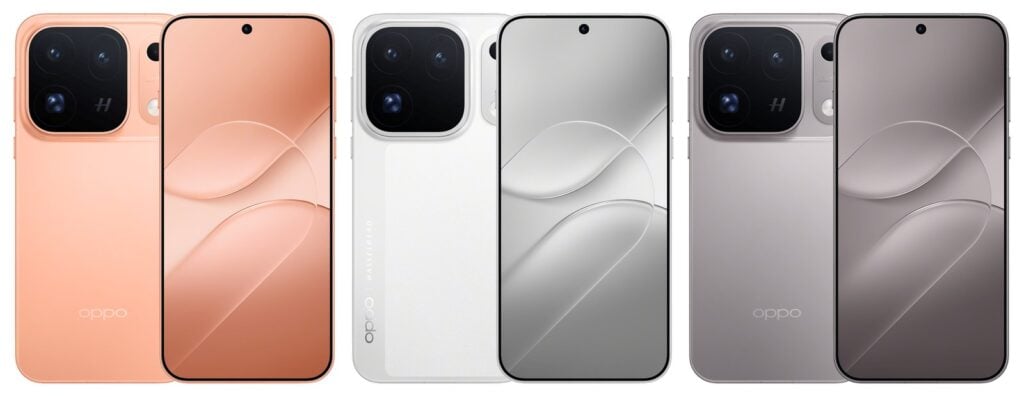
This joint effort culminated in the Oppo Find X10 series.
- The standard Find X10 packs two 200-megapixel modules co-developed with Hasselblad, paired with a colossal 8,000 mAh battery.
- The flagship Find X10 Pro Max pushes ambition even further: its three rear modules (wide-angle, ultra-wide-angle, and telephoto) are equipped with 200-megapixel sensors, an unprecedented configuration on the market.
- These three rear modules enable video recording in 4K at 120 frames per second and in 8K at 30 frames per second.
- On the hardware side, the series introduces the Hasselblad Teleconverter Kit optical accessory kit and features a distinctive matte orange ring around its imposing circular camera module.
Hasselblad has thus evolved from a mere colour calibration consultant into an industrial partner integrating complete optical assemblies and bespoke accessories.
2. Zeiss: The Obsession with Optics, Glass, and the T* Coating
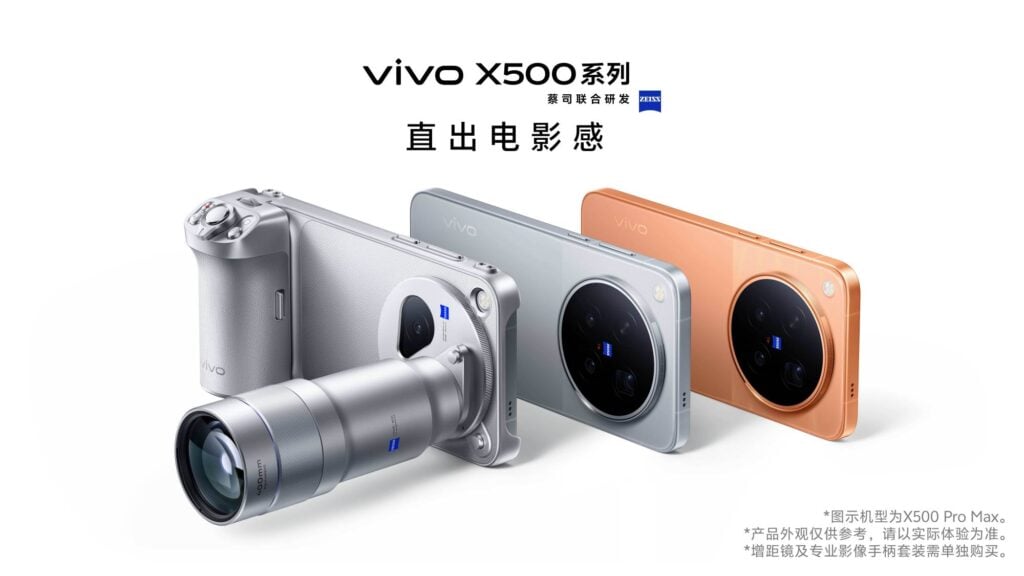
Who is Zeiss? Founded in Germany in 1846, Carl Zeiss is a global giant in cutting-edge optics and optoelectronics. Photography is merely a tiny facet of its business: Zeiss notably designs the ultra-complex optics for microprocessor lithography, surgical microscopes, ophthalmic diagnostic devices, spectacle lenses, and renowned cinema lenses. It is a strategic technology player at the heart of modern industry, science, and medicine.
Of all the optical manufacturers in the smartphone market, Zeiss has the longest and richest history. As early as the mid-2000s, the blue logo adorned Nokia’s legendary camera phones (such as the N95 or the PureView 808), before returning on Android smartphones designed by HMD Global. This historic romance ended amicably in 2021 with the Nokia XR20, formalising the end of the contract in the summer of 2022.
In the meantime, Zeiss had already turned its gaze towards other horizons. As early as 2020, the German firm entered into a technical agreement with Sony for its Xperia 1 II, contributing its famous Zeiss T* anti-reflective coating to curb chromatic aberrations and stray reflections (lens flare).
Yet it is with Vivo, starting in December 2020, that Zeiss deployed its most extensive efforts. The two groups founded the Vivo ZEISS Imaging Lab, a joint research and development centre aimed at designing optical components for the brand’s premium models.
Inaugurated with the Vivo X60 series, this collaboration initially highlighted the T* optical coating and iconic background blur (bokeh) simulations, such as the swirling profile of the renowned Biotar lens.
Over the generations, Vivo and Zeiss took a major hardware leap:
- The Vivo X300 Ultra offers an uncompromising setup: a 200 MP main sensor (35 mm equivalent focal length, highly favoured by photojournalists), a 200 MP periscope telephoto lens (85 mm, ideal for portraits), and a 50 MP ultra-wide-angle (14 mm), with 4K recording at 120 fps.
- To overcome the physical limitations imposed by smartphone thickness, Zeiss and Vivo market 200 mm and 400 mm detachable optical teleconverters that clip directly onto the device. The 400 mm version relies on a genuine, complex 15-element optical design.
- The Vivo X500 series continues along this trajectory: the flagship X500 Pro Max incorporates a 200 MP telephoto lens boasting Zeiss APO optical certification (apochromatic, virtually eliminating colour fringing) and accommodates the second generation of the Gen 2 Ultra 400mm teleconverter.
Zeiss’s approach therefore rests on what made it world-renowned: the purity of light, chemically treated glass, and the mechanics of lenses.
3. Leica and Xiaomi: Strategic Co-Creation and the Analogue Signature

Who is Leica? Founded in Wetzlar, Germany, Leica revolutionised photography in the 20th century by inventing the 35 mm format (24×36). The absolute benchmark of photojournalism and street photography thanks to its legendary M-series rangefinder cameras, the brand is distinguished by exceptional craftsmanship, a sleek design, and an inimitable analogue rendering. Beyond prestige camera bodies, Leica also manufactures sports optics instruments, such as high-precision binoculars.
Leica kicked off the modern craze for smartphone photography partnerships in 2016, with its resounding association with Huawei on the Huawei P9. Equipped with an innovative dual sensor (one RGB, the other native monochrome), the device paved the way for historic benchmarks of the genre (P20 Pro, P30 Pro). This partnership ended in March 2022 with the P50 series.
Two months later, in May 2022, Xiaomi officially took up the baton from the Wetzlar manufacture. From the Xiaomi 12S series onwards, Leica left its mark by introducing two hardware and software colour renderings that have become staples:
- Leica Authentic: a contrasty rendering that favours deep blacks and natural vignetting, while rejecting the artificial shadow lifting typical of aggressive HDR algorithms.
- Leica Vibrant: a warmer, brighter treatment suited to modern social media standards, whilst avoiding oversaturation.
Today, Xiaomi no longer speaks of a mere sponsorship, but of a model of “strategic co-creation”, in which Leica’s optical engineers are involved right from the initial drafting of the phones’ internal architecture.
The Xiaomi 17 Ultra exemplifies this technological fusion:
- Its main sensor adopts the giant 1-inch format (50 MP Light Fusion 1050L), equipped with LOFIC (Lateral Overflow Integration Capacitor) technology, guaranteeing an extended dynamic range to preserve extreme highlights, paired with a bright f/1.67 aperture (23 mm equivalent).
- Its 200 MP periscope telephoto lens uses a Leica APO-certified lens element with a genuine continuous optical zoom range between 75 mm and 100 mm (f/2.39 to f/2.96).
- The 50 MP ultra-wide-angle, meanwhile, handles macro shots from as close as 5 centimetres.
To appeal to purists, Xiaomi has also released a Leica Edition 17 Ultra. This model adopts the stylistic hallmarks of the German camera bodies: red dot, knurled bezel and, above all, a built-in rotating mechanical ring (Master Zoom Ring) that allows users to physically control focal length, aperture, or white balance. It also includes the exclusive Leica Moment mode, emulating the raw chromatic signature of the legendary Leica M9 rangefinder camera.
The collaboration has already looked ahead to the next generation, with the Xiaomi 18 Pro and 18 Pro Max, equipped with 200 MP main sensors and Leica-certified 3.2x telephoto lenses.
4. ARRI and Honor: The Quantum Leap Towards Cinematic Grading
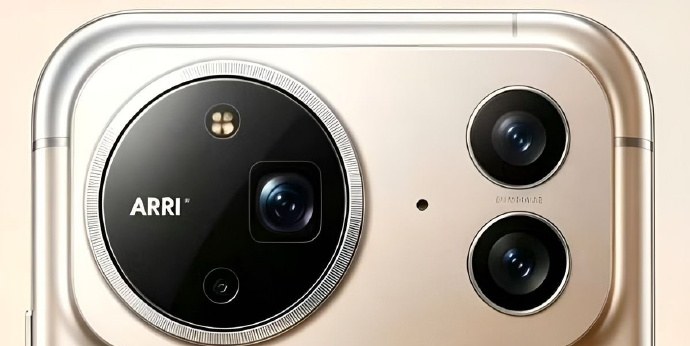
Who is ARRI? Founded in Munich in 1917, Arnold & Richter Cine Technik (ARRI) is the undisputed benchmark of the global film industry. The company does not cater to the general public: it designs and manufactures digital cameras (notably the ARRI Alexa range), cinema lenses, and lighting systems (SkyPanel) used on the vast majority of Hollywood productions. Honoured with multiple technical Oscars, ARRI dictates the standards of dynamic range, colour, and cinematic texture.
While Hasselblad, Zeiss, and Leica are the masters of still photography, ARRI (Arnold & Richter Cine Technik) is the absolute benchmark of the global film industry. Its ALEXA digital cameras shoot the majority of Oscar-winning feature films.
Hitherto absent from the mobile market, the Munich-based firm surprised the industry by signing a partnership focused on cinematic imaging (Cinematic Imaging Partnership) with Honor. The initial trial run took shape on the Honor Robot Phone technology demonstrator in August 2026, before landing on a mass-market model: the Honor Magic9 Pro Max.
Integrating ARRI required rewriting algorithms to adapt its demanding colour science to the constraints of micro-sensors and mobile image signal processors (ISPs). The Magic9 Pro Max does not skimp on components:
- A 200 MP main sensor in a 1/1.28-inch format (f/1.57).
- An imposing 200 MP telephoto lens in a 1/1.4-inch format (f/2.6).
- A 50 MP ultra-wide-angle module.
The true revolution lies in the Cinema Mode developed with ARRI. The smartphone enables recording at up to 4K at 60 frames per second in 10-bit LogC3, within the extended ARRI Wide Gamut 3 colour space. This flat gamma curve preserves all detail in shadows and highlights, offering content creators grading flexibility identical to that of cinema rushes.
For users who do not wish to grade manually, the handset natively integrates 14 preset ARRI Looks profiles, complemented by a library of 87 colour grading styles. Even the design of the rear camera module takes direct inspiration from ARRIFLEX lenses and camera bodies.
5. Comparative Summary: Who Brings What?
Each partnership follows a very specific technical and commercial logic. The table below summarises their respective strengths:
| Partner brand | Main technical contribution | Target audience |
|---|---|---|
| Hasselblad with Oppo previously: Motorola (2016) OnePlus (2021–2025) | Natural colour calibration, Pro mode ergonomics (Phocus), dedicated teleconverters, 200 MP multi-sensor architectures. | Enthusiasts of soft portraits, faithful skin tones, and balanced landscapes. |
| Zeiss with Vivo and Sony previously: Nokia / HMD (2005–2021) | T* anti-reflective coating, apochromatic lenses (APO), additional external optical designs (400 mm teleconverters). | Telephoto enthusiasts, fans of clinical sharpness, and night photography free of stray reflections. |
| Leica with Xiaomi previously: Huawei (2016–2022) | Advanced optical design (APO, LOFIC), distinct image profiles (Authentic / Vibrant), dedicated mechanical controls (Master Zoom Ring). | Street photography enthusiasts, fans of punchy black-and-white, and classic analogue rendering. |
| ARRI with Honor first foray | ARRI Wide Gamut 3 colour space, 10-bit LogC3 logarithmic curve, ARRI Looks grading profiles. | Independent filmmakers, discerning creators, and video editors seeking advanced colour grading. |
6. Buyer’s Guide: How to Choose Based on Your Actual Needs?
For a user in search of their next premium smartphone, spotting a prestigious logo is not enough to guarantee that the pictures will meet their expectations. What matters is not the prestige of the badge, but the exact nature of the technical involvement:
- If your priority is optical purity and long focal lengths: The offerings from Vivo and Zeiss (such as the X300 Ultra or the X500 Pro Max) remain unmatched in managing night-time stray light thanks to the T* coating. The availability of 15-element long focal length accessories will delight wildlife and sports enthusiasts.
- If you are looking for a distinct visual identity in street photography: The approach taken by Xiaomi and Leica (17 Ultra series) is aimed at those who reject overly artificial digital photos or those smoothed out by artificial intelligence. The Leica Authentic profile delivers a dramatic, organic feel that few algorithms manage to emulate without retouching.
- If you attach paramount importance to colour accuracy: The approach of Oppo and Hasselblad will appeal to those who value exact reproduction of skin tones and landscapes with measured contrast, free from excessive saturation.
- If professional video capture dictates your choice: The integration of ARRI science by Honor represents the first true bridge between pocket form factors and cinematic post-production workflows. Working in 10-bit LogC3 transforms the smartphone into a video capture powerhouse capable of slotting into professional projects alongside dedicated cameras.
Far from being mere promotional gimmicks, these camera partnerships have reached remarkable technical maturity in 2026. By moving from straightforward licensing agreements to co-engineering spanning glass, sensors, and digital workflows, these alliances are pushing computational photography to new heights.
At PhoneDroid, you will find Oppo, Vivo, Xiaomi and Honor camera phones in their official global versions, in our Android smartphones range.