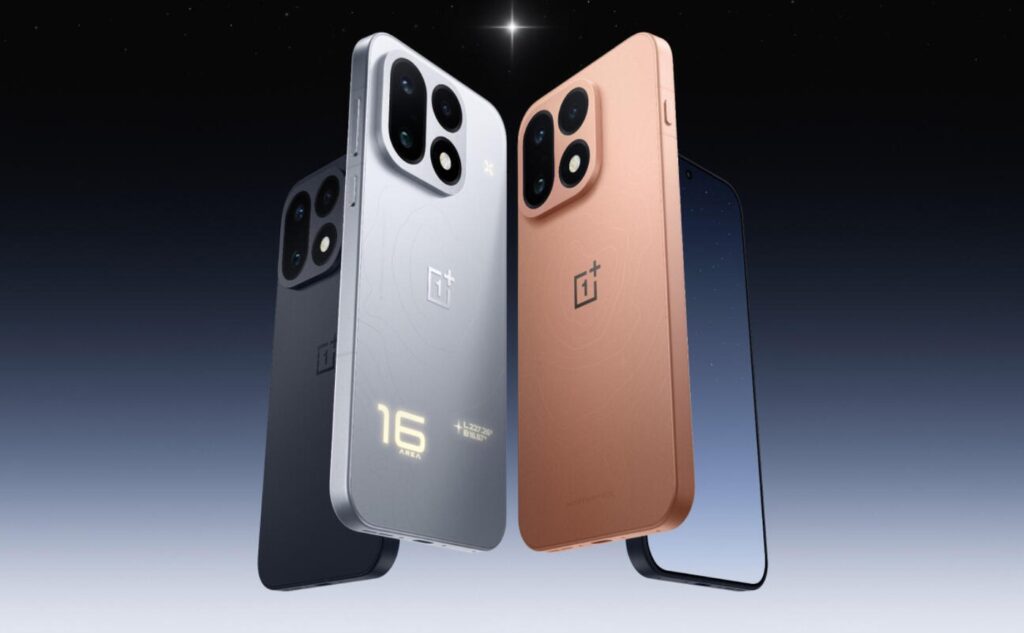
📌 Updated 21 September 2026 — OnePlus has officially unveiled the OnePlus 16’s design and opened its pre-order listing in China. Three colours, four configurations from 12 GB + 256 GB to 16 GB + 1 TB, a square metal camera island, large rounded corners and a customisable AI key on the left edge. The silver model even hides a light in its back that illuminates the logo and celestial coordinates. The launch is still expected in October, against the iQOO 16 unveiled on 29 September.
OnePlus is preparing to refresh its high-end line-up over the coming months. According to new information shared by leaker Digital Chat Station on Weibo, the future OnePlus 16 is taking shape, with its design choices, spec sheet and launch window coming into focus. Between a genuine break in display technology and an escalation in raw power, the manufacturer is putting the finishing touches to its next flagship.
165 Hz extended to the whole system: the real display breakthrough
On paper, attentive observers might get a feeling of déjà vu: the brand’s previous flagship already featured a panel capable of hitting 165 Hz. Yet the step forward being prepared by the OnePlus brand for this new generation profoundly changes the day-to-day user experience.
On earlier generations, that 165 Hz figure remained confined to a limited number of scenarios and optimised apps. With the OnePlus 16, the manufacturer is crossing a decisive threshold by extending 165 Hz to the entire operating system and to your apps. Whether you are scrolling through social media, moving around the interface menus or switching from one task to another, every animation would benefit from that extreme smoothness at all times.
It is now official. On 17 September, Li Jie, president of OnePlus China, confirmed that the OnePlus 16 will offer “global 165 Hz”. And the detail matters as much as the number: according to the screenshot shared by Digital Chat Station, the option sits directly in the display settings. On the OnePlus 15, 165 Hz outside games was only available after enabling Developer Options, and the screen then stayed locked at that rate, without dropping down when the image is static.
So it is not the headline maximum that improves for standard use, but the scope in which you actually enjoy it. The tipster stresses one point here: that system-wide 165 Hz would be achieved at hardware level rather than through a software setting — which is what the architecture described below is for. As for the much-discussed 185 Hz, it is not expected to be the default mode: this exceptional refresh rate is said to be enabled dynamically and exclusively within compatible games.
Dedicated engineering to feed the panel continuously
How can such a rollout be possible without draining the battery in a matter of hours? According to the technical documents relayed by Digital Chat Station, holding 165 frames per second permanently across the whole interface demands far more than a simple software switch. OnePlus is said to have called on a specific hardware architecture:
- An overclocked display controller: the component in charge of driving the panel would run beyond its standard nominal frequencies in order to push the image stream through without bottlenecks.
- Dedicated co-processing hardware: auxiliary chips would offload display management from the main processor, cutting overall power consumption.
- An optimised system kernel: Android’s lower layers and its task schedulers are said to have been rewritten to synchronise graphics calculations instantly with the screen’s refresh cycle.
This hardware effort explains why such a level of smoothness had not been generalised until now. You may not spot the difference by reading a spec sheet, but you would feel it within the first few minutes of handling the phone.
The official design: a square metal island and a light in the back
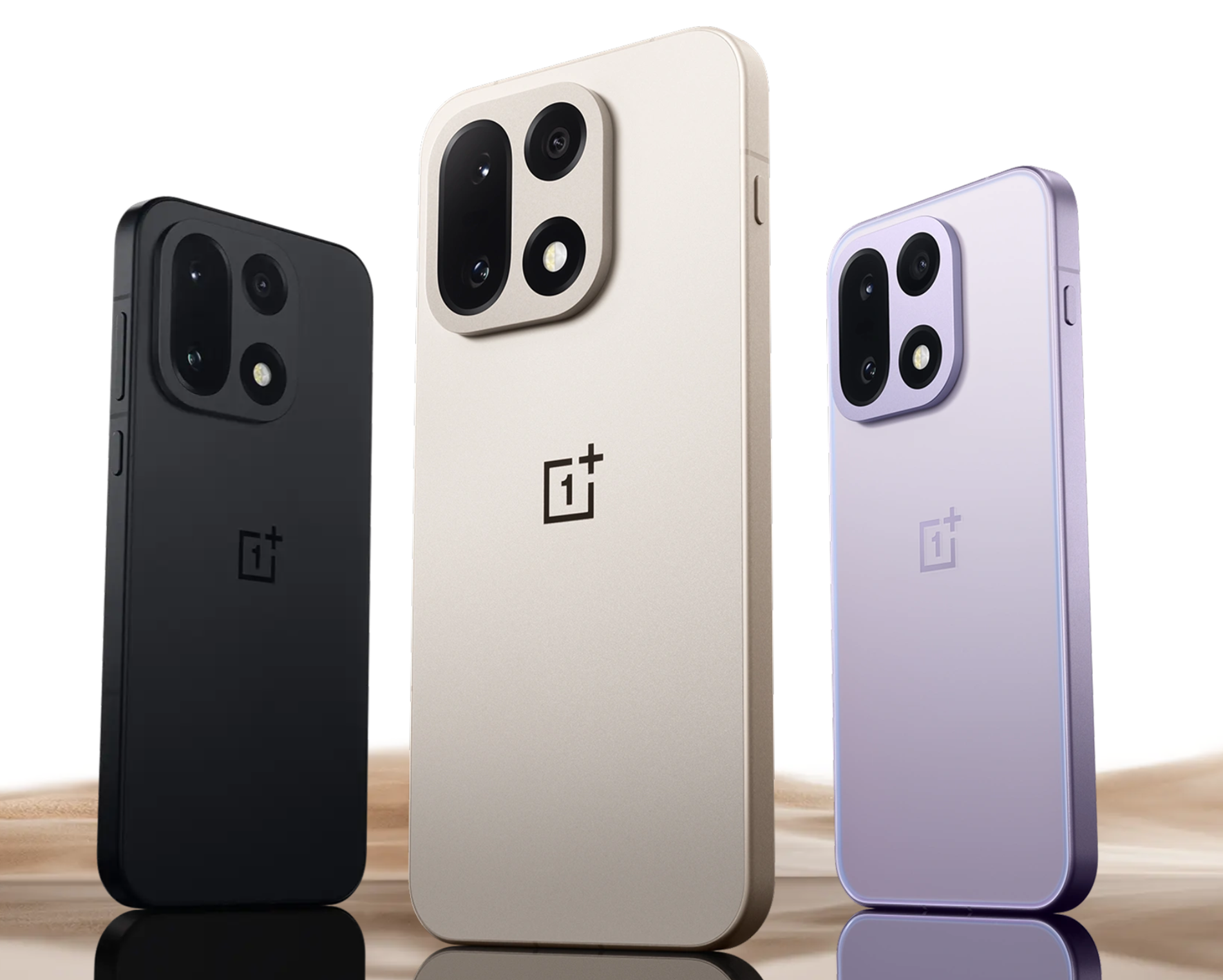
On 21 September, OnePlus lifted the lid on its upcoming flagship by publishing its pre-order listing in China. The back is built around a square metal camera island with softened corners, grouping three lenses and the flash. The frame has large rounded corners, and a customisable AI key sits on the left edge, working as a shortcut button.
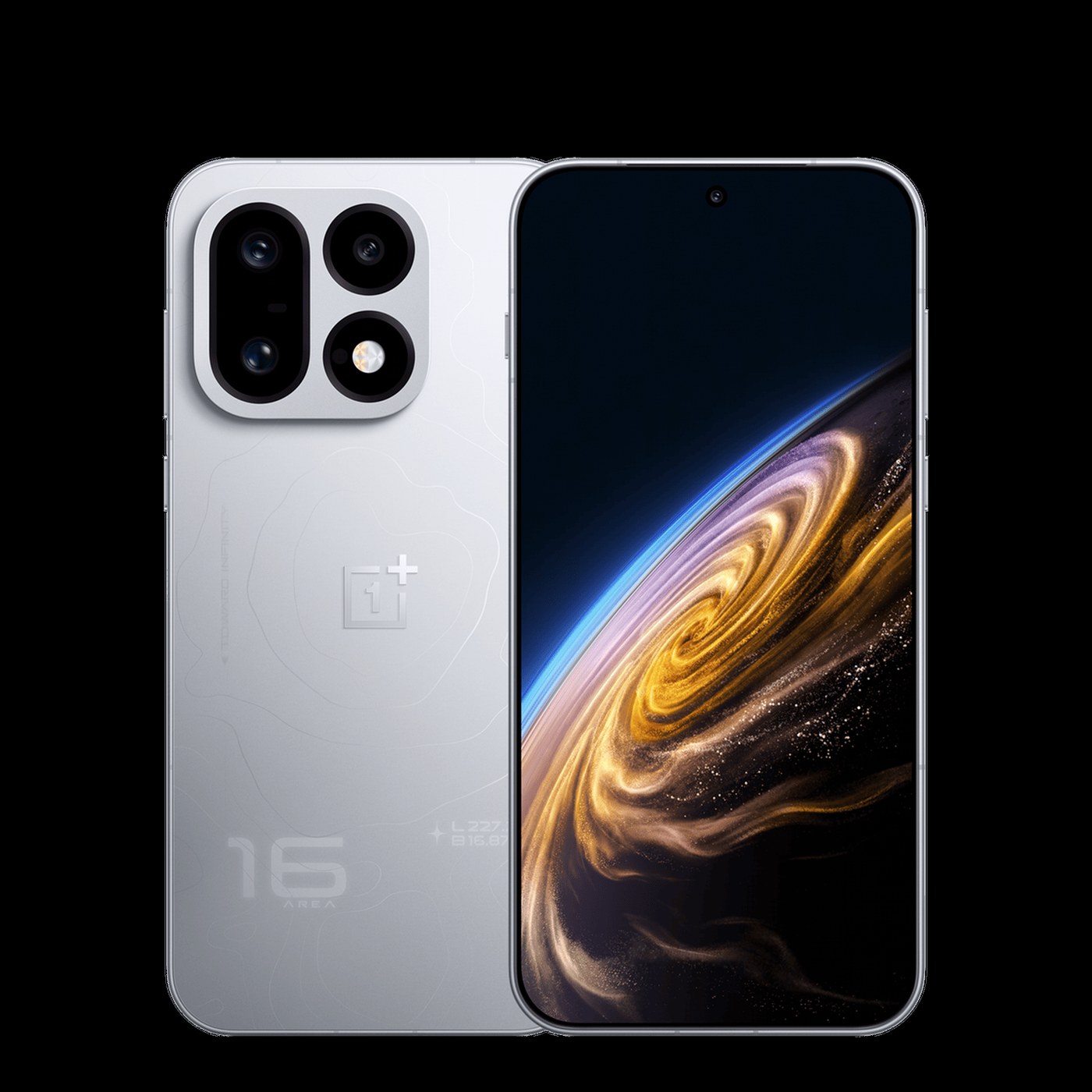
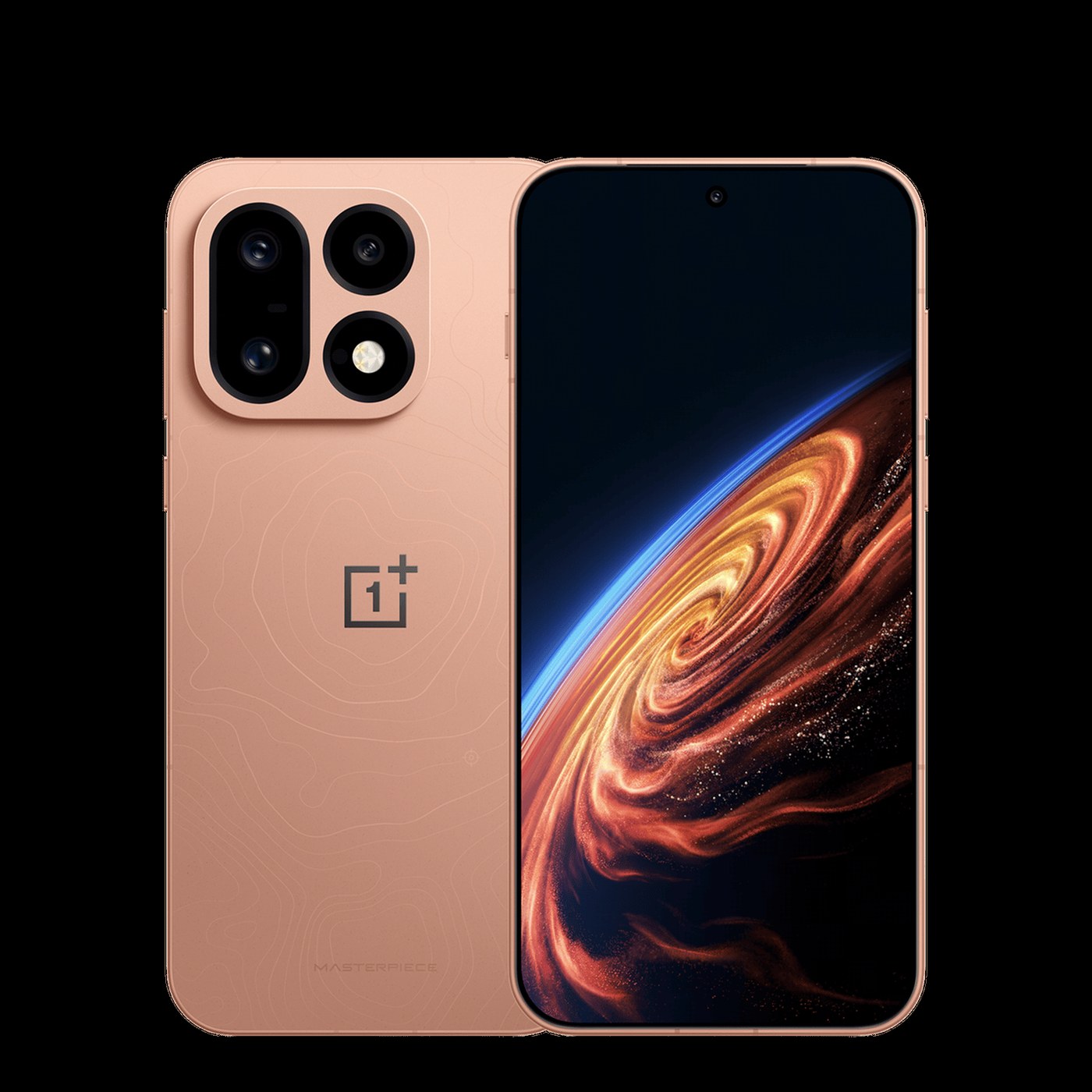
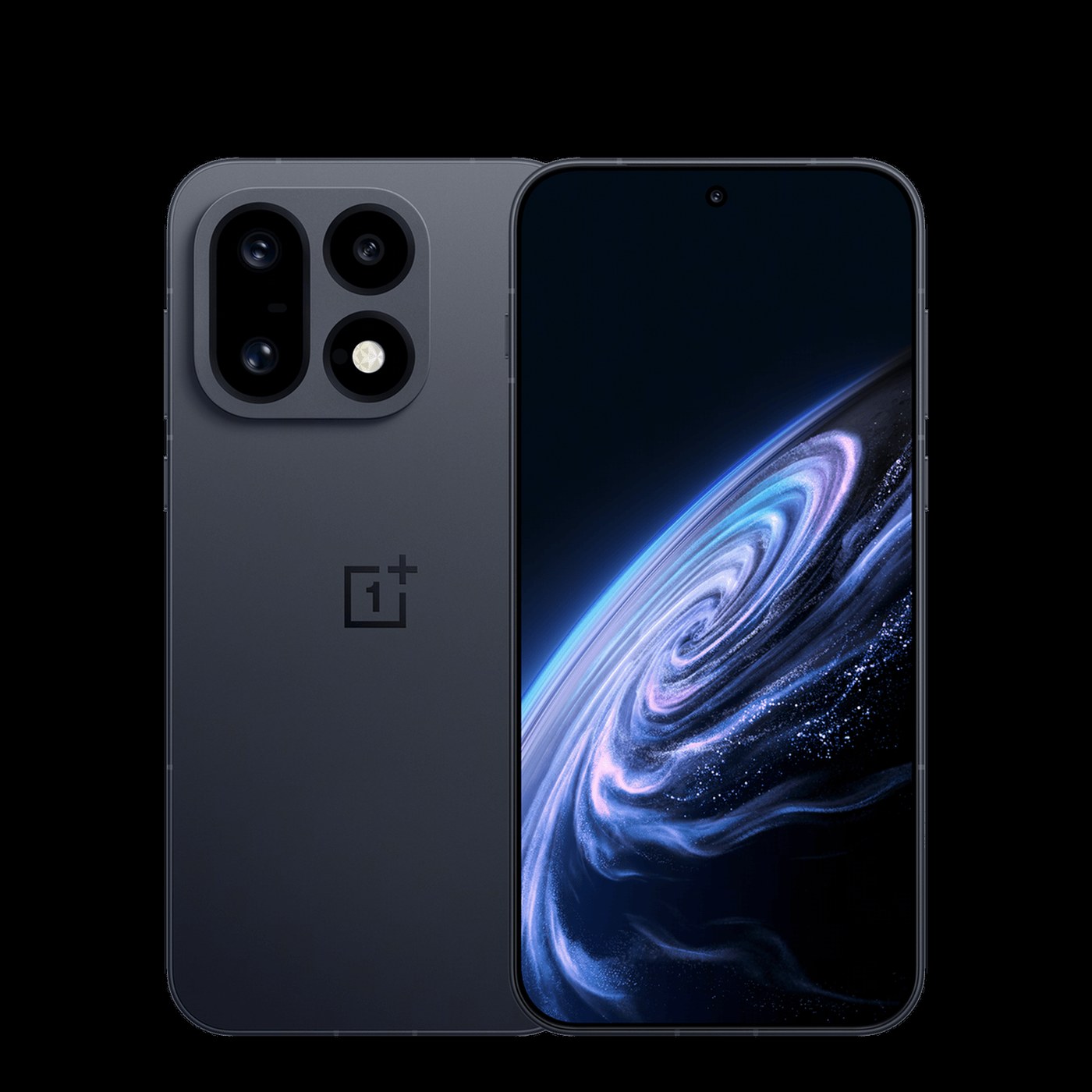
Three colours are on the menu, whose Chinese names translate as “Tomorrow’s Star”, a silver, “Martian Masterpiece”, a copper, and “Dark Forest”, a dark grey. All three carry a fine contour-line pattern on the back. But the silver one stands out: a built-in light under the rear panel, which pulses like breathing, reveals the logo, a large “16” and celestial coordinates. A rare visual signature on a smartphone, and one that will probably make it the most sought-after colour.
The pre-order listing also details the memory: 12 GB + 256 GB, 12 GB + 512 GB, 16 GB + 512 GB and 16 GB + 1 TB. The terabyte is reserved for the 16 GB version, plenty of room for 200 MP photos and high-definition video.
Ultra-thin LIPO screen and X4 luminescent material co-developed with BOE
The design is now official, and it proves the leaks right: the OnePlus 16 keeps the brand’s overall design language without any radical upheaval, with a square camera island in the spirit of the OnePlus 15. The front, on the other hand, would concentrate some genuinely first-rate structural innovations.
The phone is tipped to carry a flat 6.78-inch OLED LTPO panel, customised by BOE and running at 1.5K resolution, with support for the ultra-wide BT.2020 colour space. It would be an all-new generation of the “Oriental Screen” developed in partnership with the panel maker. It is said to benefit from LIPO encapsulation technology (Low-Injection Pressure Over-molding), a cutting-edge industrial process that delivers a flat, symmetrical screen surround of surgical thinness, measuring less than 1 millimetre on all four sides. According to Digital Chat Station, these would quite simply be the slimmest bezels in the entire history of OnePlus flagships.
But the most striking advance would sit at the very heart of the panel. The fruit of a close, ongoing technology partnership between OnePlus and manufacturer BOE, the device is said to introduce an entirely new generation of electroluminescent material, dubbed X4 material. This step follows directly on from the work carried out on previous generations: the OnePlus 15 and its 165 Hz screen already used X3 material on their 3rd-generation display. The arrival of X4 would therefore mark a move up a level, paired with a completely new design for the display driver circuitry.
According to figures from in-house testing, this X4 panel would manage to outperform the benchmark panels of Samsung’s M-series range on virtually every key criterion:
- Drastically reduced power consumption: on a phone pushed to a very high refresh rate, power draw is where the battle is won or lost. The X4 material is said to have been calibrated to keep energy losses to an absolute minimum, so you can enjoy exemplary smoothness without sacrificing day-to-day battery life.
- Twice the lifespan: compared with the previous generation, the longevity of the organic diodes would be doubled, delaying panel wear and preserving colour accuracy over time.
Two hardware elements round out the picture. The panel would be driven by an in-house display chip, built on a new manufacturing process and put through three separate calibration passes — an unusual requirement, aimed at colour consistency from one unit to the next rather than at raw performance. The screen would also carry Oppo’s latest generation of eye-protection technology, the parent brand whose visual-comfort features already ship on the group’s high-end models.
Gaming optimisations: 185 Hz in compatible games, Fengchi engine and triple-core setup
The gaming side of things, for its part, does not rest on unofficial leaks. Li Jie, president of OnePlus China, has officially confirmed that the next flagship will receive a significant upgrade to its three exclusive gaming technologies:
- A refresh rate climbing to 185 Hz in compatible games: the panel will deliver an ultra-high refresh rate when you launch optimised titles, ensuring instant responsiveness and optimal motion clarity for the most demanding competitive games. This technical choice fits a trend also seen among rivals, as illustrated by the iQOO Neo 12, which is also aiming for 185 Hz. Although earlier leaks mentioned that a 240 Hz tier was being evaluated, the final gaming refresh rate appears to be settling around this 185 Hz figure.
- The next-generation Fengchi gaming engine: a set of proprietary software optimisations designed to manage hardware resource allocation in real time, aiming for stable smoothness with no micro-stutter during long sessions.
- The “triple-core” e-sport architecture: three dedicated in-house chips, detailed below, which take display, networking and touch handling off the main processor.
P4, G3 and T3: the three in-house chips behind the “triple core”
Until now, this “triple-core architecture” was a marketing phrase with nothing behind it. Digital Chat Station finally gave it meaning on 9 September, and it is not the meaning one might have assumed: this is not the processor, the graphics chip and a display unit working in concert, but three separate chips designed by OnePlus, each assigned to a different link in the chain that runs from your finger to the image on screen.
- The P4 display chip targets panel response time — the delay between the moment an image is computed and the moment it actually appears on screen.
- The G3 network chip works on connection stability — not peak throughput, which is of little use in a game, but the consistency of the exchanges that decides whether you drop mid-match.
- The T3 touch chip shortens the delay before your taps register, the first link in the chain and the one you feel most directly.
The OnePlus 16 would be the first device to carry all three. The company is also said to have worked with FPS game studios to tune the system against real situations rather than laboratory benchmarks — a claim worth exactly what leaks are worth, but one that at least states the intent.
These three chips do not replace the main processor: they assist it and take work off it. None of this is official at this stage — OnePlus has confirmed neither the names nor how the three components coordinate.
Snapdragon 8 Elite Gen 6 Pro on 2 nm and an XXL 9,000 mAh battery
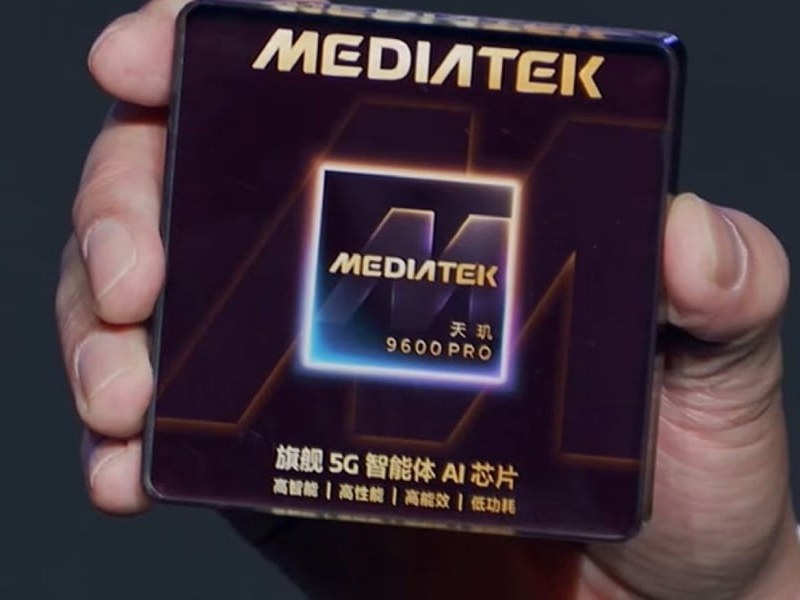
Under the bonnet, the phone would reach a new level of raw power by fitting the Snapdragon 8 Elite Gen 6 Pro on 2 nm, known internally under the code name SM8975. Built on TSMC’s most advanced process, this platform is said to deliver colossal compute power, both for artificial intelligence workloads and for the heaviest 3D rendering.
The 9 September leak adds two details about that chip: its Oryon cores would run above 5 GHz, and its IPC — the work done per clock cycle — would improve. The second point matters more than the first: a high clock speed on an inefficient core produces little but heat.
It would come alongside the adoption of the brand-new LPDDR6 memory standard, which promises unprecedented bandwidth — a detail that matters more than it might seem on a device meant to feed a very high refresh rate panel while processing very high resolution photos on the fly.
The other major step forward concerns power management, and the figure is now treated as settled. Digital Chat Station reports 9,000 mAh confirmed, noting that it is the largest capacity across this autumn’s entire wave of flagships — an exceptional number for the premium Android smartphone category. Despite that massive capacity, the brand is said to keep its ultra-fast charging technologies:
- Wired Fast Charging: 100 watts, confirmed by 3C certification.
- Wireless charging: 50 watts.
The 3C certification, issued on 16 September, removes the last doubt about charging: the PYB110 listing names chargers delivering up to 100 W. Digital Chat Station, for his part, has detailed the battery design: two cells, for 9,000 mAh typical and 8,780 mAh rated — the usual gap between the average measured capacity and the guaranteed minimum. Spreading the charge across two cells limits heat during a 100 W top-up and is gentler on the battery over time. For scale: the OnePlus 15 made do with 7,300 mAh.
One technical point is worth unpacking, because it bears on what you will actually use. The cell would draw on the high-energy technology developed by Oppo, with support for low-voltage discharge. Manufacturers sometimes cap in software how much of a battery can really be drawn on, either as a precaution or as the cell ages: the phone shuts down while energy is still available. By letting the device keep drawing down to lower voltages, this technology avoids that clipping — the 9,000 mAh on the spec sheet stay 9,000 usable mAh.
The capacity itself is not a first for OnePlus: the Turbo 6 in China and the Nord 6 in India already reach it. What changes is that it finally arrives on the numbered series, the one carrying the brand’s flagship line internationally.
The rest of the finish matches what a flagship is expected to offer. The fingerprint reader would move to ultrasonic sensing under the display, a technology that keeps reading a wet finger where an optical sensor gives up. Add stereo speakers, an X-axis vibration motor with a crisper, better-localised response, and a rating given as IP68 and IP69: the first covers immersion, the second high-pressure, high-temperature water jets.
An elite camera array: 200 MP 1/1.4-inch sensor and 3x periscope
The rear camera array would also enjoy a substantial hardware upgrade. Far from limiting itself to display performance, the OnePlus 16 is said to adopt a versatile configuration built around three separate sensors:
- Main sensor: 200 megapixels with a 1/1.4-inch format, calibrated to gather large amounts of light and render surgical levels of detail by day as well as by night.
- Ultra-wide: 50 megapixels, for landscapes and wider framing.
- Periscope telephoto: 50 megapixels on a 1/1.95-inch Sony sensor, offering 3x optical zoom dedicated to long-range shots and portraits with no loss of sharpness.
- Front camera: 50 megapixels with autofocus.
The front camera is where the change should show up fastest. The vast majority of selfie sensors work with fixed focus: the manufacturer sets sharpness once and for all at arm’s length, and anything outside that zone loses definition. With a 50-megapixel sensor and autofocus, the OnePlus 16 would recover sharpness on the group shot taken at arm’s length as well as on the tight close-up, and would gain real latitude in video for anyone who films themselves.
Digital Chat Station adds a detail that places the phone within its own family: the OnePlus 16 would be the only model in its sub-series to receive this 200-megapixel sensor. Rather than spreading its camera effort across every variant, the brand would concentrate it on the main model.
Expected OnePlus 16 specifications
| Component | Expected specifications |
|---|---|
| Screen | Flat 6.78-inch OLED LTPO 1.5K, new-generation BOE Oriental Screen |
| Refresh rate | 165 Hz system-wide (official) / 185 Hz in compatible games |
| Bezels | Symmetrical, under 1 mm (the slimmest in the range’s history) |
| Luminescent material | Bespoke BOE X4 material |
| Display driver | In-house chip on a new process, three calibration passes |
| Visual comfort | Oppo’s latest eye-protection technology |
| Processor | Qualcomm Snapdragon 8 Elite Gen 6 Pro (SM8975, 2 nm process, Oryon cores above 5 GHz) |
| In-house chips | P4 (display), G3 (network), T3 (touch) |
| RAM | LPDDR6 standard support |
| Configurations | 12 GB + 256 GB, 12 GB + 512 GB, 16 GB + 512 GB, 16 GB + 1 TB (official) |
| Design | Square metal camera island, large rounded corners, customisable AI key on the left edge (official) |
| Colours | Silver “Tomorrow’s Star” with built-in light, copper “Martian Masterpiece”, dark grey “Dark Forest” (official) |
| Main camera sensor | 200 MP (1/1.4-inch format) |
| Ultra-wide sensor | 50 MP |
| Telephoto | 50 MP periscope (Sony 1/1.95-inch sensor, 3x optical zoom) |
| Front camera | 50 MP with autofocus |
| Battery | 9,000 mAh typical, 8,780 mAh rated, dual cell (Oppo high-energy technology, low-voltage discharge) |
| Charging | 100 W wired (3C-certified), 50 W wireless |
| Biometrics | Ultrasonic under-display fingerprint reader |
| Audio and haptics | Stereo speakers, X-axis vibration motor |
| Water resistance | IP68 and IP69 |
| Network | 5G, including the N79 band (4,800 to 4,960 MHz) |
| Operating system | ColorOS 17 (Android 17) |
| Model reference | PYB110 (SRRC, MIIT and 3C approvals in China) |
| Price | No price yet · increase expected over the OnePlus 15 (leaks) |
| Launch | October 2026 (China) · no release outside China confirmed |
OnePlus 16 price and availability
On the administrative and industrial front, the timeline is speeding up. Identified under the model number PYB110, the phone has now cleared all three approvals required in China: SRRC and MIIT, which validated support for the 5G N79 band (4,800 to 4,960 MHz), then 3C certification on 16 September, which confirms 100 W charging. Nothing administrative now stands in the way of its Chinese launch. This refresh comes amid a wider reorganisation in which OnePlus and Oppo are reshaping their respective strategies.
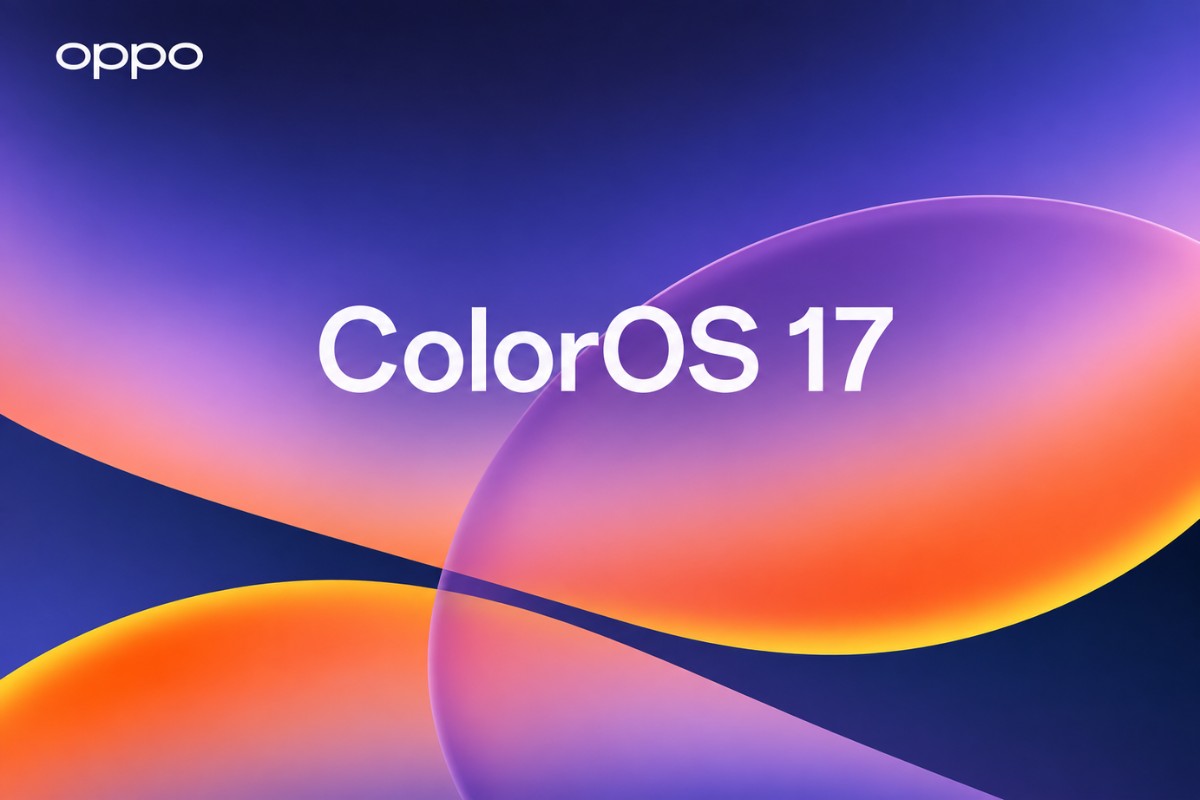
The official unveiling of the OnePlus 16 remains scheduled for October on the Chinese market, and pre-orders have been open since 21 September. It will go head to head with its autumn rivals there, starting with the iQOO 16, unveiled on 29 September. The device will also be among the first to debut on ColorOS 17, the manufacturer’s Android 17-based skin, which will introduce new system animations developed specifically to show off high refresh rate scrolling.
That leaves the question buyers in Europe care about most: availability. We have devoted a full feature to this issue, because the phone could end up skipping a European release because of the economic pressures weighing on the memory market — and a certification obtained only in China does nothing to rule that scenario out. In the meantime, PhoneDroid lists our official OnePlus smartphones, refurbished OnePlus models, as well as OnePlus cases and OnePlus tempered glass to protect your kit.
The question now reaches beyond Europe. On 13 September, analyst Yogesh Brar, whose OnePlus leaks often prove right, said that in India the OnePlus 16R would become the brand’s top model next year, followed by the Nord line in the mid-range and the N series at the entry level. If that holds, India would get no numbered OnePlus, whereas the brand has so far launched its flagship there alongside its R variant — and the OnePlus 16 would remain a China exclusive. OnePlus has not commented.
The R series usually takes a Chinese model from the Ace line, with a chip and camera one step down but a bigger battery and a lower price: the 12R was an Ace 3, the 13R an Ace 5 and the 15R an Ace 6T. OnePlus has not yet revealed anything about the Ace 7, so it is impossible at this stage to say which device the 16R would be based on. In China, early leaks also point to a price increase over the OnePlus 15.
Conclusion
The OnePlus 16 does not merely stack up numbers: 165 Hz across the whole system, three in-house chips and a 9,000 mAh battery describe a phone designed as a whole rather than as a list of options. That leaves the one unknown that really matters to a European buyer — whether it reaches us at all, which a certification obtained in China does nothing to guarantee.

![Oppo Find X10: unveiling on 22 September, dual 200 MP and 8,000 mAh [UPDATED]](https://www.phonedroid.net/blog/wp-content/uploads/2026/09/oppo-find-x10-rendu-officiel-qingcheng.jpg)