
In our previous article we established that a SuperVOOC charger is essential for your Oppo, OnePlus or Realme.
Today we answer the next question, which matters just as much: you own an 80 W phone and you are looking at a 100 W or 120 W charger. Is that a good idea? Can you buy it “for the future”? Is it dangerous?
And what about HyperCharge chargers from Xiaomi, or SuperCharge chargers from Honor? Can you mix them?
The short answer is simple: no, there is no risk whatsoever — but there is one golden rule to follow if you want it to work.
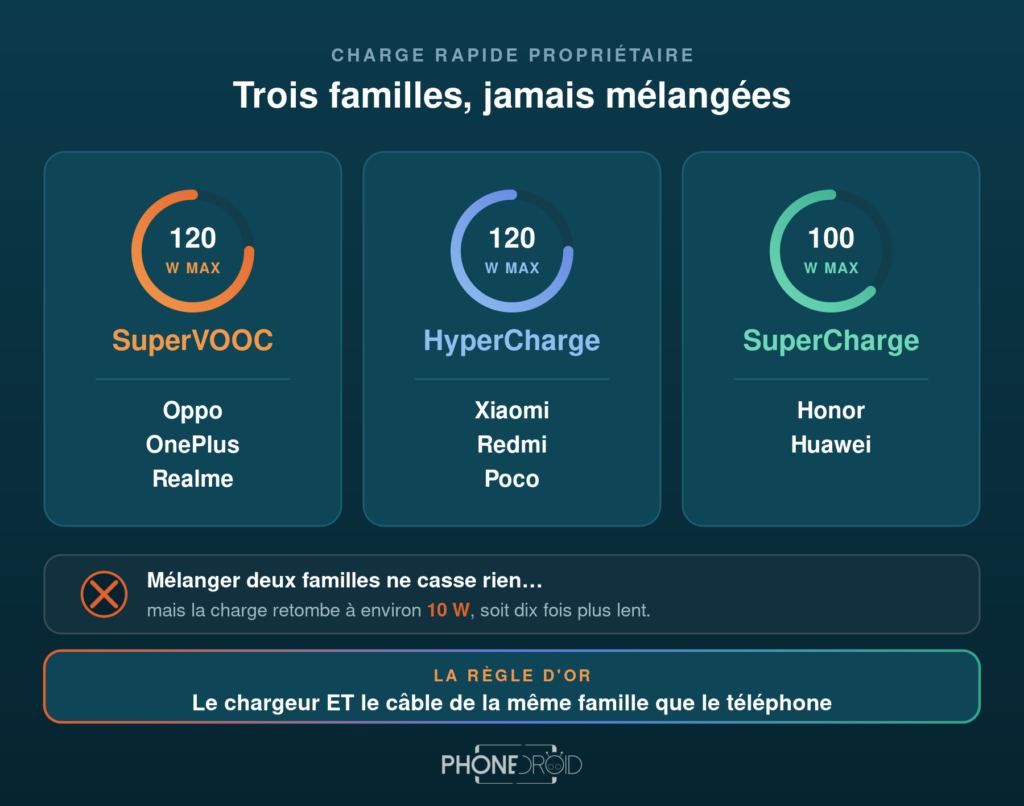
Golden rule number one: never mix the families
Before talking about power, let’s talk about brands. Proprietary fast-charging technologies are like petrol and diesel.
- The “SuperVOOC” family = Oppo, OnePlus, Realme.
- The “HyperCharge” family = Xiaomi, Redmi, Poco.
- The “SuperCharge” family = Honor, Huawei.
These three families are completely incompatible with one another.
Plug a Xiaomi HyperCharge 120 W charger into a 120 W Realme phone and the two will not understand each other. For safety they will fall back on the slowest charge available, often 10 W.
So the rule is straightforward: an Oppo, OnePlus or Realme phone needs a SuperVOOC charger. A Xiaomi phone needs a HyperCharge charger. An Honor phone needs a SuperCharge charger.
With that settled, let’s talk about power.
Case 1: the SuperVOOC world (Oppo, OnePlus, Realme)
Your phone is smart. So is your official charger. When you connect them, they negotiate the maximum power the phone can safely accept.
Scenario 1: a charger more powerful than the phone (120 W charger on an 80 W phone)
- The question: “I have an 80 W SuperVOOC phone. If I buy your 100 W or 120 W SuperVOOC charger, will it fry my battery?”
- The answer: no, absolutely not. The phone is in charge. It simply tells the charger: “I can only take 80 W, thank you.” The 120 W SuperVOOC charger then caps itself and delivers only the 80 W requested.
- Verdict: completely safe, and arguably the clever choice. If your next phone takes 120 W, you will already have the right charger.
Scenario 2: a charger less powerful than the phone (80 W charger on a 120 W phone)
- The question: “I have a new 120 W phone, but my old SuperVOOC charger is an 80 W. Will it work?”
- The answer: yes, perfectly. Again they negotiate. The phone asks for 120 W, the charger replies “I can only give 80 W”, and the phone accepts and charges at 80 W.
- Verdict: completely safe, but you will not be using your new phone’s full capability. Charging will be slower than it could be.
Case 2: the Xiaomi HyperCharge world (33 W, 67 W, 120 W)
Good news: with Xiaomi the principle is exactly the same. HyperCharge is designed to be both backward- and forward-compatible.
Scenario 1: a more powerful charger (120 W charger on a 67 W phone)
- The question: “I have a 67 W Xiaomi. Can I buy the 120 W HyperCharge charger?”
- The answer: yes, and it is the best choice. Charger and phone, both carrying Surge safety chips, will agree on 67 W. Your phone is perfectly safe and you are ready for a future 120 W model.
Scenario 2: a less powerful charger (33 W charger on a 120 W phone)
- The question: “I have a 120 W Xiaomi phone. What happens if I plug in a 33 W HyperCharge charger?”
- The answer: yes, it works. But charging will, unsurprisingly, be capped at 33 W — so a great deal slower.
Case 3: the Honor SuperCharge world (45 W to 100 W)
Honor inherited SuperCharge from Huawei and has carried it on independently since. The negotiation works exactly as it does at Oppo or Xiaomi: the phone announces what it can take, and the charger sticks to it.
Where Honor stands out is the spread between its models. Across the devices we stock, charging runs from 45 W on an Honor 600 Lite to 100 W on an Honor Magic 8 Pro, by way of 66 W on the Magic 8 Lite and Magic V5, and 80 W on the Honor 600 and 600 Pro.
One charger for the whole range
That follows directly from the rule above: since a more powerful charger caps itself, and since the most demanding Honor tops out at 100 W, the official Honor SuperCharge 100 W charger suits every Honor we sell — from the 600 Lite to the Magic 8 Pro.
So you don’t need to check your model’s exact figure: take the 100 W and it will settle on whatever your phone accepts. And it will still suit your next Honor.
And an Honor charger on an Oppo, or the other way round?
- The question: “I have an Honor SuperCharge charger lying around. Can I use it for my Oppo or my Xiaomi?”
- The answer: it will charge, and it will damage nothing — but slowly. With no shared language, the two devices fall back on standard charging, usually around 10 W. You lose most of what you paid for.
- Verdict: fine to get you through a night. Not for daily use.
Conclusion: which one should you buy?
- Identify your family. Do you have an Oppo, OnePlus or Realme (SuperVOOC), a Xiaomi, Redmi or Poco (HyperCharge), or an Honor (SuperCharge)? Never mix them.
- Don’t be afraid of the wattage. There is no risk at all in using an official charger more powerful than your phone. The phone decides, and it caps the charger.
Our advice: always buy a charger rated at or above what your phone accepts, and always from the same brand and technology. That is how you get the best speed today and stay compatible with tomorrow’s phone.
Browse our phone chargers. Ready to take the plunge? We carry the Oppo range, Honor smartphones, and cases for Oppo.

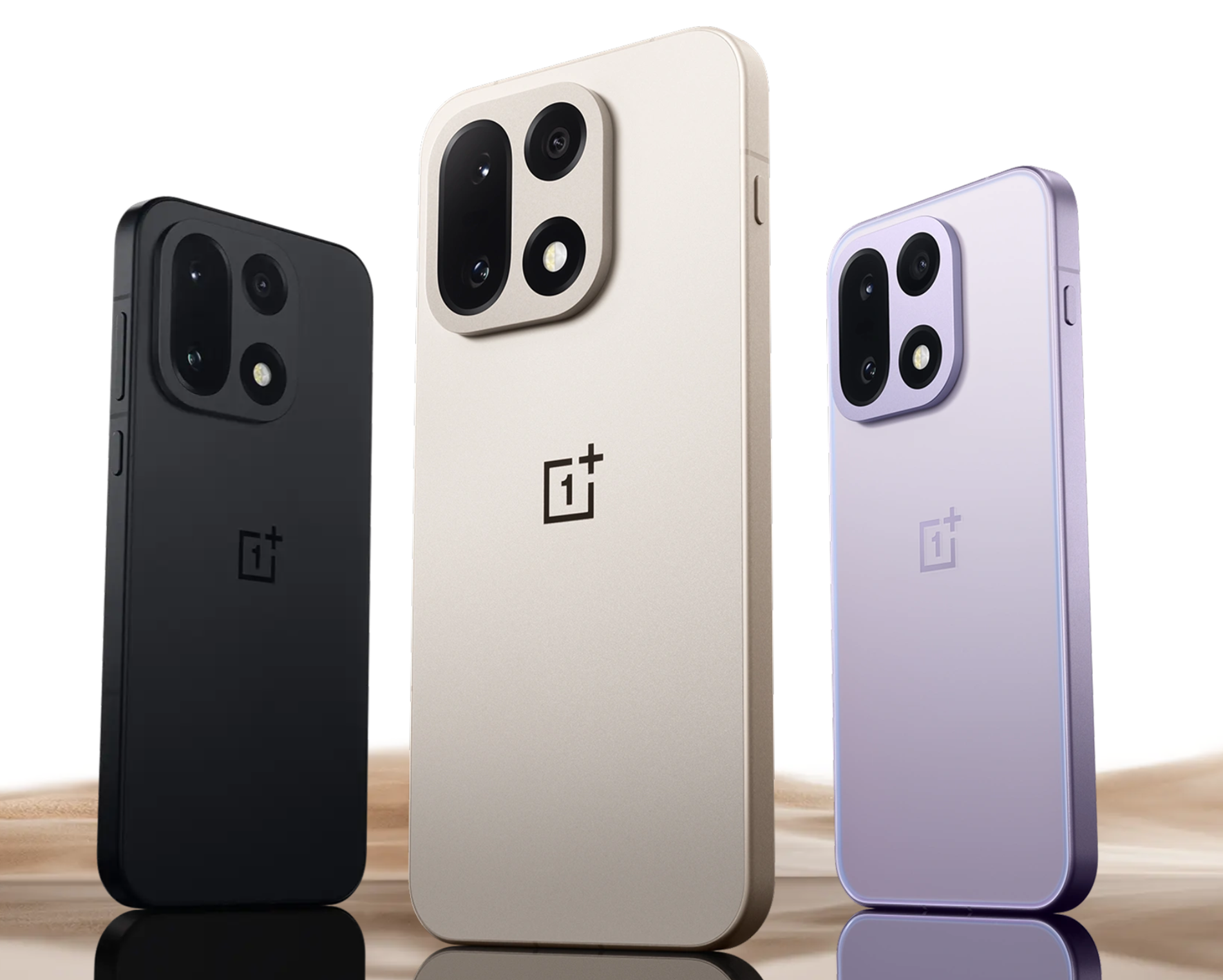
![OnePlus 16: BOE X4 display, 185 Hz and 9,000 mAh [Update]](https://www.phonedroid.net/blog/wp-content/uploads/2026/09/oneplus-16-rendus-officiels-trois-coloris.jpg)
![Xiaomi 18 Pro Max: Heading for an Outrageous Spec Sheet [UPDATED]](https://www.phonedroid.net/blog/wp-content/uploads/2025/09/Xiaomi-17-Pro-Max.jpg)
![Oppo Find X10: unveiling on 22 September, dual 200 MP and 8,000 mAh [UPDATED]](https://www.phonedroid.net/blog/wp-content/uploads/2026/09/oppo-find-x10-rendu-officiel-qingcheng.jpg)