
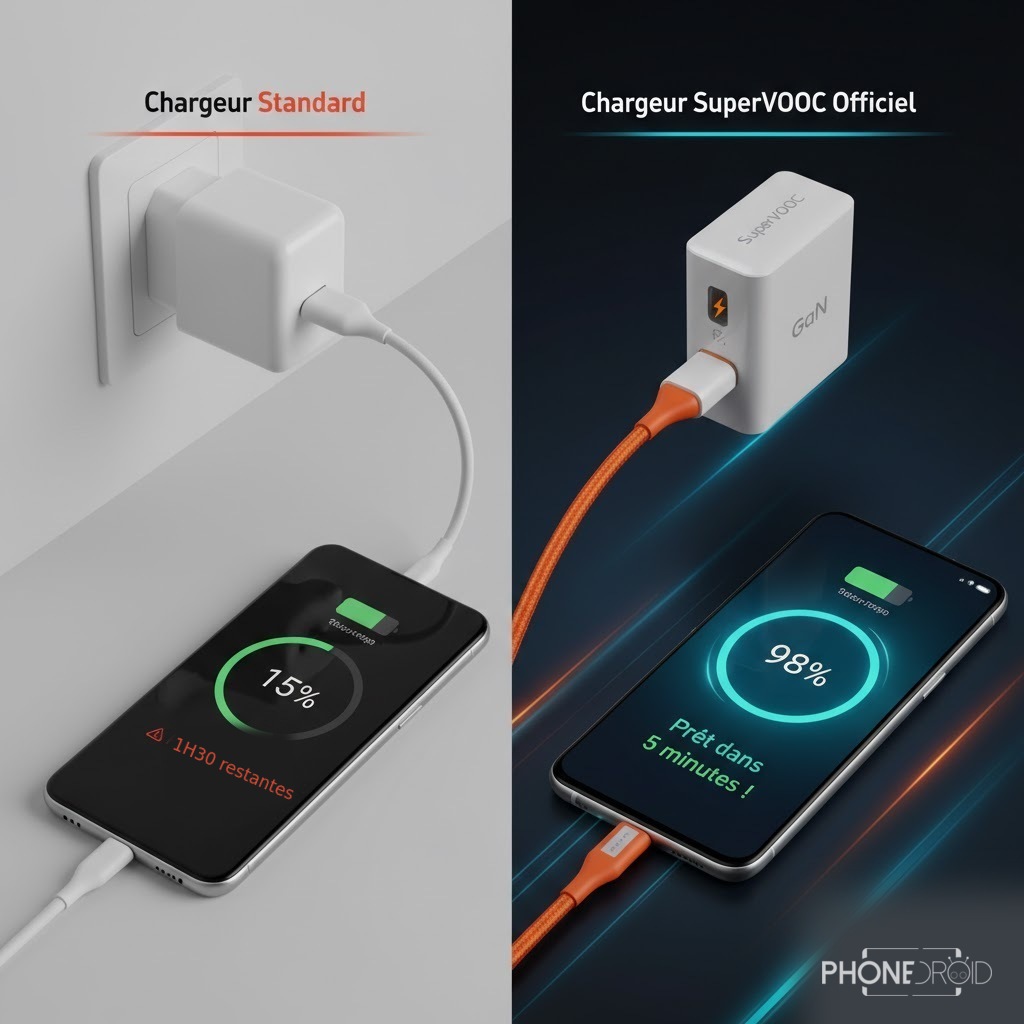
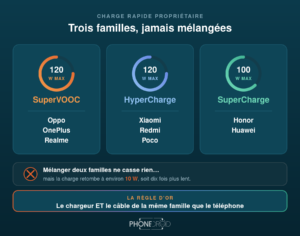
Congratulations — you have just bought an Oppo, OnePlus or Realme smartphone. You went for cutting-edge hardware, and one of the main reasons was almost certainly that remarkable promise: a full charge in under 30 minutes, sometimes under 20, thanks to SuperVOOC.
And then you open the box, and there is no charging brick inside.
Your first instinct? “No problem, I still have my old Samsung or Apple charger, or that 100 W Anker I bought online. It’ll do the job.”
Stop right there. That is the one mistake not to make.
You are about to turn a Formula 1 car into a city runabout. Here is why that specific SuperVOOC charger is not marketing — it is a technical requirement.
SuperVOOC is not simply “watts”
The key thing to understand is this: not all fast chargers are equal.
When you see “100 W” on a SuperVOOC charger and “100 W” on a laptop charger (USB-C PD), you assume they are the same. In practice it is like comparing a diesel engine with a petrol one: both are powerful, but they do not run on the same fuel.
“Standard” fast charging — the kind Samsung, Apple and Google use — is called USB Power Delivery (USB-PD). It relies on high voltage to push the energy through.
SuperVOOC, the technology used by Oppo, OnePlus and Realme, is cleverer than that. It uses low voltage and very high current instead. The charge is faster, and the phone runs much cooler while it happens.
What happens if you use a “standard” charger on a SuperVOOC phone?
Your phone is built to speak SuperVOOC.
Plug in a standard, non-SuperVOOC charger and here is what happens:
- The phone and the charger try to talk to each other.
- They fail to understand one another, because they do not speak the same “fast” language.
- For safety, both fall back on the lowest common denominator: the slowest, most basic charge available.
- The result: instead of the 80 W, 100 W or 120 W you were promised, your phone will crawl along at 10 W or 15 W.
So you bought a phone for its ability to charge in 25 minutes, and it will actually take two and a half hours. Something of a waste, isn’t it?
The complete chain: phone + charger + cable
For SuperVOOC to do its work, three elements have to be present and recognise each other:
- The phone: an Oppo, OnePlus or Realme carrying the SuperVOOC management chip.
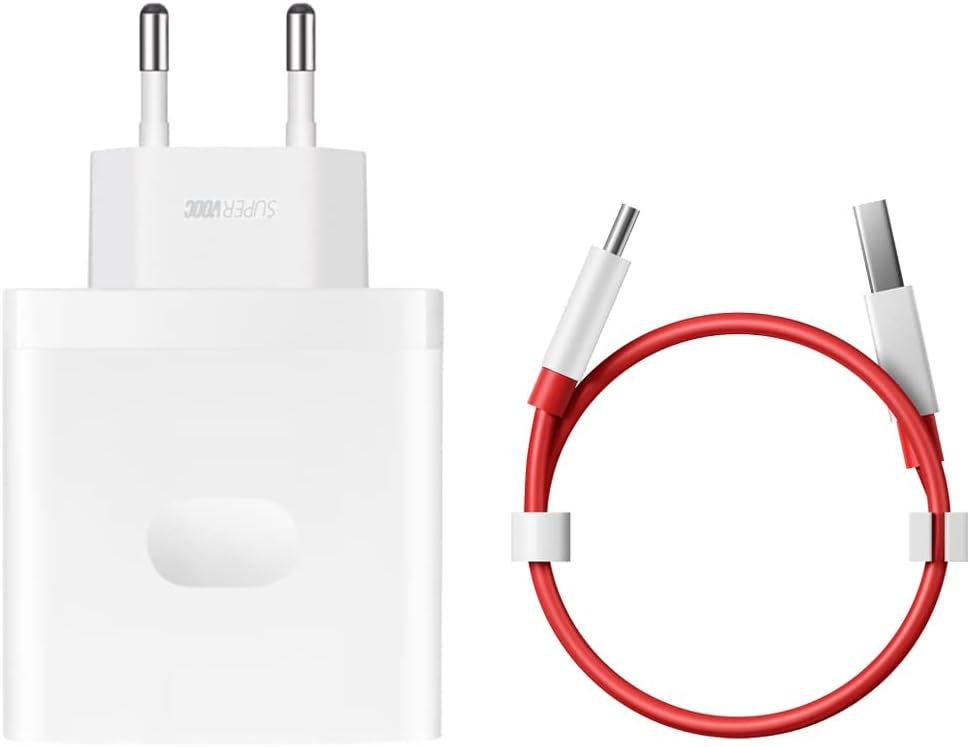
- The charger: an official SuperVOOC mains brick — 80 W, 100 W, and so on.
- The cable: the one everybody forgets. A SuperVOOC cable — usually thicker, with an orange or red connector — is a specific part. It carries extra pins to handle the high current. Use an ordinary USB-C cable and the chain is broken, and the charge drops back to slow.
In short: why you really do need a SuperVOOC charger
- For the speed: it is the only way to get the ultra-fast charging (80 W, 100 W, 120 W and beyond) you actually paid for.
- For safety: SuperVOOC is designed so that charger and phone keep talking to each other throughout. The heat is handled inside the brick rather than inside the phone, which protects your battery over the long run.
- For simplicity: any recent Oppo, OnePlus or Realme shares the same technology today. One SuperVOOC charger covers the lot.
Don’t throw away your new phone’s single best feature to save a few euros on the charger. It is the most important accessory you will buy for it.
Which SuperVOOC charger should you choose?
It is straightforward: look at the maximum power your phone accepts.
- If your phone takes 120 W, get a 120 W SuperVOOC charger — either the Realme version or the OnePlus version. Both charge just as fast.
- If your phone takes 100 W, go for the OnePlus SuperVOOC 120 W: it will limit itself to the 100 W your phone asks for, and it will still suit your next device.
- If your phone takes 80 W, a SuperVOOC 80 W is what you want.
(One note: a 100 or 120 W charger will work on an 80 W phone, simply capping itself at 80 W. The reverse is not true.)
At PhoneDroid we have picked out the official SuperVOOC chargers that will give your phone its full performance in complete safety.
And the cable matters as much as the brick: hook a SuperVOOC charger up with an ordinary cord and it drops straight back to standard charging. The official SuperVOOC 12A cable carries the full power of the family.
One thing that often surprises people: within the SuperVOOC family, the brand on the charger makes no difference. A Realme charger will charge an Oppo or a OnePlus at full speed, and the other way round. It is the technology that counts, not the logo.
Browse our official SuperVOOC chargers. We also carry Oppo phones and screen protection to go with them.

![OnePlus 16: BOE X4 display, 185 Hz and 9,000 mAh [Update]](https://www.phonedroid.net/blog/wp-content/uploads/2026/09/oneplus-16-rendus-officiels-trois-coloris.jpg)
![Xiaomi 18 Pro Max: Heading for an Outrageous Spec Sheet [UPDATED]](https://www.phonedroid.net/blog/wp-content/uploads/2025/09/Xiaomi-17-Pro-Max.jpg)
![Oppo Find X10: unveiling on 22 September, dual 200 MP and 8,000 mAh [UPDATED]](https://www.phonedroid.net/blog/wp-content/uploads/2026/09/oppo-find-x10-rendu-officiel-qingcheng.jpg)