
The appeal is undeniable. The latest Oppo, Vivo or Xiaomi flagship launches in China, and a few weeks later it turns up on import platforms at an unbeatable price, long before its (hypothetical) European release. The temptation is real. Who wouldn’t want the newest thing, cheaper and sooner?
Behind that apparent bargain, though, sit a number of technical and practical traps that can turn a dream purchase into a daily headache. At PhoneDroid, as specialists in these brands, we see far too many people disappointed by a direct import. Here is why buying the Chinese version of a smartphone is rarely a good idea for a European user.
First things first: two versions, and one bodge
A good share of the bad surprises comes from a misunderstanding about words. On import platforms, the same model is sold under labels that look alike and do not mean the same thing at all. In reality the manufacturer builds only two versions — everything else is the reseller’s doing.
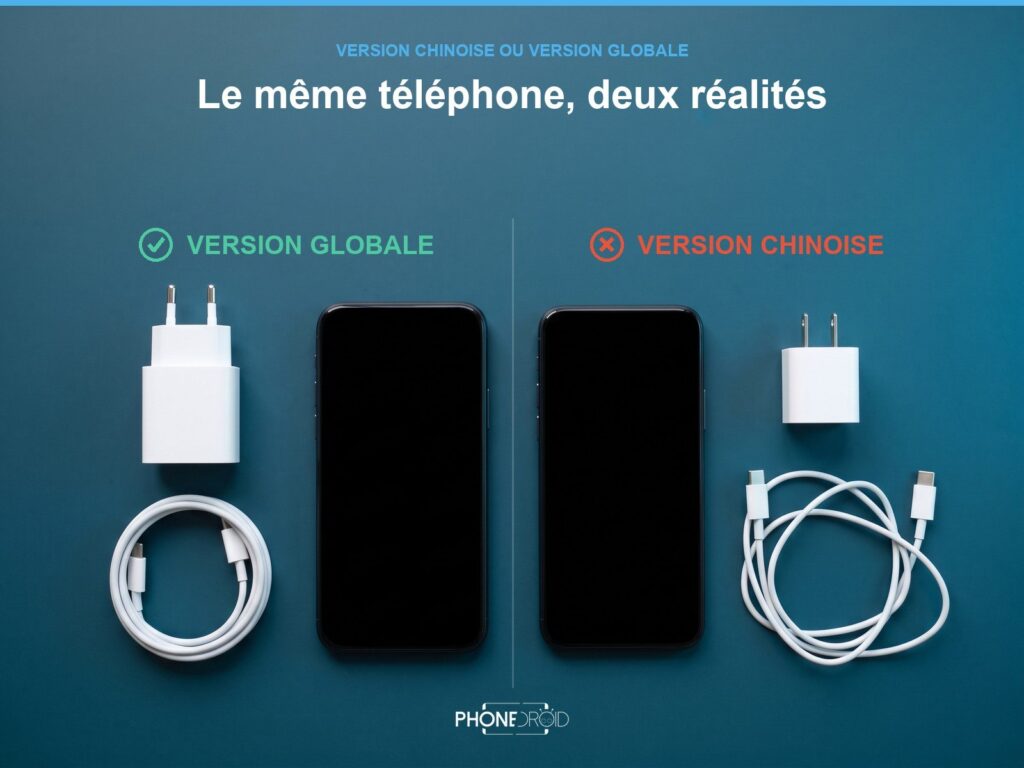
- The Chinese version: the device exactly as it is sold in mainland China. System in English and Chinese, no Google services, a flat-pin charger, and network bands chosen for Chinese carriers. It is the cheapest, and it is the one the rest of this article is about.
- The global version: the variant the manufacturer designs for international markets. Every band that matters here, Google services out of the box, manufacturer updates, your own language from the very first boot and a European charger. It is the only one we sell.
And in between: the flashed phone
This is where it really plays out, and it is what the listings never say. A reseller buys a Chinese phone, installs a different ROM on it themselves, and sells it under a reassuring label: “global ROM”, “international version”, “multilingual”. The hardware has not changed one bit.
Three consequences, and not one of them appears on the product page:
- Bloatware. These ROMs rarely arrive clean: added apps, adverts, sometimes components of unknown origin.
- No OTA updates at all. This is the decisive point. The phone will never receive anything over the air again — no new Android release, no security patch. You are buying a device frozen on the day it was sold.
- The network bands stay Chinese. Changing the software does not change the antenna: the missing bands stay missing, whatever the label claims.
Put plainly: a “global ROM” sold cheaper than a global version is not a bargain, it is a dead end. The phone will work on day one, and grow old without ever being updated.
| Chinese | Flashed Chinese | Global | |
|---|---|---|---|
| System language | English / Chinese | Multilingual | Multilingual |
| Google services | No | Yes | Yes |
| Official ROM | Yes | No | Yes |
| OTA updates | Yes | No | Yes |
| Added apps | No | Often | No |
| B20 and B28 bands | Rarely | Rarely | Yes |
| Charger supplied | Chinese | Chinese | European |
1. The network band trap (4G/5G): your phone in slow motion 🐌
This is problem number one, and the most frustrating of the lot. Phones are built for the specific network frequencies of their target market.
- The problem: Chinese versions often leave out some of the 4G and 5G bands used in Europe, notably the crucial B20 (800 MHz) and B28 (700 MHz). Those bands are what give you coverage in rural areas and inside buildings. On 5G the reasoning is the same and comes down to one band: n28 (700 MHz), the one that travels far and gets through walls. n78 (3.5 GHz) is present almost everywhere and causes no trouble; n79, which you will see on Chinese spec sheets, is not used in Europe and therefore brings nothing here.
- The consequence: your brand-new phone will get poor 4G/5G reception, or none at all, in plenty of situations. You will pay for a 5G plan and get sluggish 4G, sometimes 3G. Features such as VoLTE (calls over 4G) and VoWiFi (calls over Wi-Fi) may also fail to work properly with European carriers.
2. No Google services — and no assistant either 🚫
Phones sold in mainland China ship without Google Mobile Services (GMS), the Play Store included. Worse still, your voice assistant is nowhere to be found.
- The problem: no Play Store means no simple, secure access to the apps you use every day (Gmail, Maps, YouTube, WhatsApp…). Google Assistant — or Gemini — is absent altogether, replaced by a local assistant such as Breeno on Oppo, which speaks only Chinese and is therefore unusable here.
- The false fixes: yes, it is sometimes possible to install GMS by hand. But it is often unstable, insecure, and can stop working after an update. Some apps — banking apps, Google Pay — will simply refuse to run on an uncertified device.
- The consequence: a hobbled phone, without easy access to your apps and without the assistant you rely on daily.
3. Updates (OTA): frequent, but risky 🔄
The software on a Chinese version differs from the one on a global version. Updates may look more frequent, but they bring problems of their own.
- The paradox: Chinese versions do often receive software updates more frequently. But these are updates built for China. They can introduce local features that are useless here or, worse, break the Google services you installed by hand, sending you back to square one.
- Flashed “global ROMs” — the trap in its purest form: some sellers install a “global ROM”, often modified and unofficial, on a Chinese phone. That is worse still. Those unofficial ROMs receive no OTA update from the manufacturer at all. You are stuck on one software version, with no security patches and no new Android features.
- The consequence: either updates that may cause trouble, or no follow-up whatsoever, which leaves your phone obsolete and exposed.
4. Language, bloatware and default apps you cannot change 🇨🇳
The day-to-day experience is never quite smooth.
- The problems: you will inevitably run into untranslated menus, apps or notifications. Chinese ROMs are packed with pre-installed apps that are useless here and often impossible to remove. Worse, some default system apps — keyboard, password manager, browser — will stay in Chinese or prove very hard to swap for the ones you actually use, such as Gboard or Bitwarden. It wears on you every single day.
5. The notification nightmare 🔕
This is one of the most exasperating things about living with a Chinese ROM.
- The problem: Chinese systems are extremely aggressive about saving battery. They routinely kill background apps, and non-Chinese apps first of all.
- The consequence:
- You have to go into the settings of every single app — WhatsApp, Gmail, Facebook — and allow it to run in the background and show notifications, with no guarantee it survives the next update.
- And even with the right permissions, notifications often arrive late, in batches, or never. So much for flight alerts, live scores, or a message you needed to see straight away.
- All these “small things” add up, and they make a Chinese version markedly less reliable to live with than a version built for our market.
6. The hidden costs: VAT and customs 💸
The price shown on Chinese import sites is misleading.
- The problem: these sellers export from China and charge no European VAT — 20 % in France, and rates of the same order across the rest of the EU. To slip past checks, they very often under-declare the value of the parcel: €50 stated for an €800 phone.
- The risks:
- It is illegal. If customs intercept your parcel and spot the under-declaration, you will pay VAT on the real value, handling fees, and possibly penalties. Your bargain turns into an extra bill.
- The practice also undercuts local businesses and distorts competition.
- The real sum: add the VAT you should have paid, plus any customs handling fees, and the price gap with a European version bought properly shrinks considerably — or vanishes. The risk is not worth it.
7. Warranty and after-sales: a legal void ⚖️
This is the big financial risk.
- The problem: the manufacturer’s warranty on a phone bought in China is valid in China only. No official repair centre in Europe will take your device.
- Our counter-example: the devices we sell are official global versions, covered by a 2-year warranty and shipped from France within 24 hours — see the Vivo X300 Ultra or the Oppo Find X9S, for instance.
- The consequence: if it breaks, you will have to send the phone back to the seller in China at your own expense, customs risk included, with repair and return times running into months and no certainty about the quality of the work or a refund. A €100 saving at purchase can become an €800 write-off.
Conclusion: expertise has a price, and it is a fair one
Importing a Chinese version directly can look tempting, but the savings on the label are largely eaten up by network incompatibilities, software limits (Google, notifications, language), risky updates, the complete absence of a European warranty and the potential VAT and customs bill.
Going through a specialist reseller based in Europe, like PhoneDroid, is choosing peace of mind. We list official global versions only: every band that matters here, Google services out of the box, manufacturer updates, and the system in your language from the first boot. Add a 2-year warranty and shipping from France within 24 hours.
Don’t turn your enthusiasm for technology into an obstacle course. You will find the same brands here in their global version: the Oppo Find N6, the Vivo X300 FE or the Xiaomi 17T Pro, and more broadly our whole catalogue.
![OnePlus 16: BOE X4 display, 185 Hz and 9,000 mAh [Update]](https://www.phonedroid.net/blog/wp-content/uploads/2026/09/oneplus-16-rendus-officiels-trois-coloris.jpg)
![Xiaomi 18 Pro: The Compact Monster With Two 200 MP Sensors [UPDATE]](https://www.phonedroid.net/blog/wp-content/uploads/2026/09/xiaomi-18-pro-photos-en-main-face-dos.jpg)
![Xiaomi 18 Pro Max: Heading for an Outrageous Spec Sheet [UPDATED]](https://www.phonedroid.net/blog/wp-content/uploads/2025/09/Xiaomi-17-Pro-Max.jpg)
![Oppo Find X10: unveiling on 22 September, dual 200 MP and 8,000 mAh [UPDATED]](https://www.phonedroid.net/blog/wp-content/uploads/2026/09/oppo-find-x10-rendu-officiel-qingcheng.jpg)