📌 Update, 15 September 2026: iQOO has set the date: the iQOO 16 will be unveiled on 29 September at 7 pm in China, and go on sale as soon as the event ends. The launch poster finally brings the three colourways together — Chasing Light with its holographic back, Legend in white and Racing Track in a dark finish — and the brand promises a standard model able to rival higher-end “Pro Max” phones. The phone will run OriginOS 7, based on Android 17.
Positioned as the spearhead of raw performance and e-sport within the Vivo group, iQOO is about to renew its flagship model. The first technical details surfaced at the start of the summer, and now the phone’s appearance on Chinese certification databases confirms that its unveiling is imminent.
This new generation takes a spectacular hardware leap, shaking up the usual standards of the category by pairing a colossal battery with Qualcomm’s most muscular 2 nm platform.
The cancelled Ultra model: why the iQOO 16 inherits every superlative
To grasp the scale of the iQOO 16’s spec sheet, you have to look behind the industrial scenes at the brand. Faced with soaring memory component costs — RAM and storage — the development teams decided to drop the Ultra model altogether.
That decision has one direct — and very welcome — consequence for the standard model: instead of spreading its innovations across two separate devices to justify a prohibitively expensive Ultra, iQOO has bundled all of its best technology into the standard iQOO 16.
That is precisely the trade-off that explains why a base model inherits an 8,400 mAh battery, a 165 Hz screen and Qualcomm’s Pro chip. The iQOO 16 becomes, on its own, the technological showcase for the range.
Samsung 2K panel at 165 Hz: a fluidity leap for competitive gaming
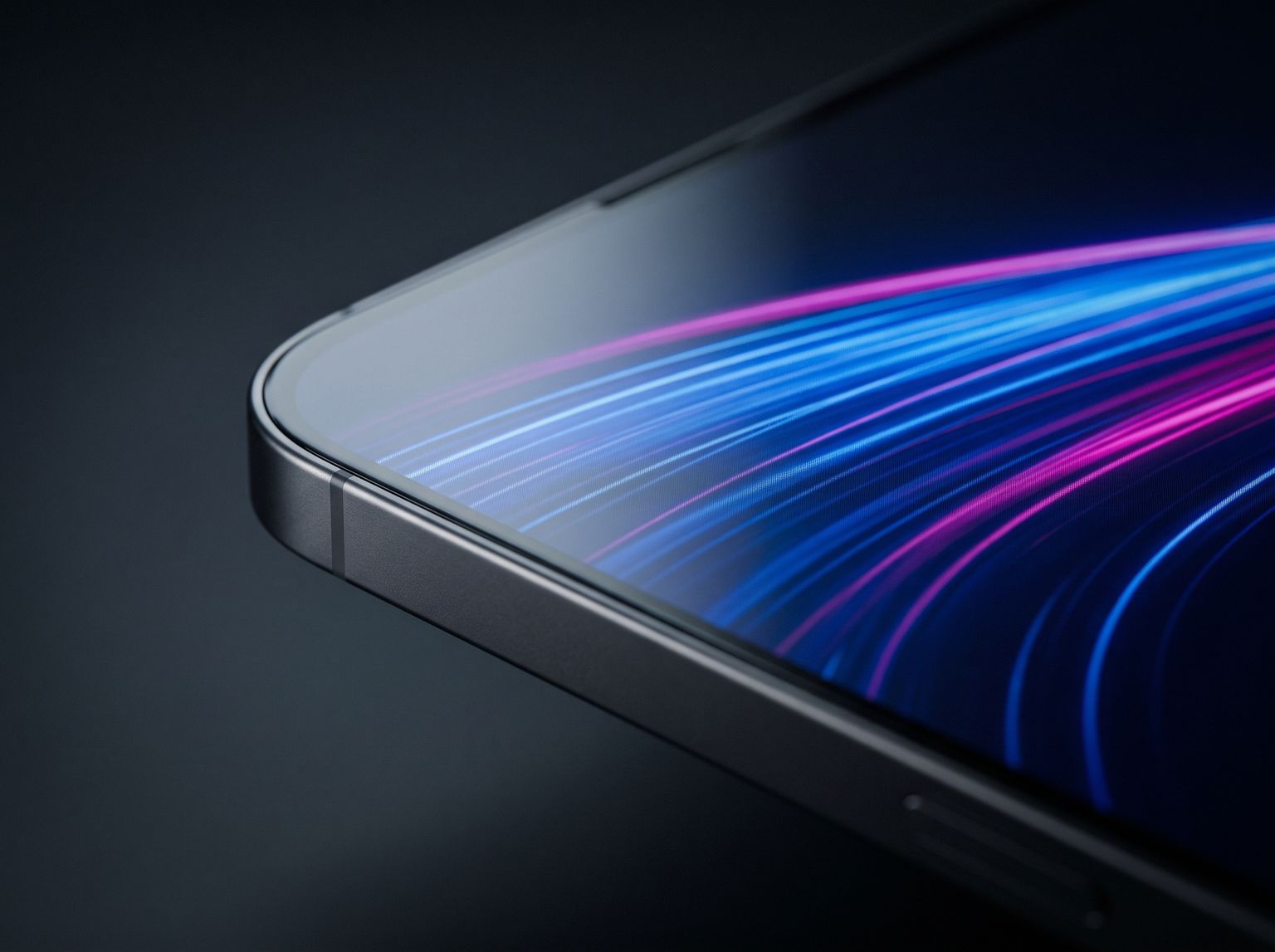
On the display side, the iQOO 16 moves up a gear with a flat OLED panel supplied by Samsung, measuring 6.85 inches.
While the screen size and the 2K resolution are said to stay close to the iQOO 15’s 3,168 × 1,440 pixels, the headline change is the refresh rate, which climbs from 144 Hz to 165 Hz.
That extra fluidity brings three very concrete benefits:
- Surgical responsiveness in games: on compatible competitive titles (FPS, MOBA), displaying 165 frames per second cuts latency and makes it easier to track fast-moving targets.
- Sharper motion: scrolling through the interface and system animations gain in precision, with no micro-stutter or blur.
- An anti-reflective treatment: the panel reportedly gets an optical coating designed to cut down reflections in bright sunlight or under direct lighting.
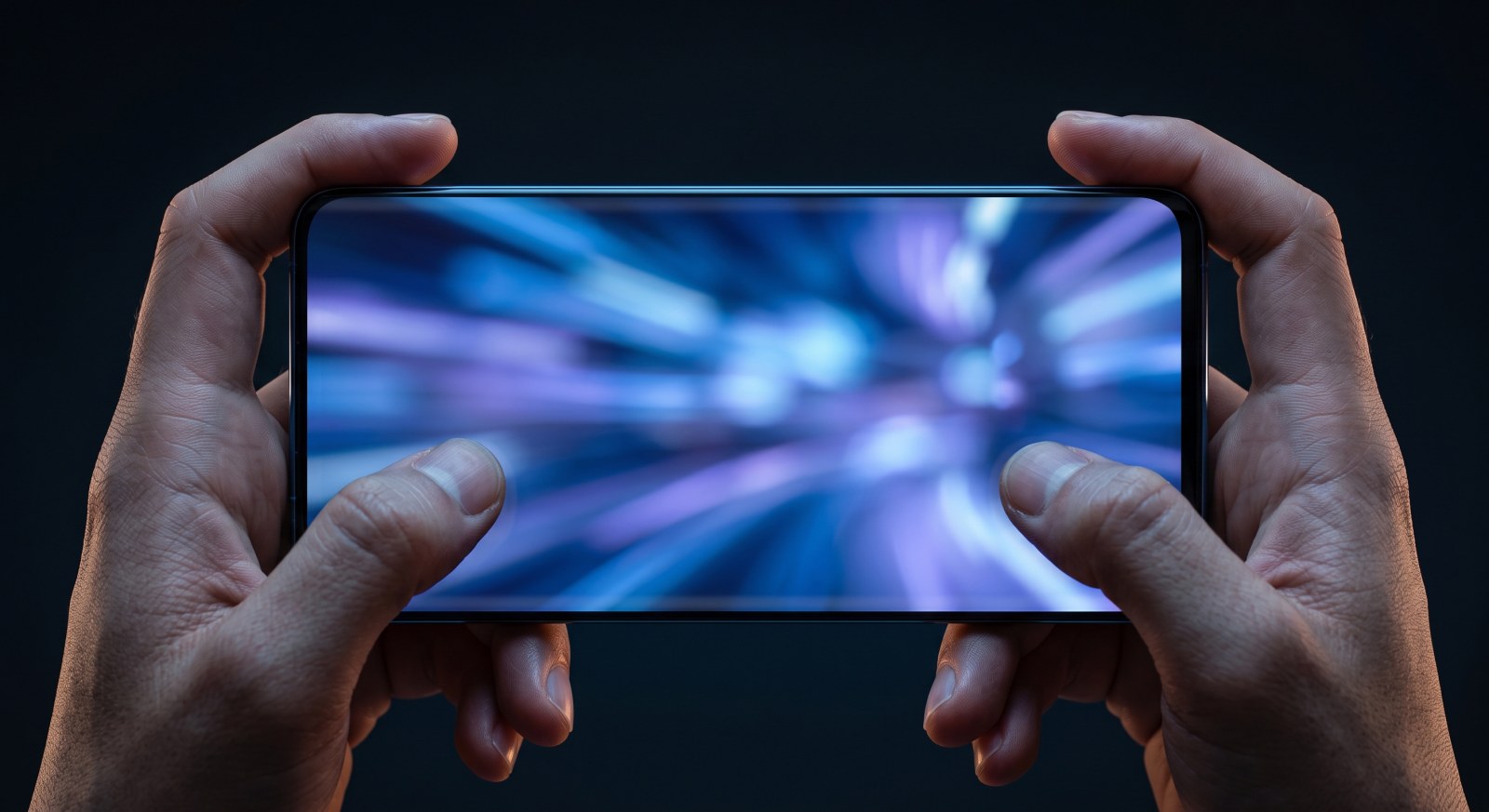
True to the demands of mobile gaming, the screen adopts a completely flat structure. That design avoids accidental edge touches when you hold the phone with both thumbs in landscape — and, incidentally, it makes fitting a tempered glass protector far easier.
Brightness and LEAD OLED technology: Wang Ken’s official statements
Perfecting a display comes down to more than its refresh rate. Wang Ken, flagship product manager at iQOO, has spoken publicly about the long-standing challenge keeping engineers busy: striking the right balance between peak brightness, power draw and panel durability.
The problem is well known across the industry: pushing maximum brightness puts excessive strain on the organic diodes, which sends power consumption through the roof and accelerates screen wear. According to Wang Ken, iQOO has made a major breakthrough by adopting Samsung Display’s 2K LEAD OLED panels.
To put the brand’s technical benchmarks in context:
- The iQOO 15 and its spec sheet relied on M14 electroluminescent material, reaching a global peak of 2,600 nits and a maximum manual brightness of 1,000 nits. The panel also offered a minimum brightness dropping to 1 nit, an essential feature for reading your phone in bed in total darkness without burning your eyes.
- For its part, the iQOO 15 Ultra pushed local peak brightness as far as 8,000 nits.
Wang Ken was adamant: the iQOO 16 would go further still than its predecessors on this front. The figures arrived on 14 September and prove him right; we detail them a little further down. This work on the display sits at the heart of a packed September, alongside the iQOO Neo 12, unveiled at the same time.
What the panel is made of has just become clearer. According to Digital Chat Station, the iQOO 16 would be the first Android phone to carry Samsung Display’s M16 emissive material, paired with a new generation of the LEAD technology — the same one said to be going into Apple’s foldable display. Moving from the iQOO 15’s M14 to the M16 is, on its own, a two-generation jump in material.
The principle is worth unpacking, because it explains the figures quoted. A conventional OLED panel carries a polarising filter whose job is to stop ambient light bouncing off the metal parts sitting behind the diodes. It does that job, but it also swallows a large share of the light the screen produces. LEAD removes it and replaces it with a filter structure etched directly onto the panel by nano-lithography. The claimed gains:
- +40 % light transmission: for the same power, more photons leave the screen instead of being absorbed by the polariser.
- −44 % power consumption: a direct consequence of the above. To reach the same brightness the diodes work less hard, which counts on a gaming phone held at full brightness for an hour.
- +50 % panel lifespan: diodes under less strain age more slowly, which pushes back screen burn-in.
Viewing angles and colour accuracy would benefit from the change as well. The tipster also announced a joint presentation with Samsung Display, described as a first for the industry. It took place on 14 September, and iQOO put its own figure on the polariser-free panel’s gain there: around 30% lower power consumption while keeping 2K resolution and 165 Hz — a more cautious number than the 44% quoted for LEAD technology in general.
Official: the world’s first 2K 165 Hz display, co-developed with Samsung Display
On 14 September, at a display-focused event held with Samsung Display, iQOO lifted the lid on its panel. The iQOO 16 will be the world’s first smartphone with a 2K 165 Hz display, using a technology called 2K LEAD 2.0 developed jointly by the two companies. The partnership goes beyond buying parts: it covers the M16 emissive material — the iQOO 16 is indeed the first Android device to use it, as Digital Chat Station had said — a driver circuit designed for high refresh rates and a dedicated production line for the brand’s flagships.
The brightness figures the brand was keeping for the event are now known:
- 1,100 nits manual brightness: the value that matters day to day, the one you reach by pushing the slider yourself. The iQOO 15 stopped at 1,000 nits.
- 2,800 nits across the whole screen: the global peak, triggered automatically in bright sunlight — 200 nits more than the iQOO 15’s 2,600 nits.
- 10,000 nits local peak: reached on a small part of the image, a reflection or a light source in an HDR video. The iQOO 15 Ultra topped out at 8,000 nits.
The work extends to colour. The panel covers 1.24 times the P3 colour space and every screen is calibrated individually. iQOO claims colour uniformity improved by 39.6% and brightness uniformity up by 22.3% on the previous generation, thanks to an in-house algorithm that compensates colour and brightness at sub-pixel level. The brand claims colour accuracy of ±0.001, a figure independent measurements will need to confirm, and a 100% first-frame brightness ratio: the screen shows the requested brightness straight away, with no gradual ramp-up.
For gaming, a new touch chip samples at up to 5,000 Hz instantaneous and 500 Hz multi-finger, and the in-house Q-flex technology cuts the delay between a touch and the action on screen. For visual comfort the list is long: full-brightness DC dimming, PWM up to 3,300 Hz to make flicker imperceptible in low light, an unpolarised natural-light display, a gaming anti-glare mode and three light sensors measuring ambient light across the whole device.
The back of the iQOO 16 shows itself: a large square module and a light strip
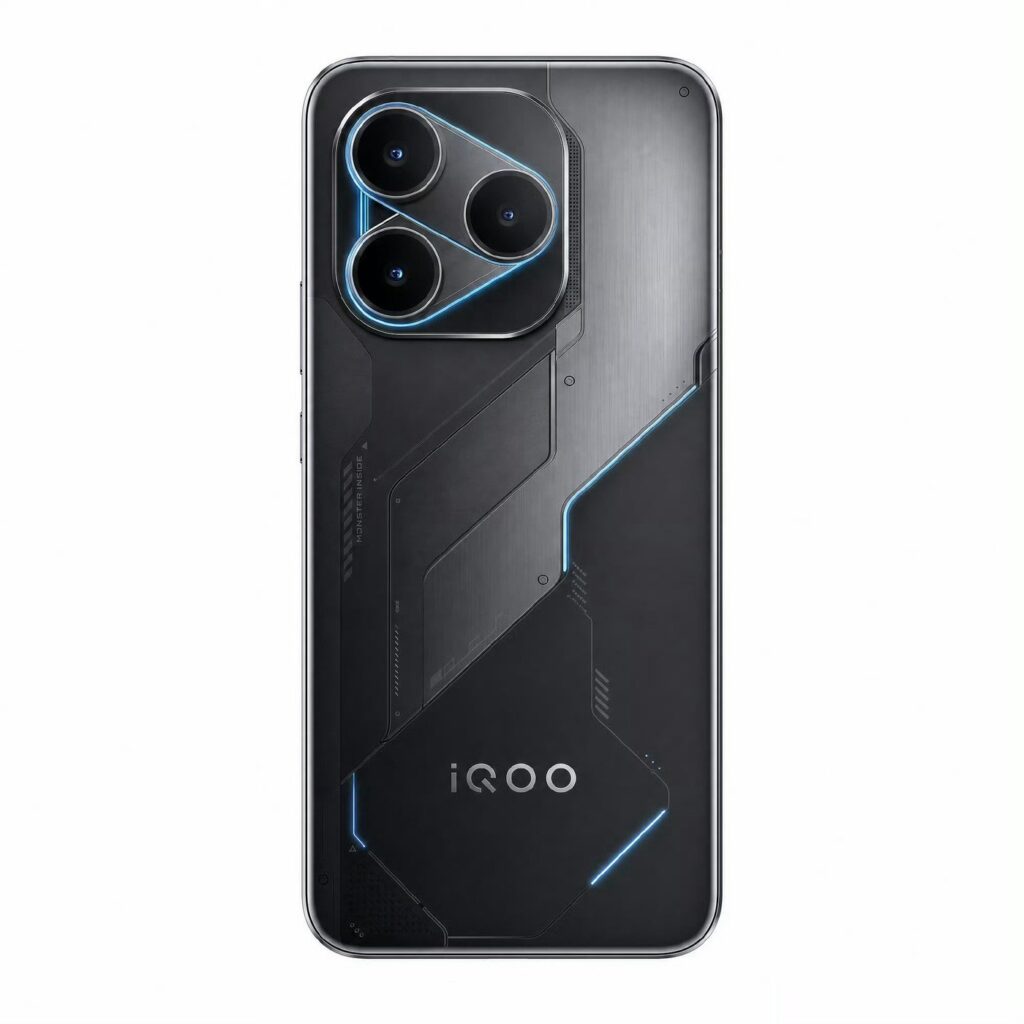
Visually, the iQOO 16 makes a clean break with its predecessor. The centred camera island gives way to a large square module with heavily rounded corners, set in the top-left corner. Two renders put into circulation on 3 September finally give us a picture of it.
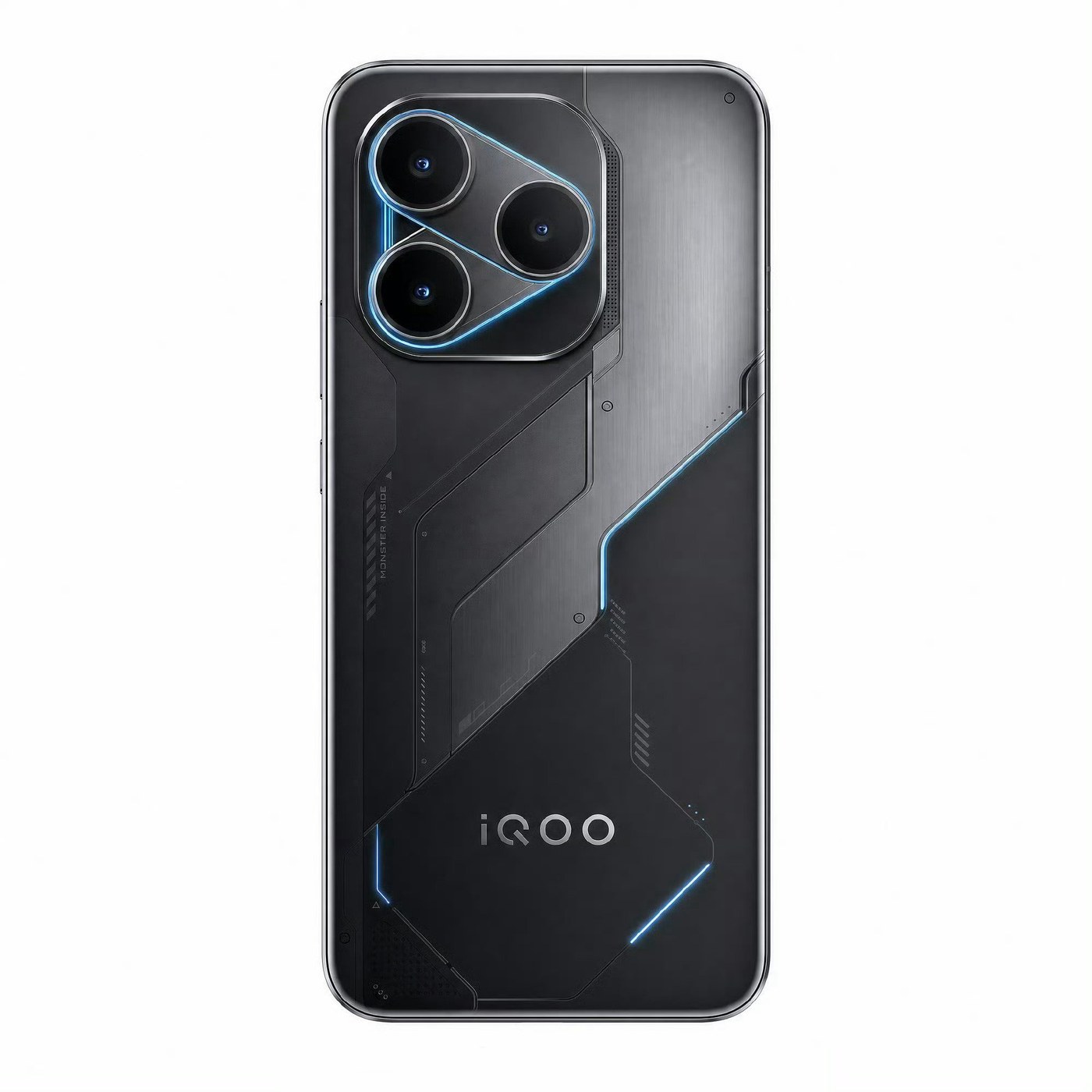
The three lenses are joined by a strip tracing a triangular loop inside the module, a geometry you rarely meet elsewhere. On the black finish that strip lights up blue and runs on diagonally to the bottom of the shell, across a faceted back that reads like a machine panel. The words MONSTER INSIDE, engraved vertically along the left edge, pick up the slogan the brand has used since its earliest days.
The second render shows a white finish, plain and free of any lighting, whose pale frame takes on distinctly rounded edges. That detail matters on a gaming phone: over an hour-long session held in landscape, those are the edges that press into your palms.
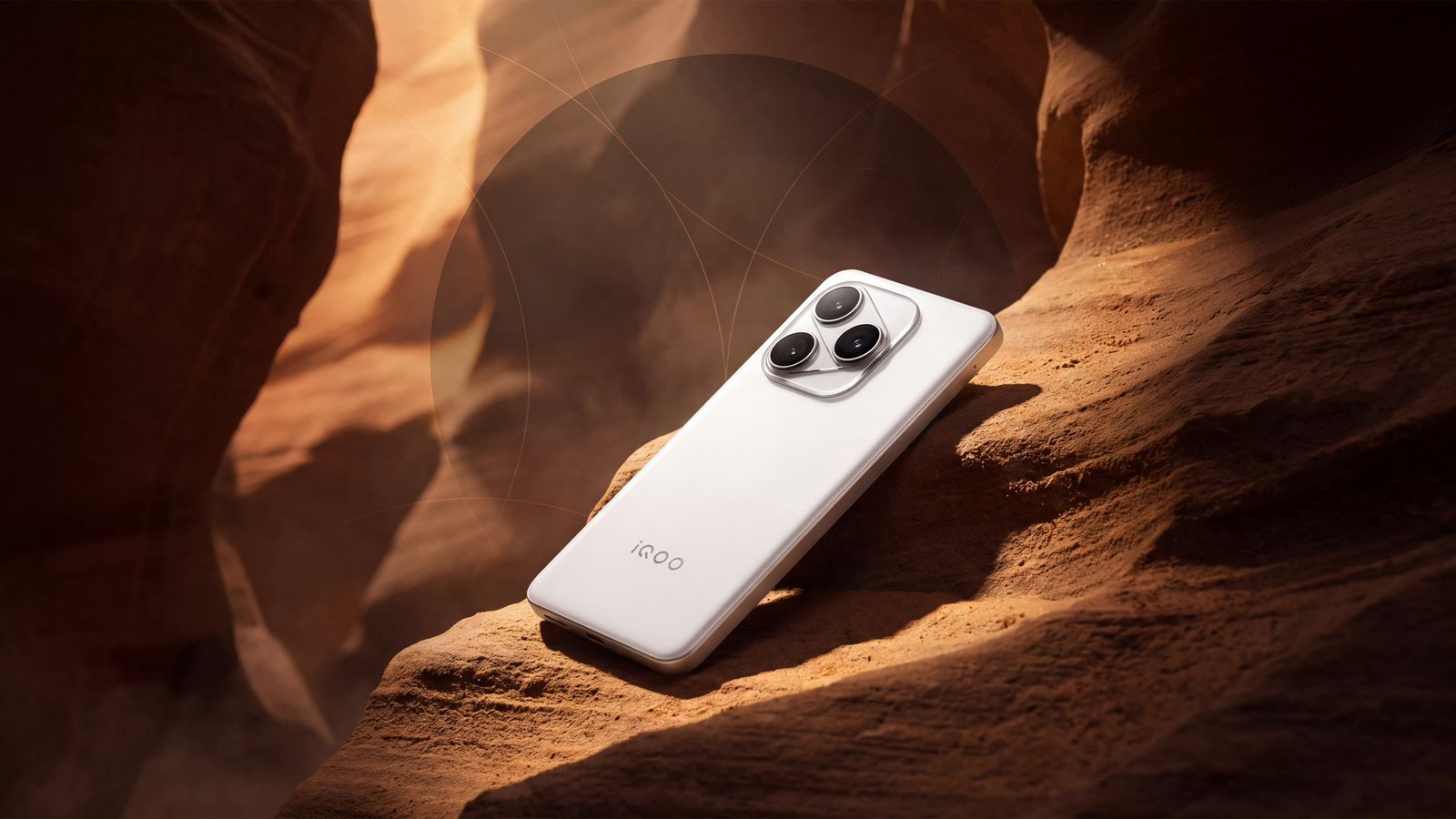
One caveat applies to both visuals. The outlet circulating them states that it does not know where they came from, and nothing has arrived from iQOO to confirm them. They line up with what we know of the device — three lenses, a flat display, a module pushed into the corner — but until the brand publishes images of its own, this design stays a credible hypothesis rather than an established fact.
That caveat has now largely been lifted. On 8 September, iQOO published its first official poster: it announces the iQOO 16 and the iQOO Pad Ultra for the end of the month, and shows both camera modules in a see-through rendering.
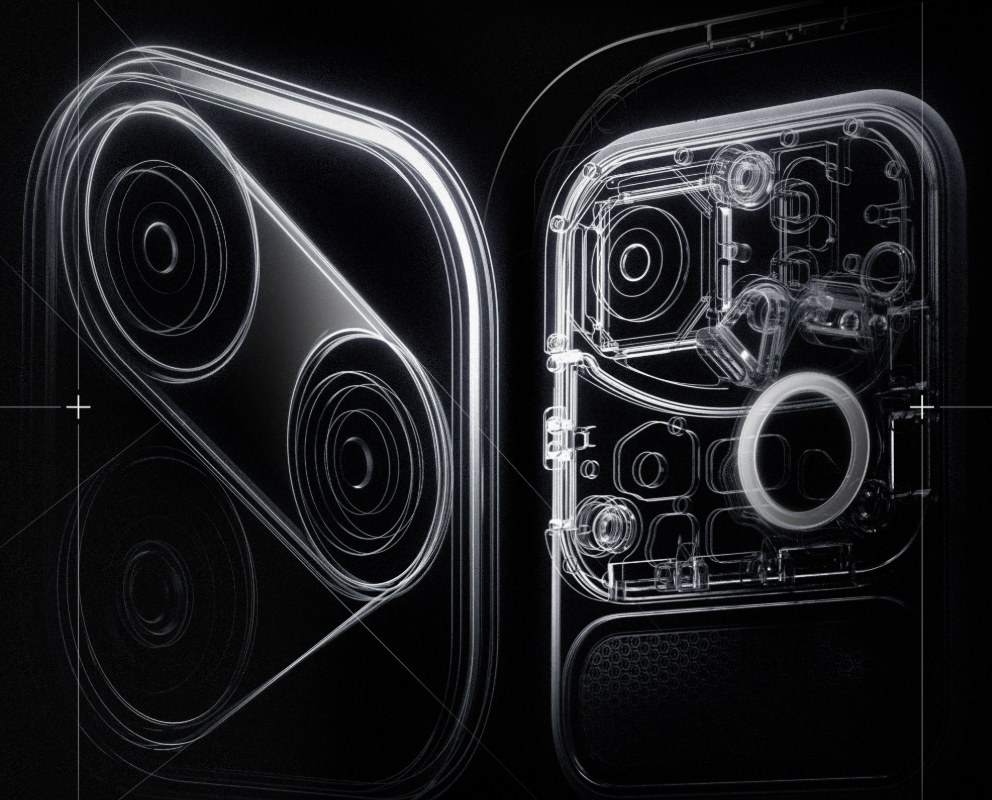
The module on the left, the iQOO 16’s, confirms the essentials of the renders: the square with its very rounded corners, the three lenses arranged in a triangle, and the loop connecting them. What the poster does not say is whether that loop lights up — and Digital Chat Station adds a caveat that matters here: the engineering unit he saw has no light strip. A prototype is not a finished product, but the doubt is now on the table.
The same tipster describes a black, slightly raised module carrying a “100X Tele Lens” marking engraved in its top-left corner, with a circular flash top right. It is the first hard number on the phone’s zoom, at a point where the magnification factor had never been settled. It almost certainly refers to maximum digital reach rather than optical zoom: that is how the marking reads on every phone that carries it.
The memory configurations are known too: 12 GB + 256 GB, 12 + 512, 16 + 512 and 16 GB + 1 TB, spread across three editions whose Chinese names translate as “Track”, “Legend” and “Light Chaser”.
The change is driven first and foremost by ergonomics. By clearing the middle of the back panel, the phone frees up the area where your fingers naturally rest when you hold it in landscape during a match. That keeps the lenses clean, and above all avoids the nagging pressure under your fingers that starts to make itself felt after an hour of play.
On 11 September, iQOO went the whole way and published a full render of the phone. The caveat set out above therefore falls for good, at least for this finish: the back of the iQOO 16 is no longer a hypothesis.
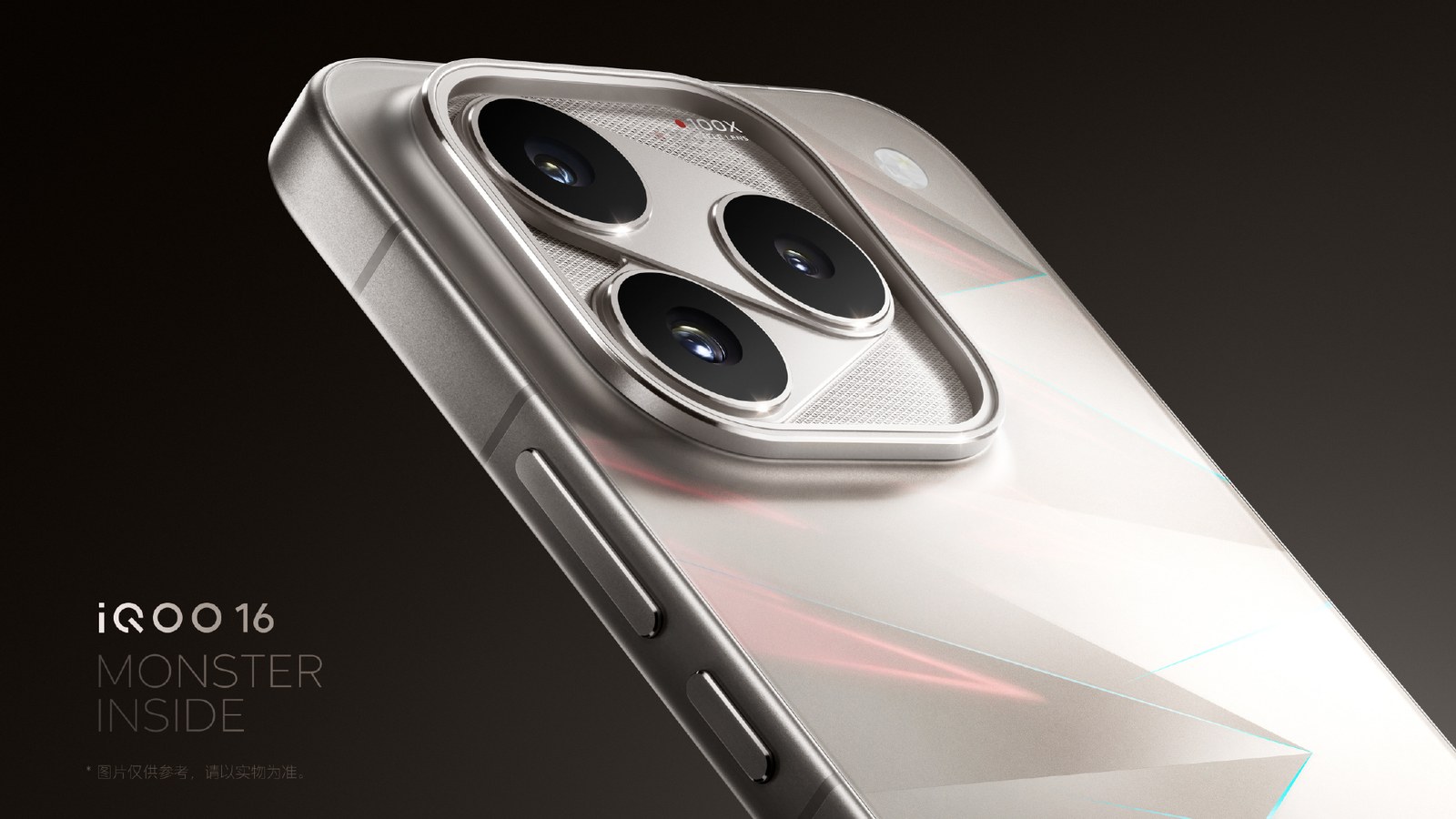
The colourway is called Chasing Light, and its holographic back rests on what iQOO describes as laser holographic imaging, an industry first according to the brand. Four precision processes are layered to produce a three-dimensional light effect that holds from any viewing angle: as the phone moves, red patterns cross paths with streams of blue light, so the shade shifts rather than staying put. Two further finishes will sit alongside it, Racing Track and Legend — the official names of the editions we previously knew only through a rough translation of their Chinese labels.
The camera module follows the same intent. iQOO says it drew on a spacecraft porthole, a design language it calls Tomorrow’s Porthole: the three lenses are joined by a mechanical structure that reads, from a distance, as a navigation marker. The island sits above a hexagonal technical pattern and makes use of transparent glass.
The render also settles a point left hanging. The “100X” marking Digital Chat Station described on 8 September is indeed there, engraved in red at the top of the island. Our reading does not change for all that: on every phone that displays it, that figure refers to maximum digital magnification, and nothing in iQOO’s communication says otherwise at this stage.
On 15 September the launch poster brought all three finishes together for the first time. Racing Track dresses the phone in a matte, near-black midnight blue with a matching camera island; Legend goes for a plain, bright white; Chasing Light remains the only one with the holographic back. On all three the camera square keeps the same layout: three lenses in a triangle, the “100X” marking at the top of the island and the flash set outside it, top right of the back.
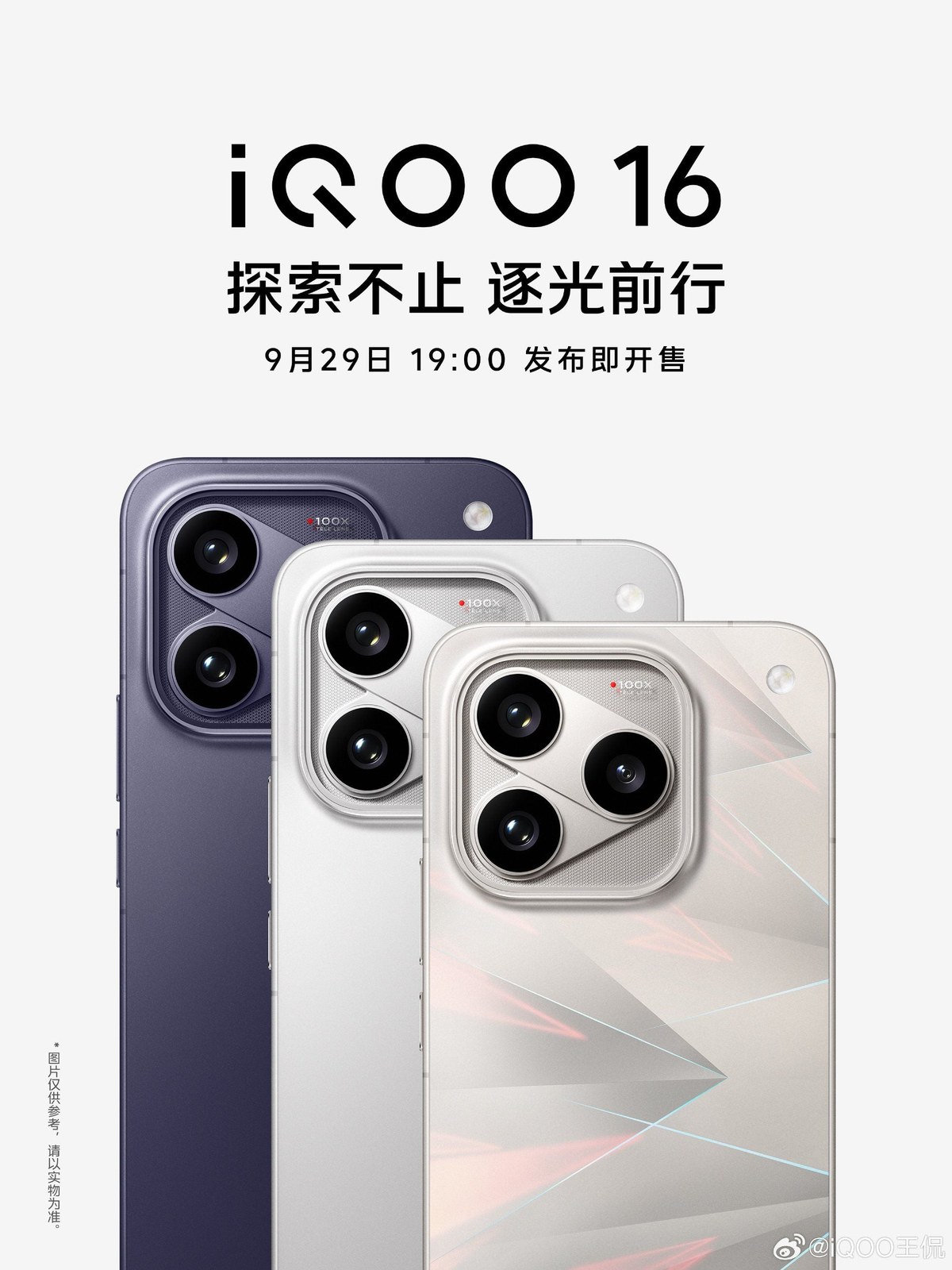
These official renders close the chapter on the images that surfaced on 3 September: none of the three finishes shows a light strip or a MONSTER INSIDE inscription engraved along the back, the slogan staying on the posters. They are in line with the engineering unit Digital Chat Station described, which had no lighting.
Three 50 MP sensors: a more ambitious camera set-up than expected
The iQOO range is built above all for extreme gaming performance, but the manufacturer has no intention of skimping on optics. According to the latest revelations from Digital Chat Station, the iQOO 16 is reportedly being evaluated with a more complete rear array than anticipated, featuring three sensors all rated at 50 megapixels:
- 50 MP main sensor (1/1.3-inch, f/1.68 aperture): tipped to use the OmniVision OV50Q sensor, this module is both the largest and the brightest on the device. A wide aperture paired with a sensor of this size is the key battleground in low light, capturing as much clarity as possible at night while keeping digital noise in check.
- 50 MP ultra-wide (f/2.0 aperture): a lens dedicated to wide shots, delivering consistent sharpness right across the frame.
- 50 MP periscope telephoto (1/1.95-inch, f/2.65 aperture): periscope optics designed for distant shots with a high level of detail.
- 32 MP front camera: this one shows up in the leaks for the first time. The resolution sits below the 50 MP several rivals fit at the front, a coherent trade-off on a device built first and foremost for gaming.
The leaker also states that the internal structure is said to adopt a reversed lens arrangement. This refers to the order in which the optics are integrated and stacked inside the camera block — an engineering choice quite distinct from simply moving the island physically to the top corner.
At this stage, the exact optical magnification (the telephoto’s zoom factor) and macro capabilities have yet to be finalised. That said, standardising the entire rear array at 50 MP guarantees one direct technical advantage: optimal consistency in colour, texture and sharpness when switching from one focal length to another.
Snapdragon 8 Elite Gen 6 Pro and a dedicated graphics chip: the full potential of 2 nm
Under the bonnet, the iQOO 16 is tipped to use Qualcomm’s most advanced platform of the moment, carrying the reference SM8975.
This is the new Snapdragon 8 Elite Gen 6 Pro, built on TSMC’s 2 nm process. As we explained in our full breakdown of the Snapdragon 8 Elite Gen 6, this Pro variant differs from the standard version not in clock speed — the processor is identical, laid out in a 2+3+3 cluster and peaking at 5.01 GHz — but in its graphics subsystem: an Adreno 850 GPU, 18 MB of dedicated graphics memory and support for LPDDR6. That expanded memory allows heavy textures to be processed in a closed loop, which reduces heat build-up and prevents performance dips.
To back up the processor, iQOO is said to include an in-house display chip, which now has a name: the Q4. This co-processor handles frame interpolation — enough to run games capped at 60 fps by their developers at 120 or 165 Hz — as well as real-time super-resolution, taking further strain off the main processor.
Its role would go a good deal further, though. According to WHYLAB, the Q4 mainly serves ray tracing applicable across every game scene, with two things mobile has not had before:
- Virtual point light sources: until now the lighting in a mobile game scene was largely computed in advance and painted into the textures. A point source genuinely lights what surrounds it, and casts shadows that move with it.
- HDR overlaid on top: the gap between the darkest areas and the brightest points of the image is rendered across the panel’s full range, instead of being squeezed towards an average brightness.
A comparison put out by the same source shows the difference on an interior scene lit by a stained-glass window: without ray tracing the floor stays evenly pale; with it, coloured light from the window pools on the flagstones and warms the columns around it. iQOO presents these effects as having been the preserve of consoles until now, and claims most popular games are already compatible. Luo Feng, at the company, has also said game screenshots could reach 8K resolution, with parameters the player can adjust.
8,400 mAh battery and certified 100 W charging
Battery life looks set to be the most striking argument on this spec sheet. The figure has just moved: after quoting around 8,500 mAh, Digital Chat Station revisited his estimate on 5 September to give 8,400 mAh. A hundred milliamp-hours less changes nothing in use — a few minutes across a day — but the shift is worth noting, because it is now the figure the tipster treats as final. The cell would use high-density silicon-carbon components, the only known way to fit that kind of capacity without making the phone absurdly thick.
On the charging side, the protocols have been validated by China’s 3C authority:
- 100 W wired Fast Charging
- 40 W wireless charging — the same level as the previous generation.
Combining an 8,400 mAh cell, the efficiency of 2 nm and 100 W charging targets mobile gamers directly — the kind of people for whom the battery percentage at 7 pm is a genuine concern.
Equipment: symmetrical audio, 0916 haptics and dual water resistance
- Symmetrical stereo speakers (1115 series): two equivalent acoustic chambers at the top and bottom of the chassis, for clean separation — essential when you need to pinpoint footsteps in an action game.
- X-axis haptic motor (0916 series): a linear actuator producing punchy, nuanced vibrations whether you are typing or gaming.
- 3D ultrasonic in-display fingerprint reader: markedly faster and more reliable than an optical sensor, including with wet fingers.
- Dual IP68 and IP69 certification: resistance to prolonged immersion and to high-pressure water jets.
- Connectivity and camera: a USB-C 3.2 port for high transfer speeds and wired video output, plus the 50 MP OmniVision OV50Q main sensor.
- Software: OriginOS 7, based on Android 17, out of the box.
Release timeline
Securing Chinese 3C certification under the reference V2606A indicates that the assembly lines are ready.
iQOO has set the date: the iQOO 16 will be unveiled on 29 September 2026 at 7 pm in China, and go on sale as soon as the event ends. That should put it among the very first phones to introduce Qualcomm’s new 2 nm chip.
The brand is turning that into a positioning argument: although billed as the standard model, the iQOO 16 would, it says, offer hardware and features able to rival higher-end “Pro Max” models. No price has been announced yet.
The brand will not come to that event alone: it has begun teasing a compact tablet, also driven by a Snapdragon 8 Elite Gen 6 series chip. Both devices are expected to be shown in the same window.
Expected iQOO 16 specifications
| Component | Expected specifications |
|---|---|
| Display | Flat 6.85-inch, Samsung OLED 2K (close to 3,168 × 1,440 px), M16 emissive material, 2K LEAD 2.0 panel co-developed with Samsung Display (official) |
| Refresh rate | 165 Hz — world’s first 2K 165 Hz display (official), anti-reflective treatment |
| Brightness | 1,100 nits (manual) · 2,800 nits (global) · 10,000 nits (local peak) — official |
| Colour and comfort | 1.24 × P3, per-screen calibration, 3,300 Hz PWM, DC dimming |
| Touch | 5,000 Hz instantaneous, 500 Hz multi-finger, Q-flex technology |
| Processor | Qualcomm Snapdragon 8 Elite Gen 6 Pro (SM8975, 2 nm TSMC), 2+3+3 cluster, 5.01 GHz |
| Secondary chip | In-house Q4 chip (ray tracing, interpolation, upscaling) |
| Software | OriginOS 7 (Android 17) |
| RAM | LPDDR6 support |
| Configurations | 12 GB + 256 GB, 12 + 512, 16 + 512 and 16 GB + 1 TB |
| Main camera sensor | 50 MP (OmniVision OV50Q, 1/1.3″, f/1.68) |
| Ultra-wide sensor | 50 MP (f/2.0) |
| Periscope telephoto | 50 MP (1/1.95″, f/2.65, reversed arrangement) |
| Front camera | 32 MP |
| Battery | 8,400 mAh, high-density cell |
| Charging | 100 W wired (3C certified) + 40 W wireless |
| Audio and haptics | 1115 symmetrical speakers, 0916 X-axis motor |
| Biometrics and water resistance | 3D ultrasonic fingerprint, IP68 and IP69 |
| Connectivity | USB-C 3.2 |
| Finishes | Chasing Light (holographic back), Racing Track and Legend — official iQOO names |
| Launch | 29 September 2026 at 7 pm in China, on sale immediately (official) |
iQOO 16 versus iQOO 15: the major changes
- Smoother display: 165 Hz against 144 Hz on the iQOO 15.
- Panel brightness and endurance: 1,100 nits manual and 2,800 nits across the whole screen, against 1,000 and 2,600 nits on the iQOO 15.
- 2 nm Pro architecture: the move to the Snapdragon 8 Elite Gen 6 Pro, with 18 MB of graphics memory and LPDDR6 support.
- Beefed-up battery: 8,400 mAh, backed by certified 100 W charging.
- Reworked ergonomics and optics: a compact square camera block in the top left, an unobstructed grip and a triple 50 MP array.
In summary
By inheriting every innovation originally planned for an Ultra version, the iQOO 16 shapes up as a particularly aggressive proposition for autumn 2026. The combination of the world’s first 2K 165 Hz display, the Snapdragon 8 Elite Gen 6 Pro and an 8,400 mAh battery makes it one of the most complete devices out there for anyone chasing sustained power without sacrificing endurance.
We will update this page as soon as the 29 September launch takes place. In the meantime, you can browse all the Vivo smartphones available in our shop, along with our selection of Vivo cases and fast chargers.

![Xiaomi 18 Pro: The Compact Monster With Two 200 MP Sensors [UPDATE]](https://www.phonedroid.net/blog/wp-content/uploads/2026/09/xiaomi-18-pro-photos-en-main-face-dos.jpg)
![Oppo Find X10: unveiling on 22 September, dual 200 MP and 8,000 mAh [UPDATED]](https://www.phonedroid.net/blog/wp-content/uploads/2026/09/oppo-find-x10-rendu-officiel-qingcheng.jpg)