📌 Update, 11 September 2026: the international Xiaomi 18 has just been certified in Taiwan under model number 2611FPNFAG. The filing confirms IP68 protection, two storage tiers and a 100 W charger. More tellingly, it lands more than a month earlier than the Xiaomi 17 did in the same database, pointing to a noticeably faster global rollout.
While the industry as a whole keeps pushing towards ever bigger, heavier phones to make room for large batteries, Xiaomi is still refining its compact line-up. The latest revelations around the Xiaomi 18 point to a remarkably complete device, pairing a 6.4-inch display, a 7,200 mAh battery and camera hardware inherited straight from the Pro models.
A two-stage launch: the Pro in September, the standard model in December
Unlike the brand’s usual approach, which until now has seen every variant revealed at once, Xiaomi is said to be splitting the release of its devices.
The Xiaomi 18 Pro is tipped to come first, around 28 and 29 September 2026. That slot would fall immediately after Qualcomm’s Snapdragon Summit (scheduled for 22 to 24 September), where the Snapdragon 8 Elite Gen 6, built on TSMC’s 2 nm process, will be made official. The standard Xiaomi 18, meanwhile, is reportedly not due to debut until December 2026.
For import enthusiasts, this staggered calendar means roughly three extra months of waiting before the compact model is unveiled, which would delay the availability of the Global Version internationally by the same amount.
The international model is already certified: what the Taiwanese filing says
On 9 September, a Xiaomi handset carrying model number 2611FPNFAG went through the NCC, Taiwan’s telecommunications authority. The same model had been spotted in July on Europe’s EEC register. Neither filing spells out “Xiaomi 18”: manufacturers only register technical references.
The most interesting signal is not in the spec list, it is in the date. The Xiaomi 17 only reached that same database at the very end of October 2025, for an international launch in February 2026. Its successor turns up more than a month earlier. On the same schedule, the global version would arrive appreciably sooner — and a single worldwide launch in December, China included, alongside the 18 Ultra, starts to look plausible.
The document itself settles several points that were open until now:
- Storage: two tiers, 256GB and 512GB, leaving 198GB and 469GB respectively available to the user — the rest is taken up by the system. No memory-card expansion is provided.
- Water resistance: IP68, stated explicitly in the filing.
- Charger: the MDY-19-EX brick is listed as supplied in the box. Its TÜV Rheinland certificate spells out the full profile: 5V/3A, 9V/3A, 11V/6.1A — the 67 W step Xiaomi has used for years — then 20V/5A, i.e. 100 W at the top.
- Radiation: the measured SAR comes in at 0.991 W/kg against a 2 W/kg regulatory ceiling — half the limit.
- Radio: VoLTE is declared, along with the 6 GHz band (5,945 to 6,425 MHz) used by Wi-Fi 6E and Wi-Fi 7.
One caveat on the charger. Its TÜV certificate is dated 30 September 2025 and covers a whole family of references, from MDY-19-ER to MDY-19-EV. It is therefore not a brick designed for the Xiaomi 18 but an existing in-house model the phone reuses — which takes nothing away from the 100 W, but makes it a confirmation rather than news.
A clear price increase, and the brand’s explanation
This is one of the key takeaways from the leaks: pricing shifts noticeably compared with the previous generation. In China, the Xiaomi 18 is said to start above 5,499 yuan for its entry-level configuration, against 4,499 yuan when the Xiaomi 17 launched. That 1,000 yuan jump marks a significant change of tier.
Faced with this anticipated increase, Lu Weibing, president of the Xiaomi group, stepped in directly to explain the industrial reasons behind it. He points to the global surge in the cost of sourcing memory components (RAM and Flash storage). By his forecasts, this pressure on the supply chain should keep prices high at least until the end of 2027, possibly 2028. In other words, this is a structural trend that will affect the entire mobile market.
It is worth remembering that a Chinese price does not translate directly into euros. Local taxation, shipping costs and import margins all add to the final price in Europe. Official pricing for the European market will be confirmed at the European announcement.
5 official colours and a familiar design
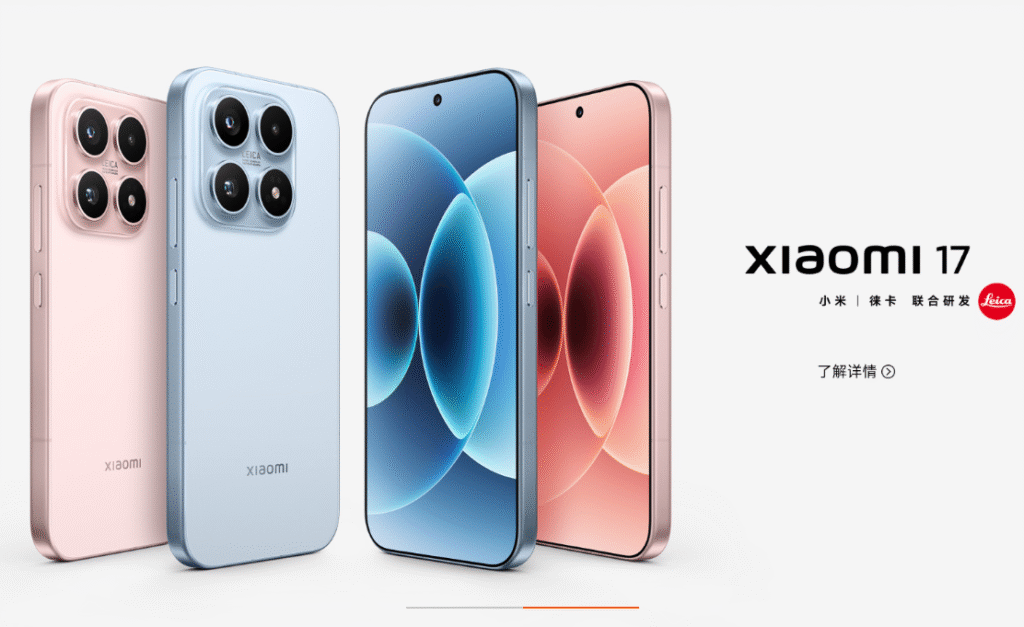
Visually, the Xiaomi 18 sticks to the brand’s established look. The back panel carries the square camera module in the top-left corner, in direct continuity with the Xiaomi 17. Keeping the same format brings a practical benefit: the overall silhouette stays familiar and accessory ranges remain highly consistent.
The novelty lies in the variety of finishes on offer. The flagship will be available from launch in 5 shades:
- Black (matte finish)
- White
- Pink
- Blue
- Red
Up front, the phone keeps a flat 6.4-inch display with 2K resolution built on SuperPixel technology. Ultra-thin symmetrical bezels help maintain a very manageable footprint, ideal for anyone after a high-end phone that can be used comfortably with one hand. Those bezels are said to rely on LIPO encapsulation, a process that folds the panel’s connections underneath the display instead of running them along its sides: for the same diagonal, the phone gains screen area without growing.
Snapdragon 8 Elite Gen 6: what 2 nm brings to the table
On the silicon side, the Xiaomi 18 will be among the first phones on the market to feature Qualcomm’s Snapdragon 8 Elite Gen 6 platform, manufactured by TSMC on its 2 nm process.
The detailed architecture of the chip reveals choices geared towards energy efficiency:
- Oryon CPU (2 + 3 + 3): two very high-frequency cores handle heavy workloads and gaming, while six secondary cores take care of background tasks (notifications, syncing) without calling on maximum power.
- 16 MB of shared L2 cache: this buffer lets the processor keep frequently used data within immediate reach, cutting day-to-day latency and improving overall interface smoothness.
- Adreno 845 GPU: handles graphics rendering and holds the refresh rate steady.
- LPDDR5X RAM: guarantees fast switching from one app to another without pages needlessly reloading.
The 2 nm process combined with the 7,200 mAh battery (against 7,000 mAh on the Xiaomi 17) puts real-world endurance of two days within reach under standard use, or even three days with moderate use.
Leica camera unit: moving to a dual 200 MP setup
The camera subsystem sees a major change. Xiaomi is setting aside the triple 50 MP array of the previous model in favour of a dual 200 MP configuration developed in partnership with Leica.
The setup consists of a main wide-angle sensor and a 200 MP 3X periscope telephoto lens. This is the first time a standard model in the range inherits a periscope-structured telephoto, hardware that had been reserved for the Pro variants until now.
In practice, a 200 MP resolution on the optical zoom gives you plenty of room to work with your framing. You can crop an image after the fact while keeping the picture beautifully sharp on screen.
Premium hardware and design trade-offs
To fit a 7,200 mAh battery inside a compact 6.4-inch chassis, the engineers chose to leave out the secondary rear display found on the Pro models. Every bit of internal volume saved has been reallocated to battery capacity.
The rest of the spec sheet holds to high-end standards:
- Ultrasonic under-display fingerprint reader: delivers fast unlocking, even with wet fingers, outperforming the accuracy of traditional optical sensors.
- Water resistance: IP68 is now confirmed by the Taiwanese filing. IP69, which covers high-pressure water jets and which manufacturers increasingly add, does not appear in it.
- Fast charging: 100 W wired with the MDY-19-EX brick listed as supplied, plus wireless charging.
Xiaomi 18 spec sheet
| Display | Flat, 6.4 inches, 2K resolution, SuperPixel panel |
| Processor | Qualcomm Snapdragon 8 Elite Gen 6 (2 nm TSMC) |
| CPU / GPU | Oryon 2+3+3, 16 MB L2 cache, Adreno 845 |
| RAM | LPDDR5X |
| Camera | Dual 200 MP Leica (main + 3X periscope) |
| Battery | 7,200 mAh (against 7,000 mAh on the Xiaomi 17) |
| Charging | 100 W wired (MDY-19-EX brick) + wireless charging |
| Storage | 256GB (198GB usable) or 512GB (469GB usable), no memory card |
| International model number | 2611FPNFAG |
| Measured SAR | 0.991 W/kg (2 W/kg limit) |
| Biometrics / Water resistance | Ultrasonic fingerprint sensor, IP68 (Taiwanese certification) |
| Colours | Black, White, Pink, Blue, Red |
| Estimated price (China) | From over 5,499 yuan |
| Launch | December 2026 (China) |
Xiaomi 18 or Xiaomi 18 Pro: which one to choose?
- Battery advantage to the standard model: the Xiaomi 18 packs 7,200 mAh against 7,000 mAh on the Pro, benefiting from the space freed up by the absence of a rear screen.
- Secondary rear display: remains exclusive to the Pro version, which is said to keep this back panel while adding a compass, quick access to the WeChat Pay payment code and a one-tap parcel collection code.
- Ultra-wide sensor: the Pro retains a dedicated ultra-wide module, whereas the standard model concentrates its camera architecture on the wide-angle and 200 MP periscope telephoto pairing.
For users who value a compact feel in the hand, battery longevity and photographic zoom, the standard model looks like a very sensible option. The full rundown of the Pro version is available in our dedicated article: Xiaomi 18 Pro, the compact monster with two 200 MP sensors.
In summary
Expected in December 2026, the Xiaomi 18 shapes up as a key model for anyone looking for a high-performance compact format with no compromises on battery life or camera quality.
You will be able to find the device in our shop as soon as it becomes available. In the meantime, feel free to browse our full range of Xiaomi smartphones, along with our dedicated accessories such as official Xiaomi cases and Xiaomi chargers.

![Xiaomi 18 Pro: The Compact Monster With Two 200 MP Sensors [UPDATE]](https://www.phonedroid.net/blog/wp-content/uploads/2026/09/xiaomi-18-pro-photos-en-main-face-dos.jpg)
![Xiaomi 18 Pro Max: Heading for an Outrageous Spec Sheet [UPDATED]](https://www.phonedroid.net/blog/wp-content/uploads/2025/09/Xiaomi-17-Pro-Max.jpg)
![Oppo Find X10: unveiling on 22 September, dual 200 MP and 8,000 mAh [UPDATED]](https://www.phonedroid.net/blog/wp-content/uploads/2026/09/oppo-find-x10-rendu-officiel-qingcheng.jpg)