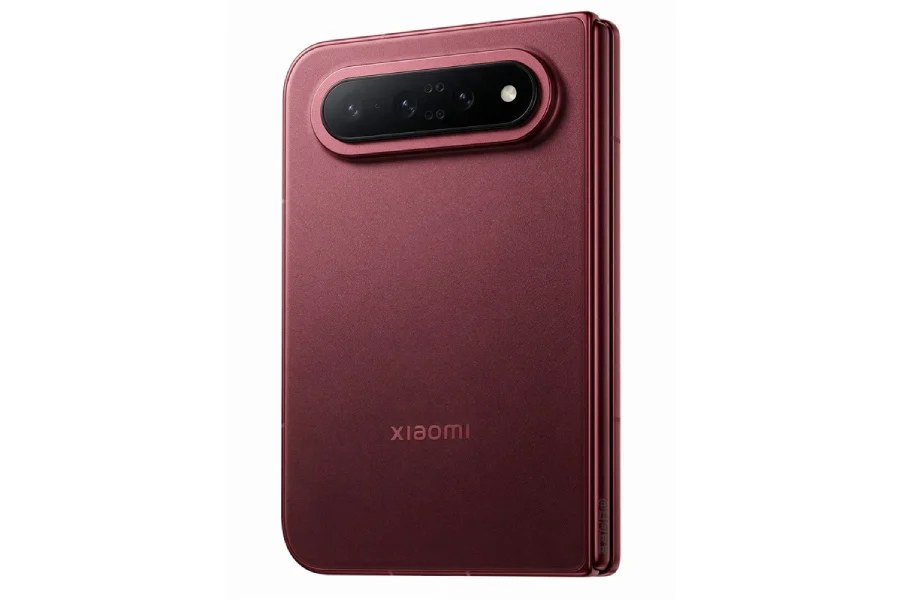
📌 Update of 2 September 2026: Xiaomi is no longer leaving anything to guesswork. The company has released the first official images of the 18 Fold and given its format a name: the “mid-fold”. The launch is set for 7 September, and the phone pairs a 5.38-inch cover display with a 7.58-inch inner panel, with the camera system developed alongside Leica.
The foldable segment is about to cross a decisive technical milestone. While manufacturers compete in ingenuity to refine their hinges and shave millimetres off their devices, Xiaomi is preparing a particularly aggressive September on the large-format foldable market.
Xiaomi has now shown the device itself, with official images and video to back it up, and the Xiaomi 18 Fold has few secrets left. The brand is hardly a newcomer to foldables, but this model marks a historic industrial turning point: it is the very first device to carry the manufacturer’s own processor, the XRING O3.
A 6,000 mAh battery: the large foldable that refuses to compromise on endurance
Battery life has long been the Achilles’ heel of large book-style foldables. Constrained by the space taken up by the hinge and the second display, manufacturers usually fit them with smaller batteries than their own conventional flagships. The Xiaomi 18 Fold would break clearly with that habit.
According to tipster Bald Panda, the phone would carry an energy reserve that puts it at the top of its category:
- A 6,000 mAh capacity: a level no other book-style foldable reaches today, where the Galaxy Z Fold 8 stops at 4,880 mAh and the Huawei Pura X View at 5,300 mAh.
- 67 W wired charging: a figure in keeping with the format, enough to restore the bulk of that reserve without leaving the phone tied to a cable for long.
- 50 W wireless charging: rare at this level on a foldable, it saves you from unfolding the phone to drop it on a pad.
All three figures come from a leak rather than an official announcement: they remain to be confirmed at the September unveiling, since Xiaomi has so far detailed only its platform.
XRING O3: a game-changing in-house chip at the heart of the Xiaomi 18 Fold
Putting home-grown silicon inside a premium foldable is a bold industrial statement. With the XRING O3, Xiaomi intends to prove it can design a complete platform capable of taking on the leaders of the semiconductor industry.
According to the technical figures released by the brand, the processor rests on a resolutely aggressive architecture:
- A 3 nm process: the SoC packs 24 billion transistors into a 133 mm² die (a 26% increase over the XRING O1).
- A 10-core CPU made up entirely of “big cores”: unlike traditional mobile processors, which pair performance cores with low-power cores for light tasks, Xiaomi has chosen to fit its chip exclusively with cores dedicated to raw power.
- Claimed performance: Xiaomi quotes a score of 5.22 million points on AnTuTu — which would make it the first mobile chip to clear the 5 million mark — along with a multi-core result above 15,000 points (+60% versus the previous generation).
- G2-Ultra NX graphics: a first for the brand, promising an 85% jump in graphics performance while cutting power draw by 64%.
- LPDDR6 support and a unified bus: the first mobile chip compatible with LPDDR6 memory, it claims 113.8 GB/s of bandwidth (+48%) and static latency brought down to 82 ns thanks to a unified fusion bus and high-density metal wiring.
For now, these bandwidth and latency figures are laboratory measurements supplied by the manufacturer itself, and they will need to be confirmed by independent testing under real-world conditions.
LPDDR6 from CXMT: the world first is confirmed
The XRING O3’s LPDDR6 compatibility had so far been presented as a feature of the chip. Xiaomi has gone further by publicly naming its supplier, turning a technical promise into an industrial commitment.
Lei Jun announced on Weibo that the Xiaomi 18 Fold would be the world’s first smartphone to ship with CXMT’s LPDDR6 memory, congratulating the Chinese foundry on reaching mass production. The XRING O3, unveiled on 24 August, had been designed specifically to work with the new standard.
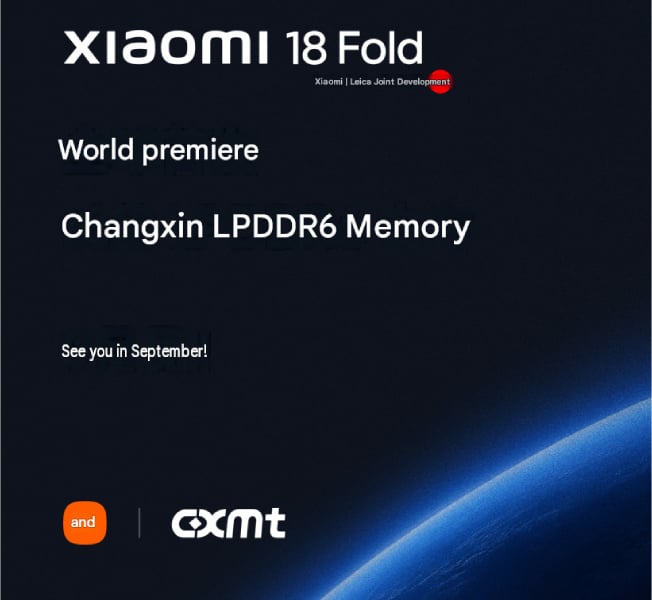
- Transfer speeds of up to 12,800 Mbps: CXMT claims an architectural leap over its LPDDR5X memory, both in internal organisation and in how data is moved.
- Up to 16 GB per chip: that density makes very large amounts of RAM possible without multiplying components inside a chassis already constrained by the hinge.
- A tangible gain in everyday use: faster memory means apps that open more quickly, steadier multitasking and on-device AI tasks handled more efficiently.
These figures come from CXMT’s own semi-annual report and have not yet been measured independently. The win is a notable one for the foundry all the same, as it takes an early lead over Samsung and SK Hynix on the new standard.
The “mid-fold”: the foldable Xiaomi deliberately made smaller
Xiaomi did not wait for its conference to show the phone. The company has put a video and a dedicated page online, and it has taken the opportunity to name the format: the mid-fold.
The reasoning starts from something every owner of a large foldable has noticed. Once the device is closed, the day is spent on the outer screen, and the big panel only comes out in bursts. Compact foldables solve the bulk, but concede almost everything else. Xiaomi is placing its 18 Fold between the two.
It all comes down to two diagonals and a rethought hinge.
The cover display measures 5.38 inches, noticeably smaller than the 6.3 to 6.5 inches that have become the norm on large foldables. The trade is deliberate: by trimming the outer screen, Xiaomi ends up with a folded object the brand compares to a passport, held and used in one hand. The official images leave little room for doubt on that point.
Opened up, the phone frees a 7.58-inch panel in a new aspect ratio that Xiaomi says was designed for multitasking and video — in other words a display less square than the usual book-style foldables, where a film still leaves wide black bars on either side.
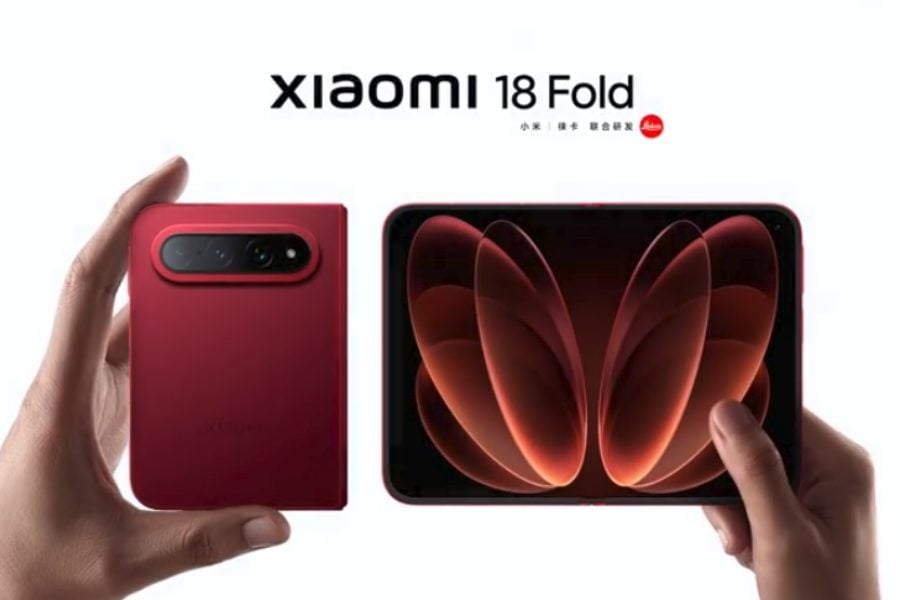
- A “dragon bone” hinge: Xiaomi is announcing an entirely new articulation, along with a simulation-based testing system meant to prove how it holds up over time.
- Leica on camera duty: the official visual carries the joint-development mark between Xiaomi and Leica, as on the brand’s numbered flagships.
- A horizontal camera bar, in red: the optical module runs across the width of the back and gathers three lenses and an LED flash, on a red finish already seen on the Redmi K100 Pro Max.
Lu Weibing, who heads Xiaomi’s smartphone business, does not present this as one more foldable. He describes it as the most advanced flagship in the catalogue, built to compete with the brand’s numbered models — and sees the mid-fold as a direction other manufacturers could well follow.
Two strategies in September: XRING O3 for the Fold, Qualcomm 2 nm for the Pro
The Xiaomi 18 Fold launch falls within an exceptionally busy September for the group. Lei Jun has confirmed a series of major presentations, starting with the Xiaomi SkyNomad family SUV range built on the Kunlun platform — an illustration of how far the brand’s ecosystem now stretches.
The date is now set: 7 September. The Xiaomi 18 Fold will be made official at that event alongside its XRING O3 chip, joined by the Xiaomi Pad 9 Pro Max tablet — also powered by the XRING O3 — as well as the Xiaomi N70 Pro, N70 Max and N90 Max.
This strategy highlights an interesting duality within the catalogue:
- The Xiaomi 18 Fold acts as a technological showcase for the in-house XRING O3, built on a 3 nm process.
- The Xiaomi 18 Pro, for its part, will follow later, at the end of September, with the Qualcomm Snapdragon 8 Elite Gen 6 built on TSMC’s 2 nm process (delivering roughly 30% more transistor density), backed by 100 W wired charging, the 5G N79 band and UWB technology.
The Xiaomi 18 series: a diversified line-up for the autumn
The Xiaomi 18 Fold slots into a complete family of flagship models, each aimed at specific uses:
- The standard Xiaomi 18 will be the compact option in the range with its 7,200 mAh battery, expected in December.
- The Xiaomi 18 Pro Max stands as the multimedia and photography giant with its dual 200 Mpx LOFIC sensors and 8,000 mAh battery.
- Worth remembering: the Xiaomi 18 Ultra has been cancelled for this generation, leaving the traditional photographic halo position to the Pro Max.
Expected specifications of the Xiaomi 18 Fold
| Component / Feature | Confirmed or expected details |
|---|---|
| Processor | Xiaomi XRING O3 (3 nm process, 24 billion transistors) |
| CPU architecture | 10 cores (100% big performance cores) |
| Graphics (GPU) | G2-Ultra NX |
| RAM | LPDDR6 from CXMT — a world first (up to 12,800 Mbps, for 113.8 GB/s of bandwidth on the SoC side) |
| Rear camera module | Horizontal three-sensor bar with LED flash, developed with Leica |
| Design and finishes | “Mid-fold” format, official red finish, “dragon bone” hinge |
| Cover display | 5.38 inches |
| Main display | 7.58-inch foldable panel, new aspect ratio |
| Battery | 6,000 mAh |
| Charging | 67 W wired · 50 W wireless |
| Main camera | 200 MP |
| Security | Side-mounted fingerprint sensor |
| Software | HyperOS 4, based on Android 17, with the on-device MiMo AI model |
| Official launch | 7 September 2026 (China) |
In summary
With the Xiaomi 18 Fold, the manufacturer is not simply refreshing its foldable line-up: it is taking a strategic step towards independence by introducing its own XRING O3 processor architecture. Between a ten-big-core chip with LPDDR6 support and a “mid-fold” format that takes the opposite tack to the big book-style foldables, this model looks set to be one of the major technological attractions as autumn approaches. To that strategic independence is now added a far more concrete argument for buyers: 6,000 mAh inside a foldable chassis, more than anything the competition currently offers in this format.
Everything still missing lands on 7 September — the price, real-world battery life and availability outside China. In the meantime, you can browse our full catalogue of Xiaomi smartphones as well as our refurbished Xiaomi deals. To kit out your current devices, take a look too at our Xiaomi chargers, our Xiaomi cases and our Xiaomi tempered glass screen protectors.

![Xiaomi 18 Pro: The Compact Monster With Two 200 MP Sensors [UPDATE]](https://www.phonedroid.net/blog/wp-content/uploads/2026/09/xiaomi-18-pro-photos-en-main-face-dos.jpg)
![Xiaomi 18 Pro Max: Heading for an Outrageous Spec Sheet [UPDATED]](https://www.phonedroid.net/blog/wp-content/uploads/2025/09/Xiaomi-17-Pro-Max.jpg)
![Oppo Find X10: unveiling on 22 September, dual 200 MP and 8,000 mAh [UPDATED]](https://www.phonedroid.net/blog/wp-content/uploads/2026/09/oppo-find-x10-rendu-officiel-qingcheng.jpg)