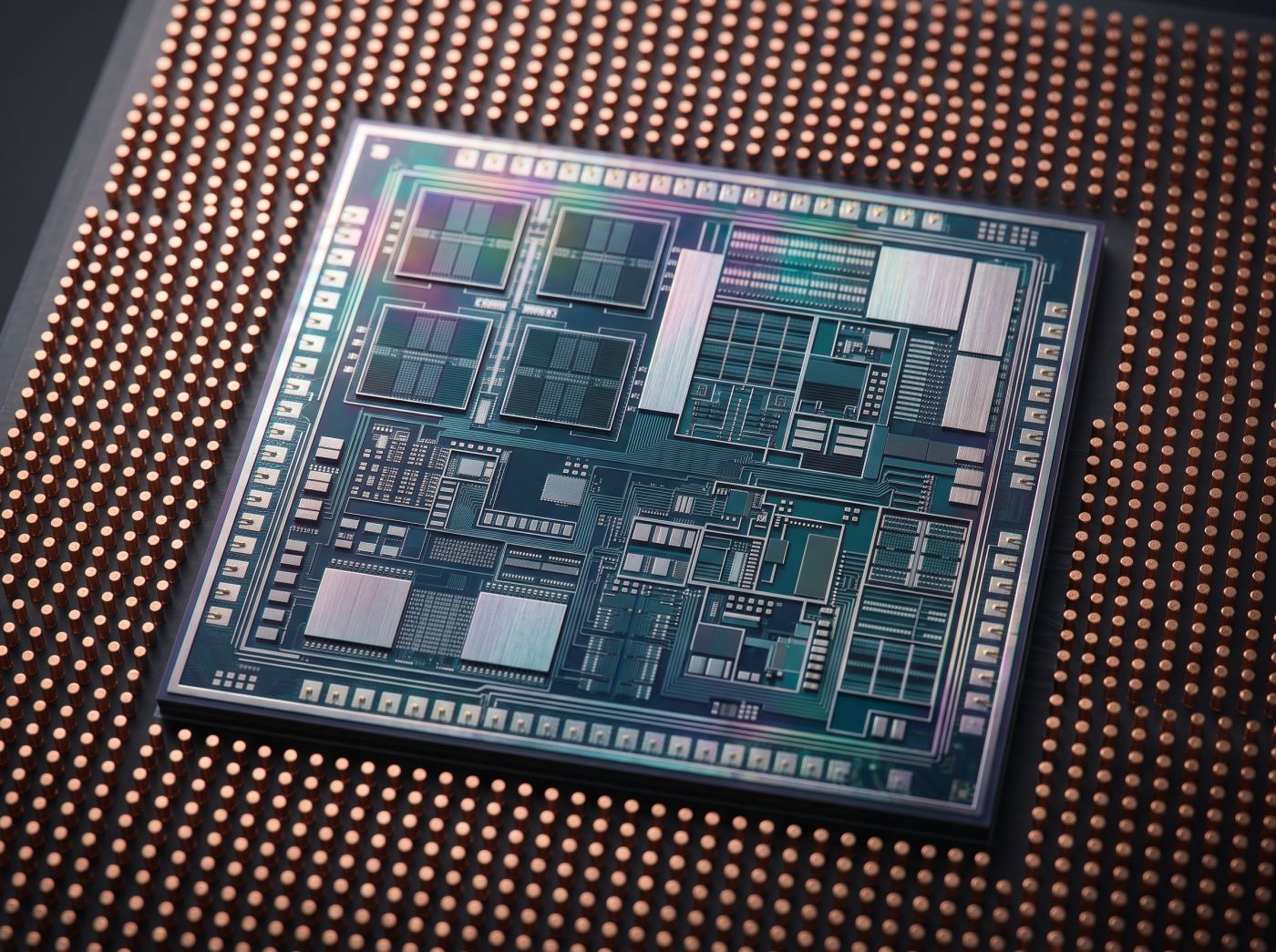
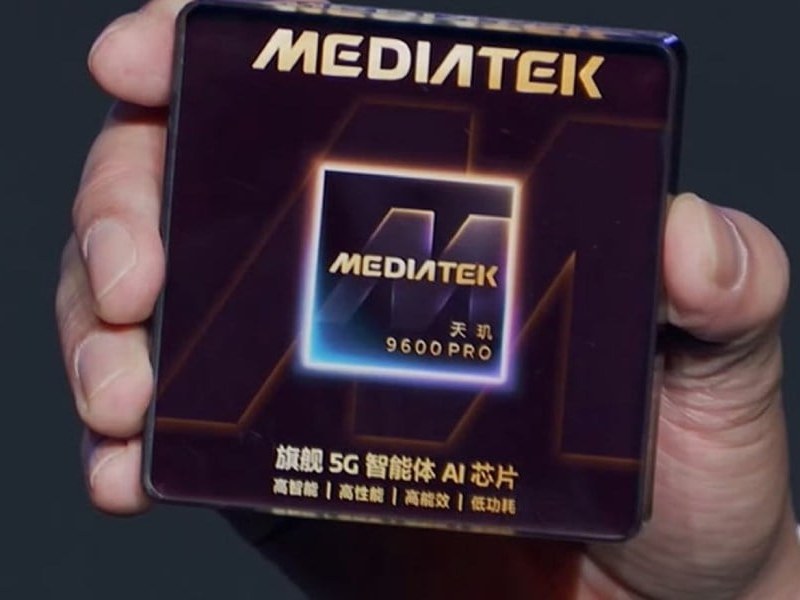
The mobile semiconductor industry crossed a historic line on 15 September. Just as the race towards ever-finer process nodes seemed to be slowing under thermal constraints and foundry costs, MediaTek made its very first chip built on TSMC’s 2 nm process official, with considerable fanfare: the Dimensity 9600 Pro. Packing more than 33 billion transistors onto a single die, this cutting-edge silicon redefines the computing standards for the very top-end smartphones of autumn 2026.
Moving from 3 nm lithography to the 2 nm process alone brings a 14% performance gain and a 23% cut in power consumption at chip level, before the changes to the internal architecture even come into it. With a completely reworked configuration built on ARM C2 cores, pioneering support for LPDDR6 RAM and an AI engine designed to run huge models locally, MediaTek intends to take on its rivals head-on. Here is a full tour of the hardware breakthroughs this powerhouse introduces.
2+3+3 architecture and ARM C2 cores: the era of dual ultra-large cores
For its fourth-generation all-big-core architecture, MediaTek shakes up the traditional layout of flagship processors. Until now, the established formula relied on a single exceptional prime core backed by mid-tier cores. The Dimensity 9600 Pro breaks that rule with an unprecedented 2 + 3 + 3 arrangement:
- 2 ARM C2-Ultra super-large cores clocked at 4.55 GHz: each with 2 MB of dedicated L2 cache to absorb the most intense load peaks.
- 3 ARM C2 Pro big cores clocked at 4.35 GHz: each with 1 MB of L2 cache to sustain a high level of performance.
- 3 ARM C2 Pro cores clocked at 3.10 GHz: each with 512 KB of L2 cache, handling everyday workloads with exemplary efficiency.
The whole set is organised around 16 MB of shared L3 cache, bringing the processor’s total cache to 34.5 MB. That is a 21% increase in L2 cache over the Dimensity 9500. The larger pool keeps heavy instructions right next to the compute units, drastically cutting memory access delays when the processor is under heavy load.
These engineering choices translate into tangible gains: MediaTek announces performance increases of 17% single-core and 15% multi-core over the Dimensity 9500. On Geekbench 6.4, the Dimensity 9600 Pro records 4,276 points single-core and 12,650 points multi-core, confirming the gap with the 3,666 and 11,014 points of the previous generation. On power, the ultra-large cores need 37% less energy, while multi-core power consumption drops by a spectacular 61% at matching peak performance.

A world first: LPDDR6 memory and UFS 5.0 storage support
A flagship chip cannot reach its full potential without a memory subsystem able to move data without bottlenecks. The Dimensity 9600 Pro becomes the first smartphone processor to officially support the LPDDR6 RAM standard and the UFS 5.0 storage protocol.
LPDDR6 delivers 33% higher throughput than LPDDR5X, reducing overall system latency. UFS 5.0, meanwhile, simply doubles sequential read and write speeds compared with dual-channel UFS 4.0 solutions. For the user, this technological leap promises near-instant app launches and immediate processing of the heaviest video and photo streams.
G2-Ultra NX GPU and Imagiq 1290: aiming for 185 fps and 4K at 240 fps
The graphics subsystem welcomes the all-new G2-Ultra NX GPU. According to the manufacturer’s figures, it delivers 27% more peak power than the previous generation, while cutting power consumption by 24% at equal output. Ray tracing performance improves by 18%, allowing frame rates to climb as high as 185 frames per second in optimised competitive titles.
Multimedia processing relies on the Imagiq 1290 image signal processor. This dedicated chip supports slow-motion video recording in 4K at 240 frames per second. It also integrates a hardware decoder for the cutting-edge H.266 video codec, which lowers power consumption by 23% compared with purely software decoding.
Native artificial intelligence: dual NPU and 30-billion-parameter models
The Dimensity 9600 Pro adopts an architecture built entirely around artificial intelligence (AI-native). The silicon integrates a dual neural processing unit (NPU) setup:
- A 10th-generation high-performance NPU 1090: whose prefill phase speeds up by 51% over the previous generation. According to MediaTek’s poster, it also generates 55% more tokens per watt consumed than the Dimensity 9500’s.
- A 2nd-generation low-power NPU: dedicated to always-on background sensing tasks, which cuts its own power consumption by 40%.
Thanks to the Generative AI Engine 3.0, INT4 integer computing power is doubled. That progress makes it possible to run complex mixture-of-experts (MoE) models with up to 30 billion parameters directly on the device, without any reliance on remote cloud servers.
Overall orchestration falls to the Tianji Intelligent Computing Fusion architecture. The system dynamically supervises how workloads are shared between the CPU cores, the NPU and RAM, preventing a generative AI model running in the background from starving everyday apps of resources or sending the power bill soaring.
MediaTek Dimensity 9600 Pro specifications
| Component / Feature | Official specifications |
|---|---|
| Process | TSMC 2 nm (more than 33 billion transistors) |
| CPU architecture | 2+3+3 (all big ARM C2 cores) |
| Super-large cores | 2× ARM C2-Ultra at 4.55 GHz (2 MB L2 cache each) |
| Big cores | 3× ARM C2 Pro at 4.35 GHz (1 MB L2) + 3× ARM C2 Pro at 3.10 GHz (512 KB L2) |
| Total cache | 34.5 MB (including 16 MB of L3 cache) |
| CPU performance | +17% single-core, +15% multi-core vs Dimensity 9500 (Geekbench 6.4: 4,276 / 12,650) |
| Graphics processor | G2-Ultra NX (+27% peak performance, ray tracing +18%, up to 185 fps) |
| Memory & storage | LPDDR6 support (+33% throughput) and UFS 5.0 (doubled sequential speeds) |
| ISP & video | Imagiq 1290, 4K slow motion at 240 fps, H.266 hardware decoding (−23% energy) |
| AI engine (NPU) | Dual NPU (high-power NPU 1090 + low-power NPU, 30B MoE models on-device) |
Dimensity 9600 Pro availability: the first confirmed smartphones
Manufacturers wasted no time confirming they would use this elite component. Right after MediaTek’s event, Vivo and Oppo confirmed that their upcoming camera flagships would adopt the Dimensity 9600 Pro:
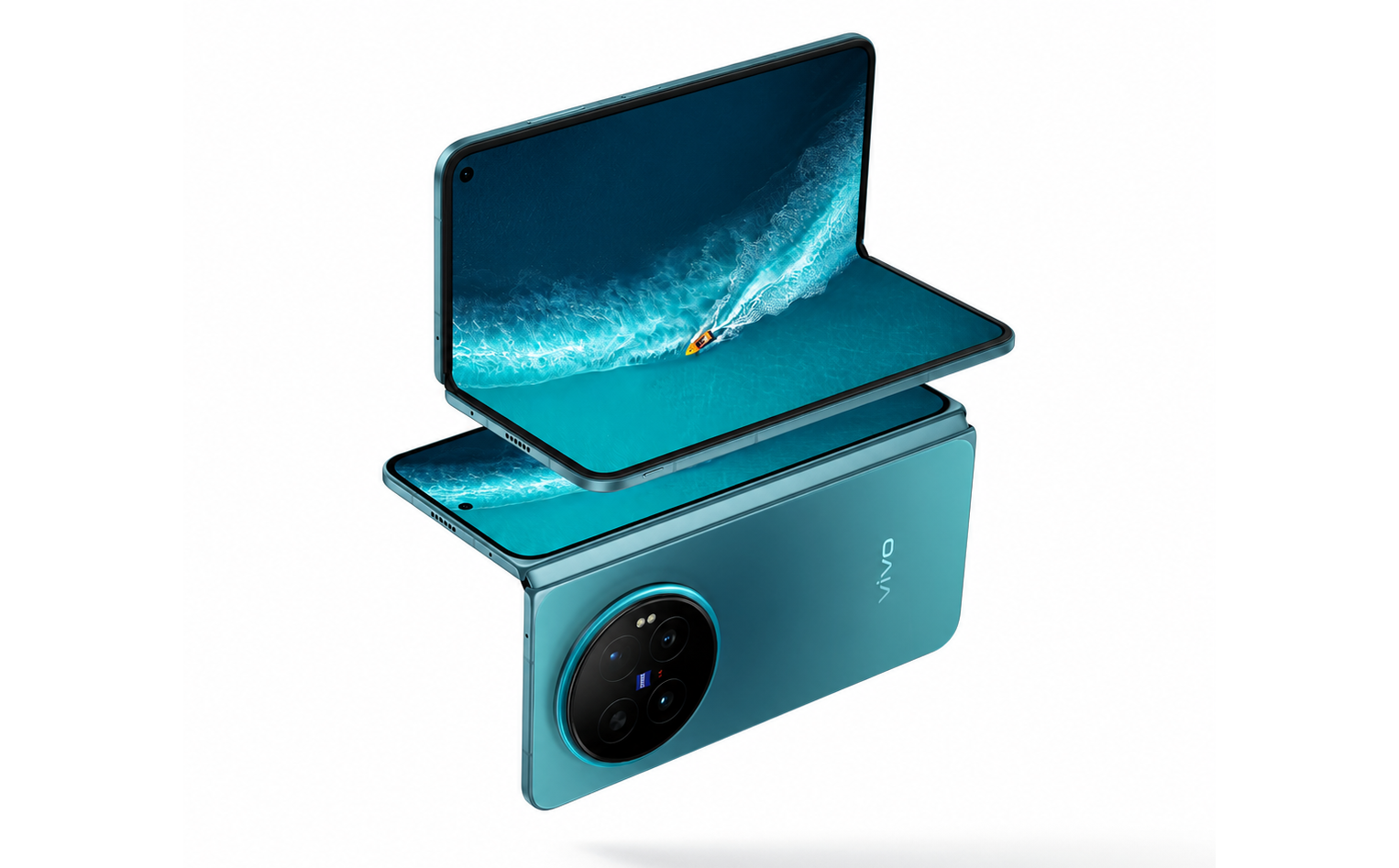
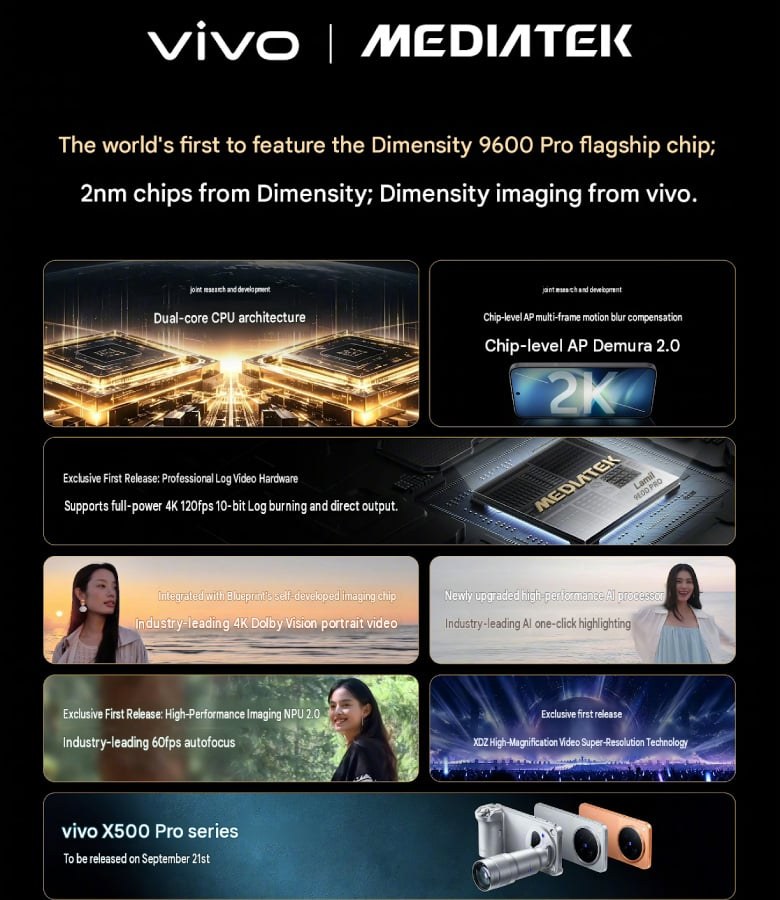
- Vivo X500 Pro and X500 Pro Max (launching 21 September 2026): the brand, which presents the X500 Pro series as the world’s first to carry the chip, has unveiled a joint poster highlighting extensive co-development. The chip integrates AP Demura 2.0 hardware processing to correct luminance irregularities on the 2K screen, along with motion smear compensation for fast subjects. The phone offers professional 10-bit Log recording at 4K 120 fps with direct output and no external recorder. Paired with Vivo’s in-house BluePrint imaging chip, it introduces 4K Dolby Vision portrait video (presented as a world first) and XDZ video super-resolution technology for high magnification.
- Oppo Find X10 Pro Max (launching 22 September 2026): Oppo integrates its new-generation Tide Engine to dynamically shift power between gaming sessions and local AI tasks. The Falcon Scheduler makes it possible to film in 4K at 60 fps for extended periods while promising up to eight hours of continuous gaming at maximum frame rate. The phone also packs an 8,000 mAh Glacier battery (energy density of 867 Wh/L) in spherical silicon-carbon, designed to stay healthy for up to five years.
Conclusion
By introducing TSMC’s 2 nm process, an unprecedented dual C2-Ultra core architecture and LPDDR6 / UFS 5.0 compatibility, the MediaTek Dimensity 9600 Pro sets a major technological milestone. It does not just line up impressive theoretical scores: its concrete optimisations for advanced 4K video and local artificial intelligence promise to elevate the flagships of late 2026. The standard Vivo X500, for its part, will get the Dimensity 9600M, built on 3 nm. While you wait for these first models, browse our Vivo smartphones and our Oppo smartphones.