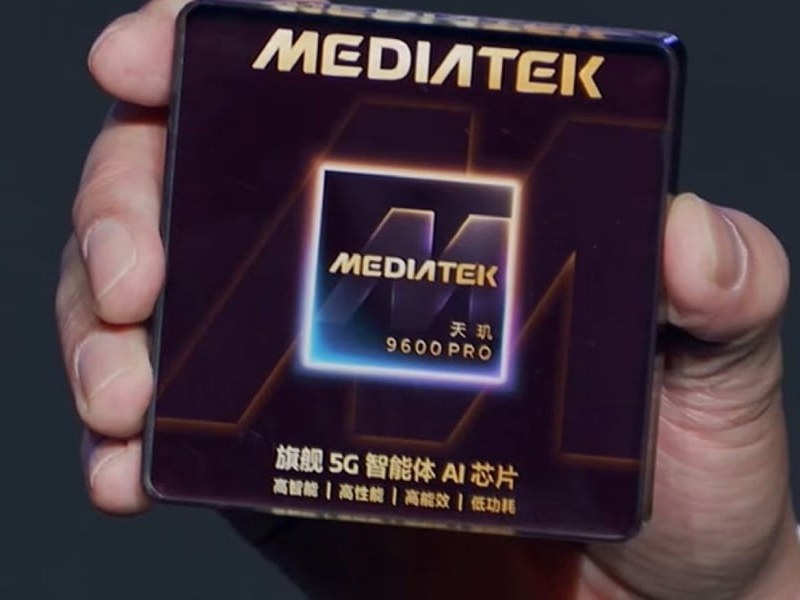
📌 Updated 15 September 2026 — MediaTek has made the Dimensity 9600 Pro official, and Vivo confirms the X500 Pro series will be the world’s first to carry it. The two brands’ joint poster spells out what the chip brings: dedicated hardware for 10-bit Log video at 4K 120 fps, 4K Dolby Vision portrait video achieved with Vivo’s BluePrint chip, processor-level motion blur compensation and XDZ video super-resolution. The standard X500 gets the Dimensity 9600M instead. Launch on 21 September in China.
As part of a complete overhaul of its line-up, Chinese manufacturer Vivo has confirmed it is skipping the “X400” name — a nod to the Asian tetraphobia that associates the number 4 with death — to jump straight to the Vivo X500 family in September. The range is built around three flagship models launched simultaneously (Vivo X500, Vivo X500 Pro and X500 Pro Max) alongside the Vivo X500e, ahead of a Vivo X500 Ultra powered by a Qualcomm chip, expected in the first half of 2027.
At the very top of that hierarchy for 2026 sits the Vivo X500 Pro Max. A genuine technology showcase, this model brings together the manufacturer’s finest work in 2K display, memory architecture and very high-definition photo and video processing.
BOE Q11 display: a 2K panel that draws less power than the previous 1.5K
For years, choosing a 2K resolution on a smartphone meant accepting a harsh trade-off on battery life. That is precisely why most manufacturers settled on 1.5K panels: the extra sharpness simply didn’t justify the additional drain on the battery. With the Vivo X500 Pro Max, the manufacturer turns that equation on its head.
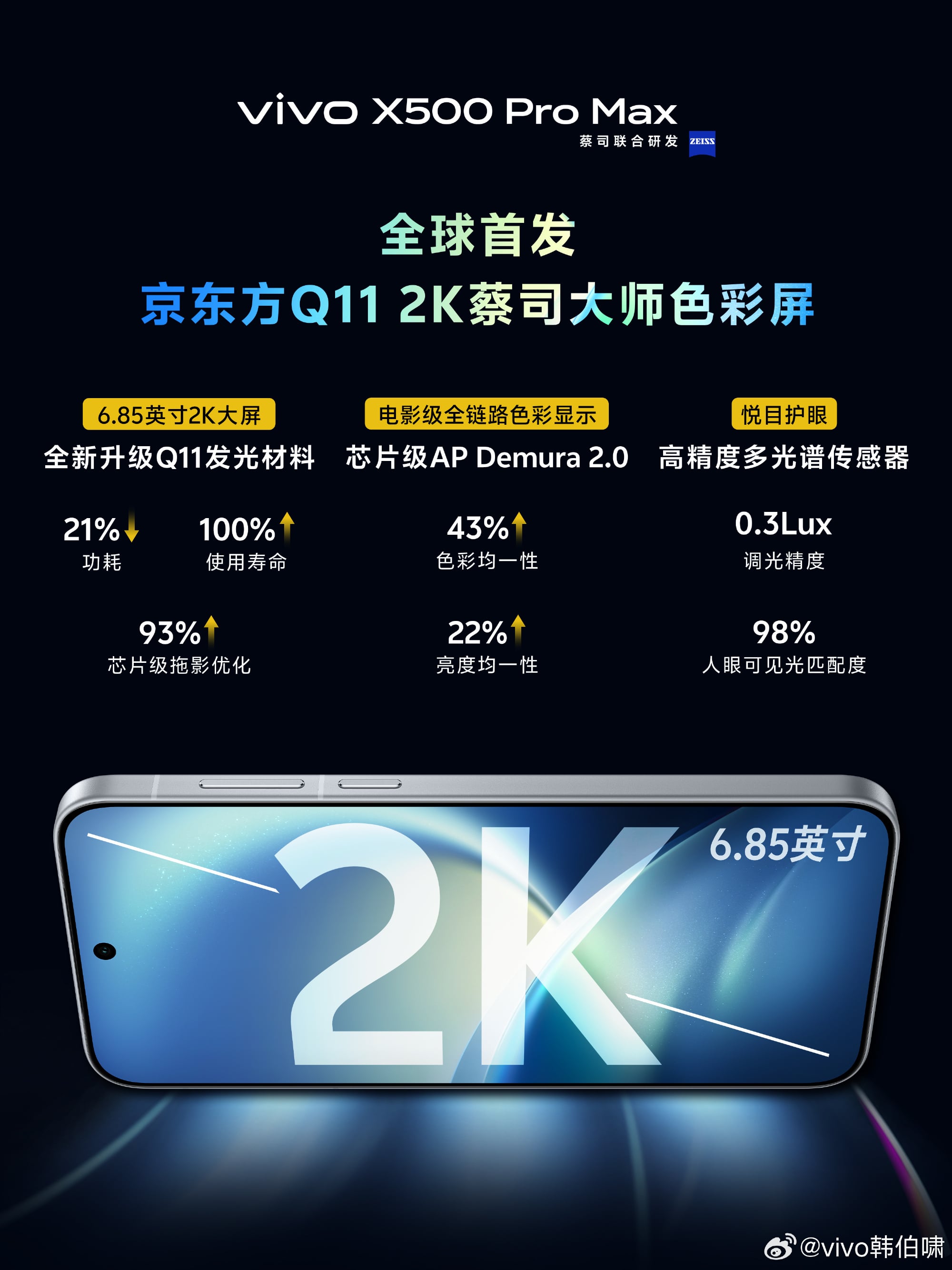
In an official announcement backed by product chief Han Boxiao, Vivo is unveiling the world’s first BOE Q11 panel, sold under the name “Zeiss Master colour display”. According to the figures shared by the brand, this 2K display manages to cut power consumption by 21% compared with the previous generation’s 1.5K panel, while doubling its operational lifespan (+100%).
This efficiency breakthrough makes even more sense when combined with the high-density 8,000 mAh battery housed in the chassis: instead of the 2K display penalising endurance, both advances pull in the same direction for once. That still needs to be verified in real-world use, once the device is in our hands.
The BOE Q11 panel also introduces high-end optical and colorimetric refinements:
- AP Demura 2.0 optimisation at chip level: paired with pixel-by-pixel compensation, this technology reduces image retention and visual smearing by 93%.
- Greater consistency: Vivo claims a 43% improvement in colour uniformity and 22% in brightness uniformity across the entire panel surface.
- Under-display multispectral sensor: calibrated to deliver 98% correspondence with the light spectrum visible to the human eye, it reads both the intensity and the colour temperature of ambient lighting. Enough to adjust brightness in 0.3 lux steps, a level of precision vivo presents as the finest in the Android ecosystem.
Design and large 2.5D display: total immersion in 2K LTPO at 144 Hz
Like the Pro model, the Vivo X500 Pro Max sports an imposing circular camera module centred on the back, setting it visually apart from the standard model, whose optical block sits off-centre in the top-left corner. The phone is dressed in contoured 2.5D glass and opts for a completely flat panel up front.
Until now, that design rested on leaks alone. Vivo made it official on 9 September, twelve days before launch, by publishing the first image of the range. It confirms the circular module and reveals a detail renders never conveyed: the rim of the island rises in a gentle slope from the shell rather than cutting into it. The gradual transition does not reduce the island’s thickness, but it softens it to the eye.
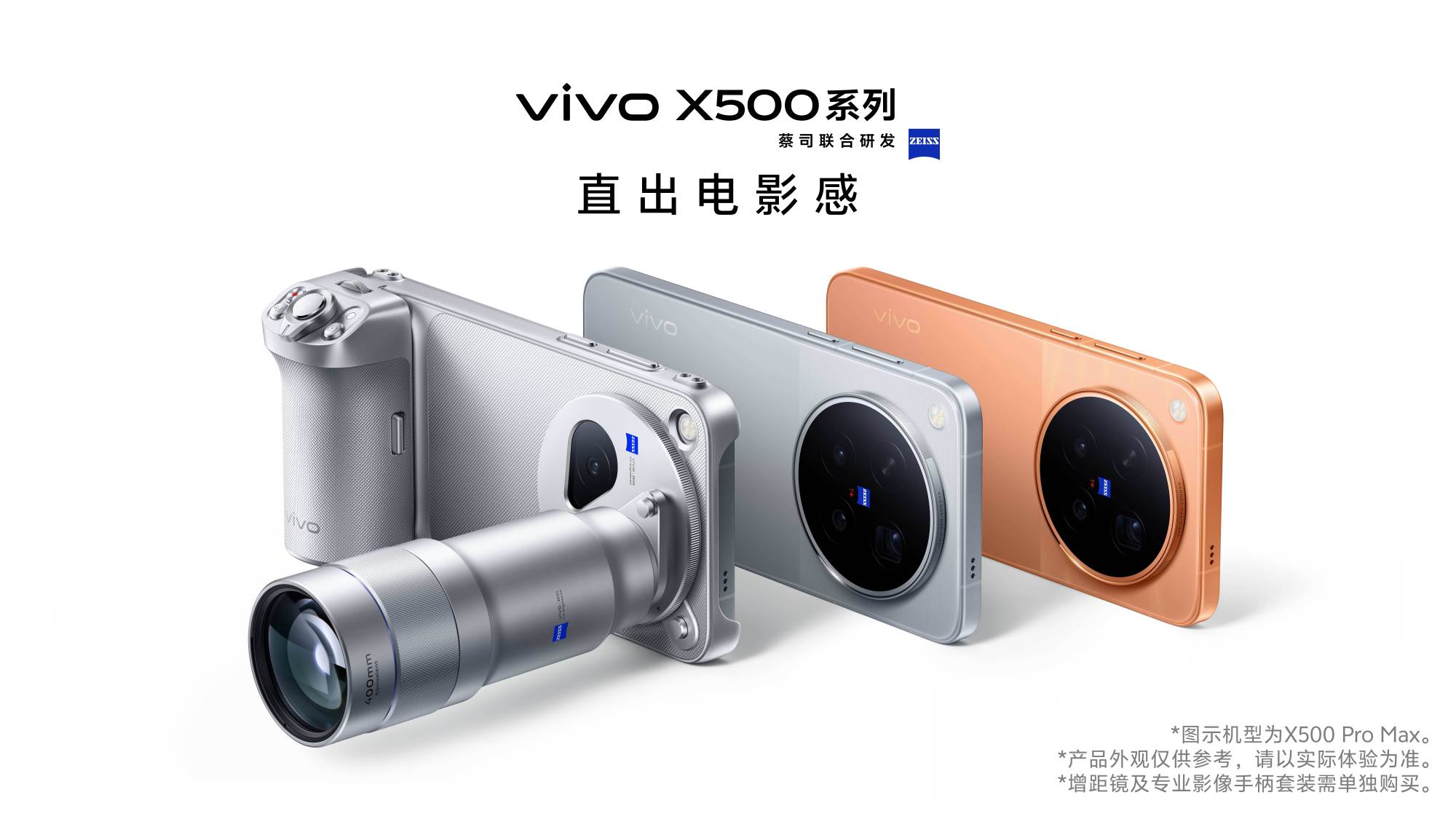
On 10 September, Vivo followed that poster with the full set of official renders, and the range of finishes is now known: grey, white, orange and black. The grey is a speckled silver-grey, the white leans pearly, and the coppery orange remains the presentation colour.
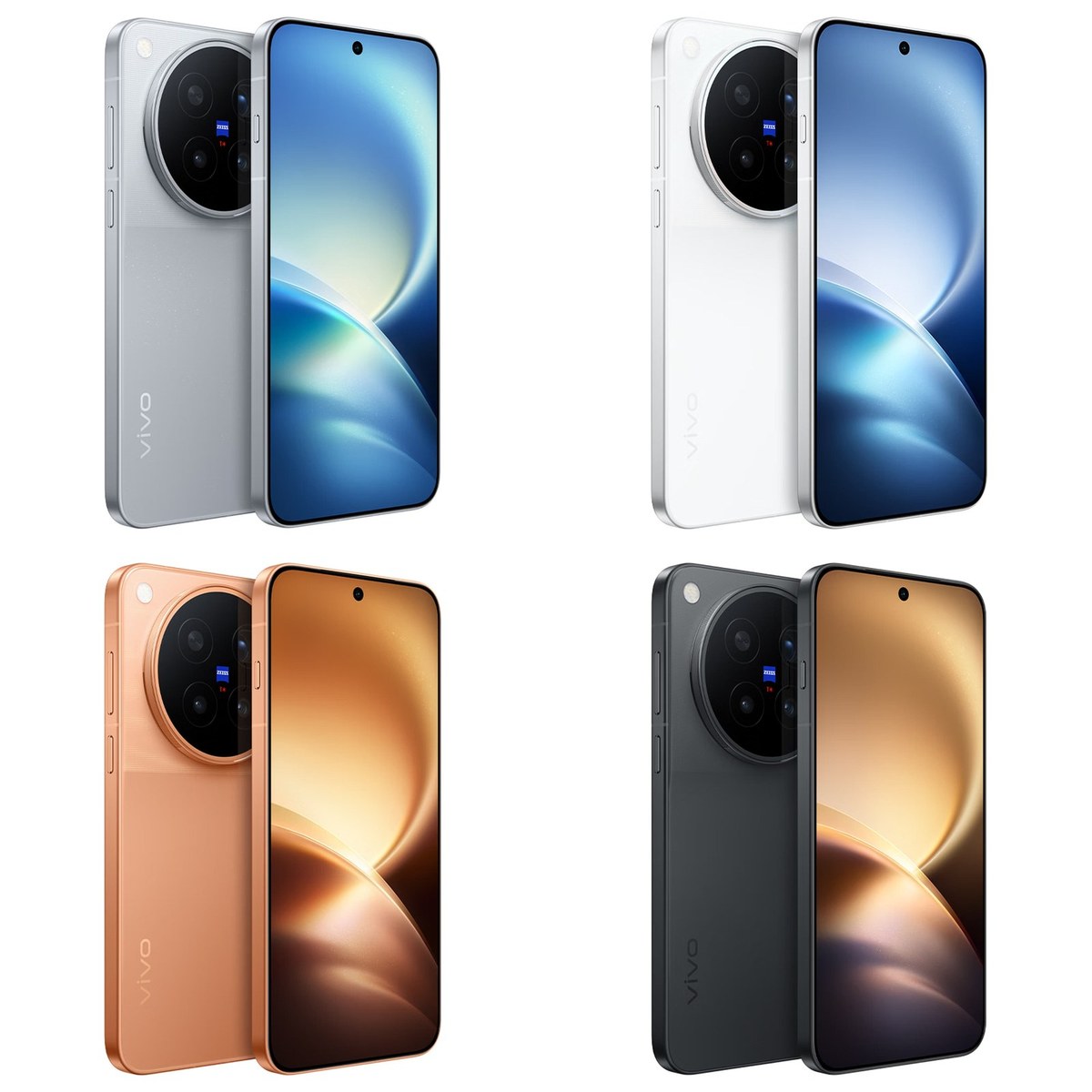
These renders matter above all for two details the announcement mentions nowhere, and which hold across all four colours:
- One more button on the left edge. The X500 Pro has none: its left edge is bare. Vivo has not said what it does, but a dedicated button on a device sold alongside a photography grip and an extender leaves little room for doubt.
- An “APO” engraving on the upper-left lens. Apochromatic optics bring the three primary colours onto the same focal plane. In plain terms, they remove the coloured fringing that edges high-contrast outlines — a branch against a white sky — and that is exactly where a long telephoto usually gives itself away.
Above all, the image stages the 400 mm extender mounted on a professional photography grip, which gives the phone the look and the handling of a dedicated camera. A note at the foot of the poster warns that both accessories are sold separately.
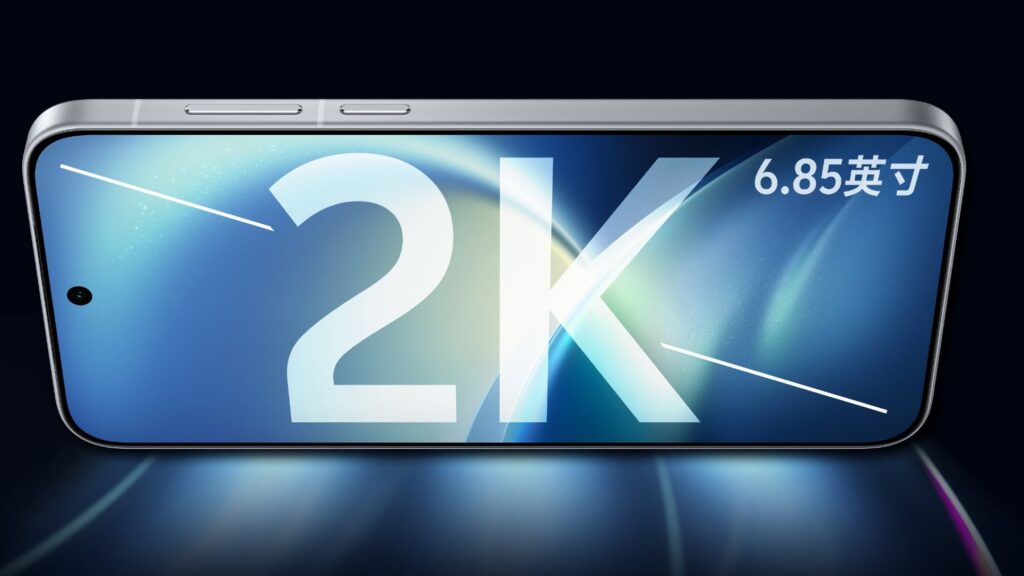
Display duties fall to this large 6.85-inch OLED panel. It offers a native 2K resolution of 3,200 × 1,440 pixels, delivering surgical precision for watching multimedia content and editing photos. Thanks to LIPO encapsulation technology (Low-Injection Pressure Overmolding), the chassis features ultra-thin symmetrical bezels on all four sides, along with softened corners for comfortable handling.
The screen features an adaptive LTPO refresh rate from 1 to 144 Hz. The system dynamically modulates the display speed: it climbs to 144 Hz during gaming or fast scrolling for optimal responsiveness, and drops to 1 Hz as soon as the content becomes static, cutting overall consumption accordingly.
3C certification: what the official document actually confirms
The Vivo X500 Pro Max has passed through China’s 3C body under the reference V2602DA. This kind of filing is a regulatory formality: it doesn’t tell the phone’s story, but whatever it declares has been verified. Three points stand out:
- 90 W wired charging — an officially validated feature of the model.
- BeiDou satellite communication, which allows an emergency message to be sent well outside any network coverage.
- Support for the n79 band, a 5G frequency widely used in China.
The same filing round saw two other devices from the group go through, under the references V2606A and V2609A — in all likelihood the iQOO 16 and the Vivo X500 Pro. The entire range is therefore moving forward at the same pace ahead of an imminent launch.
Dimensity 9600 Pro on Geekbench: an unprecedented dual prime-core architecture
The internal architecture of the Vivo X500 Pro Max has started giving up its technical details. A development unit of the device (referenced V2610) has been spotted on the Geekbench testing platform with a MediaTek chip under the code MT6995(ENG), corresponding to the Dimensity 9600 Pro processor built on TSMC’s 2 nm node, which MediaTek made official on 15 September.
The listing data reveals an unprecedented 2 + 3 + 3 CPU configuration:
- 2 “Canyon” prime cores clocked up to 4.55 GHz: MediaTek confirms these are its new Arm C2-Ultra cores, each with 2 MB of L2 cache, marking a historic first for MediaTek, which is fitting two ultra-wide cores into a high-end mobile chip instead of just one.
- 3 mid-tier “Gelas-B” cores clocked at 4.35 GHz: Arm C2 Pro cores with 1 MB of L2 cache.
- 3 efficiency “Gelas” cores clocked at 3.10 GHz : MediaTek’s official spec sheet lists them as C2 Pro cores too, with 512 KB of L2 cache, rather than the Dimensity 9500’s C1-Pro cores Digital Chat Station had suggested.
- Graphics subsystem: Mali-G2-Ultra-NX MC12 GPU for high-fidelity 3D rendering.
On that first listing, the prime cores were running at a capped frequency of 2.8 GHz rather than their full 4.55 GHz potential. That is why we did not relay the raw scores from that run: they said nothing about real performance. The prototype also carried 12 GB of RAM.
That caveat no longer applies. On 5 September, six fresh runs were filed under the reference V2602DA, this time at a base frequency of 3.10 GHz. The results:
- Single-core: 3,058 to 4,137 points, with only two runs clearing the 4,000 mark.
- Multi-core: 10,923 to 13,086 points, with a single run crossing 13,000.
The gap between the weakest and the best result reaches 35 % single-core, which says a good deal about how far along the firmware is. Keeping only the best run would paint a flattering but misleading picture of the phone; the range is the honest figure. On 15 September MediaTek gave its own reference figures, measured in the lab on Geekbench 6.4: 4,276 points single-core and 12,650 multi-core, 17% and 15% ahead of the Dimensity 9500.
These runs also bring an unexpected point of comparison. The Oppo Find X10 Pro Max went through Geekbench on the same day with exactly the same chip — same MT6995, same clocks, same GPU — for 3,691 and 11,093 points. The Vivo is therefore 12 % and 18 % ahead on its best runs. At this stage the gap speaks of firmware maturity and thermal tuning rather than available power: both phones have identical silicon.
A word, finally, on the model numbers, which have become clearer. V2602A is the Chinese edition, V2602DA its satellite communication variant, and V2610 the global version — the one that concerns us. The Chinese edition and the global version share the same Dimensity 9600 Pro: no downgraded chip for export.
In mass production, this SoC will be paired with the LPDDR6 RAM standard — with Vivo among the first in the world to adopt it — and will run OriginOS 7 based on Android 17.
Vivo and MediaTek: what the chip brings to video
On 15 September MediaTek officially presented its chip, and Vivo followed straight away with a joint poster announcing the X500 Pro series as the world’s first to carry it. The lead will be short-lived, since the phones launch on 21 September, but the poster sheds light on the groundwork the two companies did together:

- Chip-level AP Demura 2.0 correction: already announced for the 2K panel, it is now presented as joint development. The processor itself evens out brightness differences from one point of the screen to another.
- Multi-frame motion blur compensation: also handled by the chip, it targets fast subjects — a running child or an animal — exactly where the image usually smears as the shutter fires.
- Dedicated Log video hardware: recording in 10-bit Log at 4K 120 fps is handled directly by the chip, with direct output from the phone and no external recorder.
- 4K Dolby Vision portrait video: achieved by pairing the Dimensity 9600 Pro with Vivo’s own BluePrint imaging chip, and billed as an industry first.
- Imaging NPU 2.0: the poster credits it with 60 fps tracking autofocus, while the revised AI processor adds a one-tap highlighting feature.
- XDZ: a new video super-resolution technology designed for high magnification, where detail usually collapses as you zoom while filming.
Taken together, these additions show where Vivo has put the effort: into video far more than raw power, which the chip delivers anyway. That fits a phone already claiming 10-bit 4:2:2 encoding and the ACES system, and sold alongside a photography grip.
The standard X500 does not share this chip: it gets the Dimensity 9600M, made official by MediaTek the same day, whose spec sheet mirrors the Dimensity 9500’s.
Photo and video: Zeiss Ultra Dynamic sensor, 3° stabilisation and a 200 MP telephoto with 400 mm extender
Photography and video form the heart of the Vivo X500 Pro Max’s breakthrough, with the brand claiming a determined push towards cinematic video:
- 50 MP Zeiss Super Dynamic main sensor, marketed as the “Zeiss Ultra Dynamic Main Camera” (1/1.28-inch) with LOFIC technology: co-developed with Sony under the BluePrint Guangyu 900 label (based on the Sony LYT-838 sensor), this module delivers up to 17 EV of dynamic range. The LOFIC structure (Lateral Overflow Integration Capacitor) absorbs excess light charge in high-contrast scenes, eliminating blown-out areas in both photo and video.
- 200 MP Zeiss APO periscope telephoto (Samsung HP0 / BluePrint sensor, 85 mm): made official by Han Boxiao on Weibo, this module includes CIPA 7.0 technology and supports an official 400 mm extender identical to the X300 Ultra’s. This transfer of high-end optics makes it possible to isolate extremely distant subjects without any loss of sharpness.
- 50 MP ultra-wide (Sony IMX8 series).
- 50 MP front camera with autofocus for sharp shots at any distance.
Doubled 3° optical stabilisation and cinema frame rates
On the video stability front, the manufacturer is introducing a major advance explained by Han Boxiao: whereas in photography you can simply fire off multiple shots until one comes out sharp, a single shaky second in video is enough to ruin an entire sequence.
To solve that challenge, the Vivo X500 Pro Max deploys 3° optical stabilisation (CIPA 7.0 standard) on its main sensor, which is double the compensation range of the previous model. This technology, previously confined to the telephoto lens of the Ultra range, moves directly onto the main sensor. By mechanically stabilising the optics across such a wide amplitude, the phone can lengthen the shutter time without motion blur, capturing far more light in night-time shots.
The device confirms its high-end recording capabilities:
- 4K at 120 frames per second in HDR with direct HDR output.
- 4K slow motion at 240 frames per second to break down ultra-fast action.
- Super Capture Engine with burst shooting up to 30× and hardware lossless ISZ 4× zoom across two successive steps, ideal for concerts, sporting events and fast-moving wildlife.
Professional video: 10-bit Log, ACES and 8K Live
This is the area Vivo detailed most on 9 September, and the one that separates the range most clearly from the previous generation. The phone records in 10-bit with 4:2:2 sampling, twice the colour information of standard 4:2:0. On footage watched as shot, the difference is slight; the moment you grade the sequence afterwards, it decides what holds together and what falls apart.
The device also carries dedicated Log recording hardware, allowing it to shoot 4K at 120 frames per second in 10-bit Log. Log deliberately produces a flat, desaturated image on screen: that is not a flaw but a reserve of material, held in the highlights and the shadows to be worked on in the edit.
Vivo also announces support for the ACES system, the reference colour encoding used in cinema post-production pipelines, along with native 8K Live output and 8K live streaming on supported platforms. These features are not aimed at a general audience, but they explain the direction the brand claims: making the X500 a shooting tool as much as a phone.
8,000 mAh battery and 90 W charging: the speed is now confirmed
Taking advantage of the internal volume offered by its large 6.85-inch chassis, the Vivo X500 Pro Max packs a substantial silicon-carbon battery with a capacity in the region of 8,000 mAh. Combined with the frugality of the 2 nm process, the BOE Q11 panel and LPDDR6 memory, it comfortably delivers two to three days of continuous use.
On the charging side, the 3C certification officially confirms 90 W wired power, backed by 40 to 50 W fast wireless charging.
The spec sheet also includes an ultrasonic under-display fingerprint sensor and dual IP68 and IP69 water-resistance certification.
Vivo X500 Pro Max price: what to expect
Vivo has not communicated any official pricing ahead of the presentation. For reference, at the previous generation’s launch, the Vivo X300 Pro started at 5,299 yuan (around €685) in 12 GB + 256 GB, and topped out at 6,699 yuan (around €865) in 16 GB + 1 TB, while the satellite option required a version priced at 8,299 yuan (around €1,070).
Including BeiDou satellite connectivity as standard on the certified X500 Pro Max points to a clear hardware upgrade. Given the 2K BOE Q11 panel, LPDDR6 RAM, the 2 nm chip with two ultra-wide prime cores and the 200 MP telephoto with 400 mm extender, the final price will sit firmly in the ultra-premium segment.
Official launch and global variant
The date is now settled: the event takes place on 21 September at 7 pm in China, and the X500 series will not be alone there — Vivo will also show the Vivo Watch 6 and the Vivo Buds Clip earbuds. The rollout outside China is expected in November.
The unveiling of the Vivo X500 Pro Max is confirmed for September 2026 in China by Han Boxiao, and the calendar has firmed up. Vivo will first present its OriginOS 7 interface on 16 September, then the X500 series about a week later. The X500 Pro Max will be joined by the standard X500 and the X500 Pro.
The Global Version is making administrative progress: model V2610 has already been approved on Indonesia’s TKDN platform, then, on 13 September, in Malaysia’s SIRIM database, where the X500 (V2619) and the X500 Pro (V2621) joined it — confirming a swift international rollout after the Chinese launch.
Vivo X500 Pro Max specifications
| Component | Specifications |
|---|---|
| Display | Flat 2.5D, 6.85 inches, BOE Q11 OLED 2K (3,200 × 1,440 px), “Zeiss Master” |
| Display technologies | LTPO 1-144 Hz, LIPO, AP Demura 2.0 (−93% image retention), doubled lifespan (+100%) |
| Efficiency & display sensors | Consumption −21% vs 1.5K, under-display multispectral sensor (0.3 lux precision) |
| Processor | MediaTek Dimensity 9600 Pro (2 nm TSMC, code MT6995), made official on 15 September |
| Geekbench | 3,058 to 4,137 single-core · 10,923 to 13,086 multi-core (six runs, non-final firmware) |
| CPU architecture | 2 C2-Ultra cores (4.55 GHz) + 3 C2 Pro cores (4.35 GHz) + 3 C2 Pro cores (3.10 GHz) |
| Graphics chip (GPU) | Mali-G2-Ultra-NX MC12 |
| RAM | LPDDR6 (world first) |
| Operating system | OriginOS 7 (Android 17) |
| Main camera | 50 MP Zeiss Ultra Dynamic / BluePrint Guangyu 900 (1/1.28″, LOFIC, 17 EV) |
| Telephoto | 200 MP Zeiss APO periscope, Samsung HP0 BluePrint (85 mm, Ultra’s 400 mm extender) |
| Ultra-wide | 50 MP (Sony IMX8 series) |
| Front camera | 50 MP with autofocus |
| Photo & video features | 4K 120 fps HDR, 4K 240 fps slow motion, 10-bit Log at 4K 120 fps, 10-bit 4:2:2, ACES, 8K Live, 3° OIS CIPA 7.0 (doubled range), 30× burst, ISZ 4× zoom, 4K Dolby Vision portrait video, XDZ video super-resolution |
| Battery | Around 8,000 mAh (silicon-carbon cell) |
| Charging | 90 W wired (3C certified), 40 to 50 W wireless |
| Network | n79 band and BeiDou satellite (3C certified) |
| Security & water resistance | Ultrasonic under-display fingerprint sensor, IP68 and IP69 |
| Rear design | Centred circular camera module |
| References | V2602DA (China) · V2610 (global: Geekbench, TKDN, SIRIM) |
| Official release | 21 September 2026 at 7 pm (China, confirmed by Vivo) |
Vivo X500 Pro or Vivo X500 Pro Max: which one to choose?
To help you decide between the two flagships arriving this September:
- Size and display: the X500 Pro targets fans of more manageable formats with its 6.37-inch 1.5K panel, while the Pro Max offers a full 6.85-inch multimedia canvas in 2K BOE Q11 that is remarkably frugal with power.
- Periscope and optics: the Pro model carries an ultra-responsive 64 MP Zeiss APO telephoto (85 mm) for portraits, while the Pro Max packs the 200 MP HP0 telephoto with the Ultra’s 400 mm extender to capture distant subjects in motion.
- Video and stabilisation: the Pro Max has extended 3° optical stabilisation (doubled range) with 4K 120 fps HDR recording and 4K 240 fps slow motion, against 4K 60 fps HDR and 4K 120 fps slow motion on the Pro.
- Memory and battery life: LPDDR6 and a battery of around 8,000 mAh on the Pro Max, against 6,500 to 7,000 mAh on the Pro model.
To discover the compact model’s specifications, read our dedicated article on the Vivo X500 Pro.
In summary
Officially confirmed for September 2026 in China, the Vivo X500 Pro Max pushes back the boundaries of high-end mobile phones. By combining a 2K BOE Q11 panel that draws less power than the old 1.5K, the muscle of a 2 nm chip with two prime cores, a 200 MP telephoto with the Ultra’s 400 mm extender, 3° stabilisation and an 8,000 mAh battery with certified 90 W charging, Vivo is delivering a complete technical showcase for demanding creators.
You’ll be able to find all these new releases in our shop as soon as they become globally available. In the meantime, browse our selection of Vivo smartphones, along with our protective accessories including our Vivo cases and our Vivo tempered glass screen protectors.

![Vivo X500 Pro: 6.37-inch 144 Hz display, Dimensity 9600 Pro and the 7,000 mAh challenge [UPDATED]](https://www.phonedroid.net/blog/wp-content/uploads/2025/10/Vivo-X300-Pro-noir.jpg)
![iQOO 16: 2K 165 Hz display, Snapdragon 8 Elite Gen 6 Pro and an 8,400 mAh battery [UPDATED]](https://www.phonedroid.net/blog/wp-content/uploads/2026/09/iqoo-16-rendu-fuite-noir.jpg)
![Vivo X500: Sony LYTIA-828 sensor made official, flat 6.59-inch 144Hz display [UPDATED]](https://www.phonedroid.net/blog/wp-content/uploads/2026/09/vivo-x500-affiche-officielle-capteurs-zeiss.jpg)
![Xiaomi 18 Pro: The Compact Monster With Two 200 MP Sensors [UPDATE]](https://www.phonedroid.net/blog/wp-content/uploads/2026/09/xiaomi-18-pro-photos-en-main-face-dos.jpg)
![Oppo Find X10: unveiling on 22 September, dual 200 MP and 8,000 mAh [UPDATED]](https://www.phonedroid.net/blog/wp-content/uploads/2026/09/oppo-find-x10-rendu-officiel-qingcheng.jpg)