
📌 Updated 15 September 2026 — MediaTek has made the X500’s Dimensity 9600M official, and its spec sheet confirms what the hands-on photo hinted at: the same 3 nm process, the same 4.21 GHz processor and the same Mali-G1 Ultra graphics as the Dimensity 9500. What is new sits in software — a third-generation scheduler, gaming up to 185 fps, Gemini Nano 4 support — while the X500 Pro and Pro Max get the Dimensity 9600 Pro, made official the same day. Launch on 21 September in China.
While Vivo continues the international rollout of its previous line-ups, the industry’s attention has already shifted to China, where the brand is preparing its next generation of flagships. The manufacturer’s strategic choices are coming into sharper focus, confirming a decisive move towards flat displays and a complete overhaul of the naming scheme.
A generation skipped: goodbye X400, hello X500
The first significant change concerns the very name of this future smartphone family. Vivo is skipping the “X400” designation altogether and jumping straight to the Vivo X500 badge.
The marketing decision draws on a deeply rooted tradition in several Asian countries: tetraphobia. The number 4 is phonetically close to the word for “death”, which regularly pushes tech brands to avoid that numbering for their flagship products.
A distinct design for the standard model
Here lies one of the biggest revelations from this new leak: for the first time, Vivo will introduce a clear visual split between the standard model and its Pro variants.
- Vivo X500 Pro and Pro Max: will sport a large circular camera module centred on the back panel.
- Standard Vivo X500: takes a different approach with a substantial circular camera module placed in the upper-left corner.
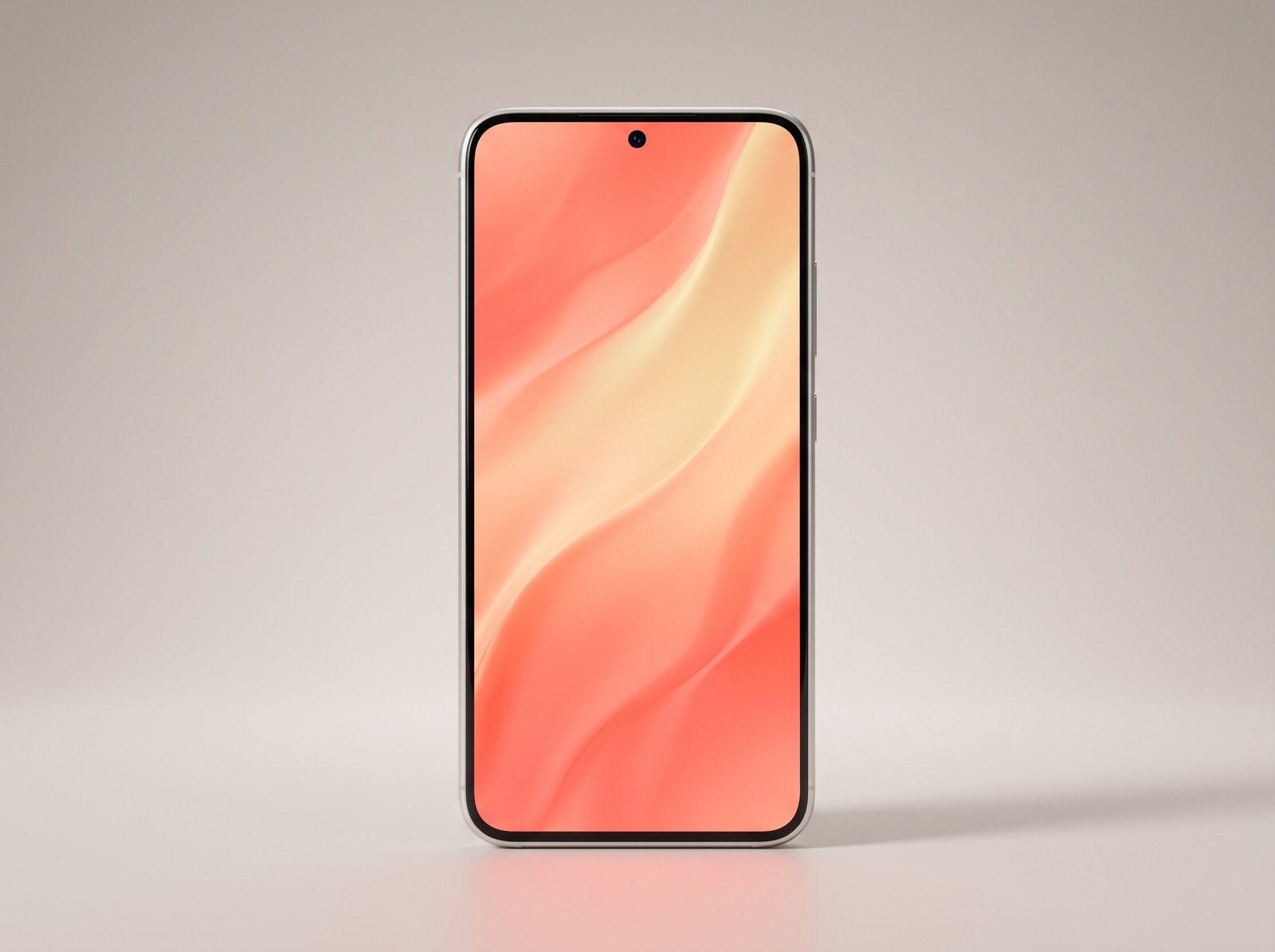
Up front, the entire range goes for completely flat panels, dropping curved edges. Ultra-thin symmetrical bezels and slightly rounder corners should deliver optimised viewing comfort and handling.
On 10 September, Vivo put an end to the guesswork by publishing official renders of all three models. On the X500, the leak was right, and the image adds a detail no description carried: the circular island does not sit directly on the back, it rests on a slightly raised rounded square plate. The lineage is obvious — this is the grammar of the 2022 Vivo X90, revisited.
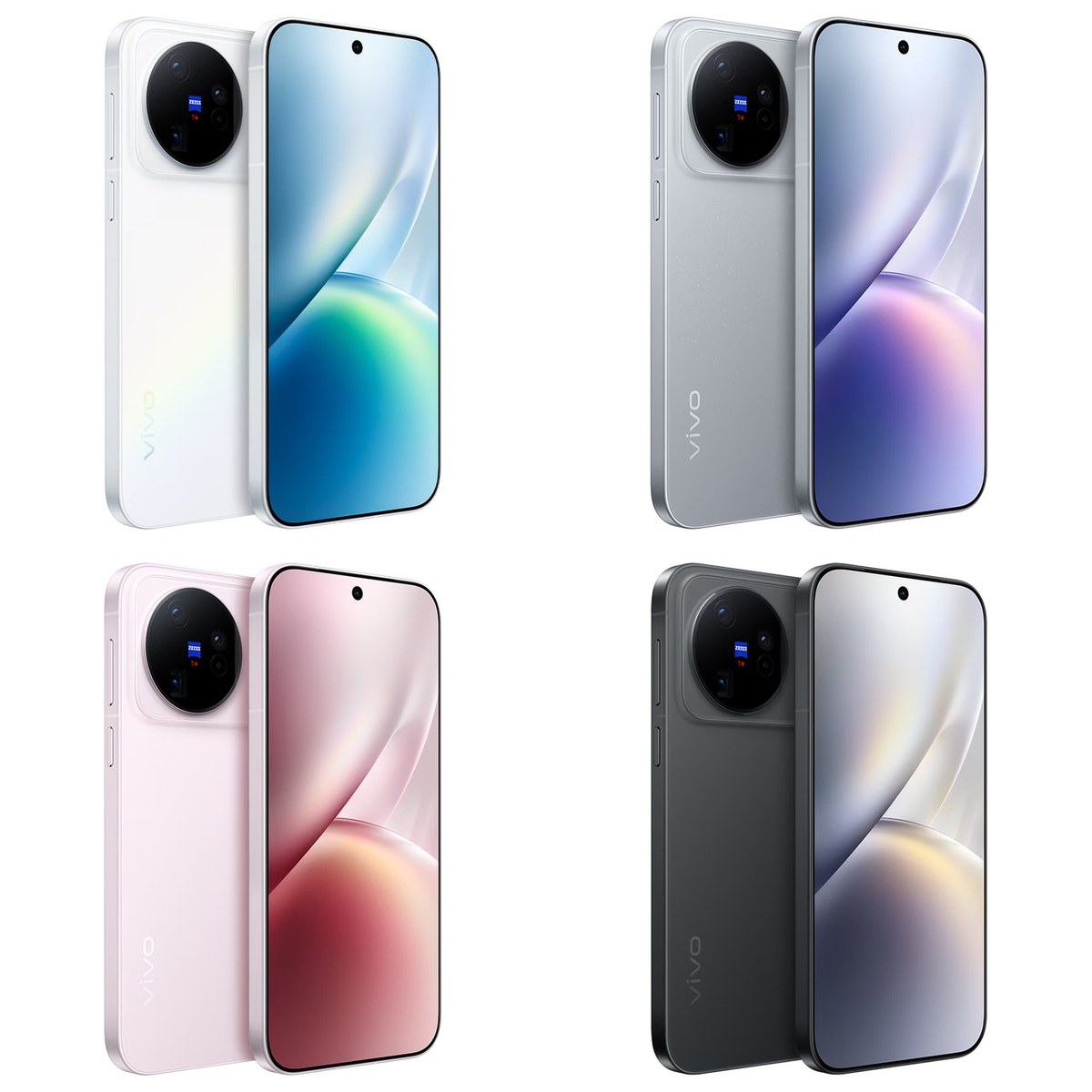
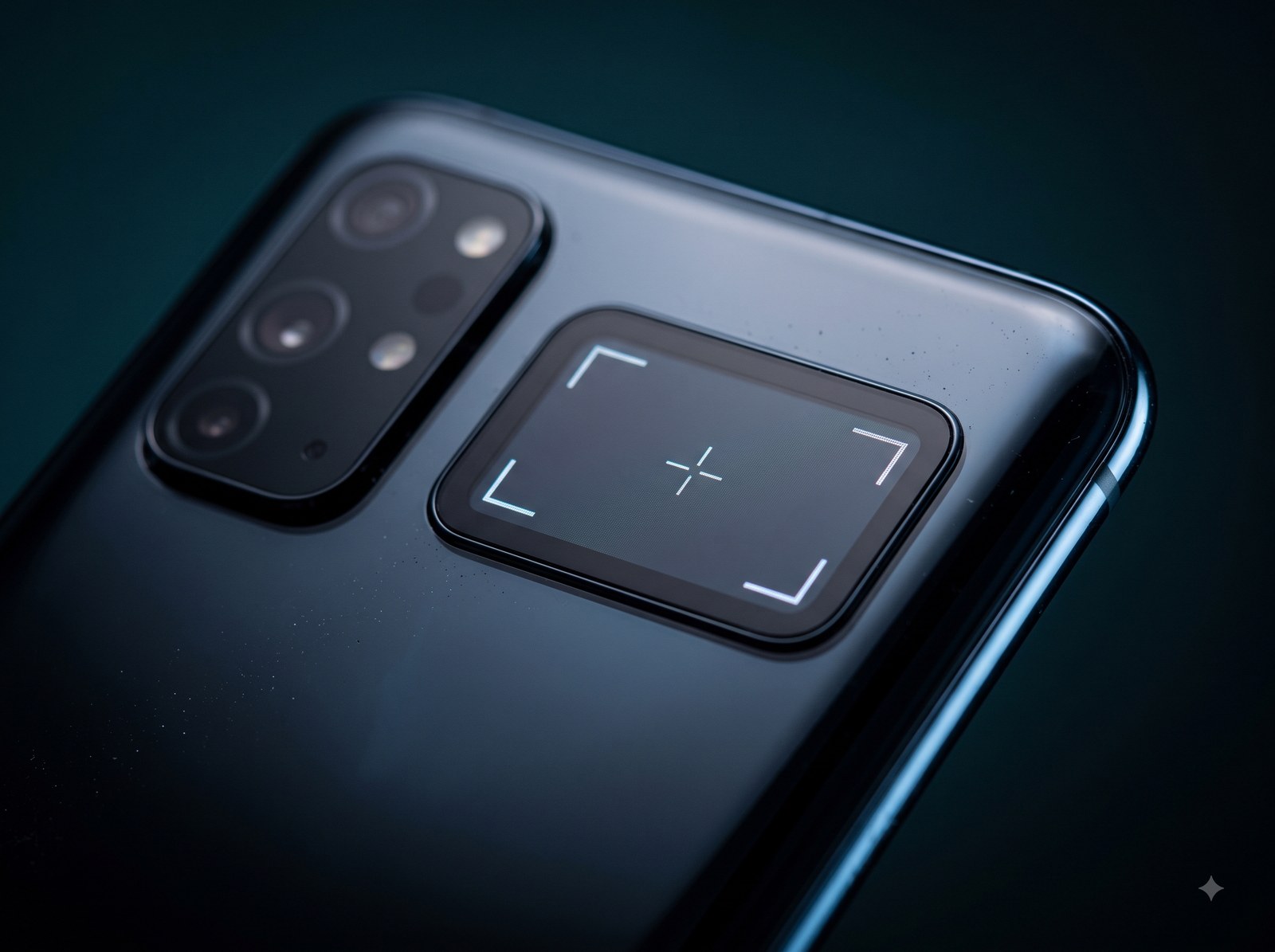
The four colours fall into two families: two light, textured finishes — a pearly white and a speckled grey that catches the light — and two plainer ones, a very pale pink Vivo calls “dawn” and a deep black. Inside the disc sit three round openings and a rectangular window, the periscope mentioned above, along with the ZEISS signature and its T* mark — the anti-reflective coating the optics maker keeps for its best-corrected lenses.
Three screen sizes to cover every use case
The screen size split within the X500 series is now much clearer:
- Vivo X500 Pro (compact): 6.37-inch LTPO panel (1.5K resolution).
- Standard Vivo X500 (mid-size): 6.59-inch flat panel (1.5K resolution).
- Vivo X500 Pro Max (large format): huge 6.85-inch LTPO panel (2K resolution).
The whole series will benefit from a refresh rate climbing to 144Hz, ensuring maximum smoothness for browsing and gaming alike.
3C certification: 7,500 mAh and 90 W charging
The Vivo X500’s listing with China’s 3C regulator (China Compulsory Certificate) marks the final administrative step before an official launch. Once a handset clears this stage, its market release is imminent and the registered charging figures become entirely reliable.
The document confirms that the Vivo X500 supports 90 W wired fast charging. According to related leaks, that charging speed is reportedly backed by 40 W wireless charging and feeds a battery of roughly 7,500 mAh. The spec sheet displayed by the unit photographed in hand on 13 September reads exactly 7,500 mAh.
On a mid-size device (6.59 inches), that kind of capacity translates into very comfortable battery life, while 90 W charging tops up most of the tank in the time it takes to have breakfast. The X500 Pro and Pro Max have been certified with the same 90 W output, and the Pro Max has also received approval in Indonesia, a sign that a global rollout is in the works.
MediaTek Dimensity SoC and Sony LOFIC camera tech
Under the bonnet, Vivo is continuing its close partnership with MediaTek by launching the new generation of high-end silicon:
- The standard Vivo X500 carries a MediaTek Dimensity 9600M, built on 3 nm: that is what the unit photographed in hand on 13 September showed, and MediaTek made it official on the 15th.
- The Pro and Pro Max versions move up a tier with the Dimensity 9600 Pro.
The name is new; the chip probably less so. The unit photographed by tipster Panda is Bald shows eight cores topping out at 4.21 GHz, the exact figure of the Dimensity 9500 we already sell in the Vivo X300. Oppo appears to be taking the same route: its Find X10, identified on Geekbench with the Dimensity 9500’s signature, is expected to be sold under the same Dimensity 9600M name. MediaTek settled the question on 15 September by publishing the Dimensity 9600M spec sheet: it is indeed a reworked Dimensity 9500 — still the brand’s 3 nm flagship processor, with the advantage of a chip that is already well run in.
Set side by side with the Dimensity 9500’s, the official spec sheet shows no hardware difference at all:
- Same process: TSMC’s 3 nm N3P node.
- Same processor: one C1-Ultra core at 4.21 GHz, three C1-Premium cores at 3.5 GHz and four C1-Pro cores at 2.7 GHz, with the same caches.
- Same graphics and same NPU: a Mali-G1 Ultra MC12 and the APU 990.
- Same memory and same imaging: LPDDR5X at 10,667 Mbps, four-lane UFS 4.1 storage, sensors up to 320 MP and 8K 60 fps video.
The changes lie elsewhere. The in-house scheduler moves to its third generation (Dimensity Scheduling Engine 3.0) to share work more effectively between processor, graphics and memory. In games, neural network rendering allows up to 185 frames per second, with the same MRFC 3.0 frame interpolation hardware as before. And the NPU now supports the Gemini Nano 4 and Qwen 3.5 Omni 4B models, along with a camera agent that suggests shots based on the scene.
For anyone choosing the X500, that is reassuring news: a chip whose drivers and thermal management have a year of refinement behind them, with refreshed AI features. The Pro models, for their part, get the Dimensity 9600 Pro, built on 2 nm and made official the same day.
The same photo gives the memory: 12 GB of RAM and 512 GB of storage on the base configuration. Vivo adds virtual expansion on top — up to 24 GB of RAM borrowed from storage — and around 50 GB gained by compressing files.
On the software side, the device is said to run the new OriginOS 7 interface, based on Android 17. This release should enrich the user experience and fine-tune background task management.
When it comes to photography, the Pro models will set themselves apart with a 50-megapixel Sony main sensor featuring LOFIC technology (Lateral Overflow Integration Capacitor). The component is specifically designed to handle high-contrast scenes (harsh backlighting, night shots in the city) by avoiding blown-out areas and preserving an unprecedented level of detail in the highlights.
Camera: Vivo confirms a Sony LYTIA-828 sensor and a Zeiss APO periscope
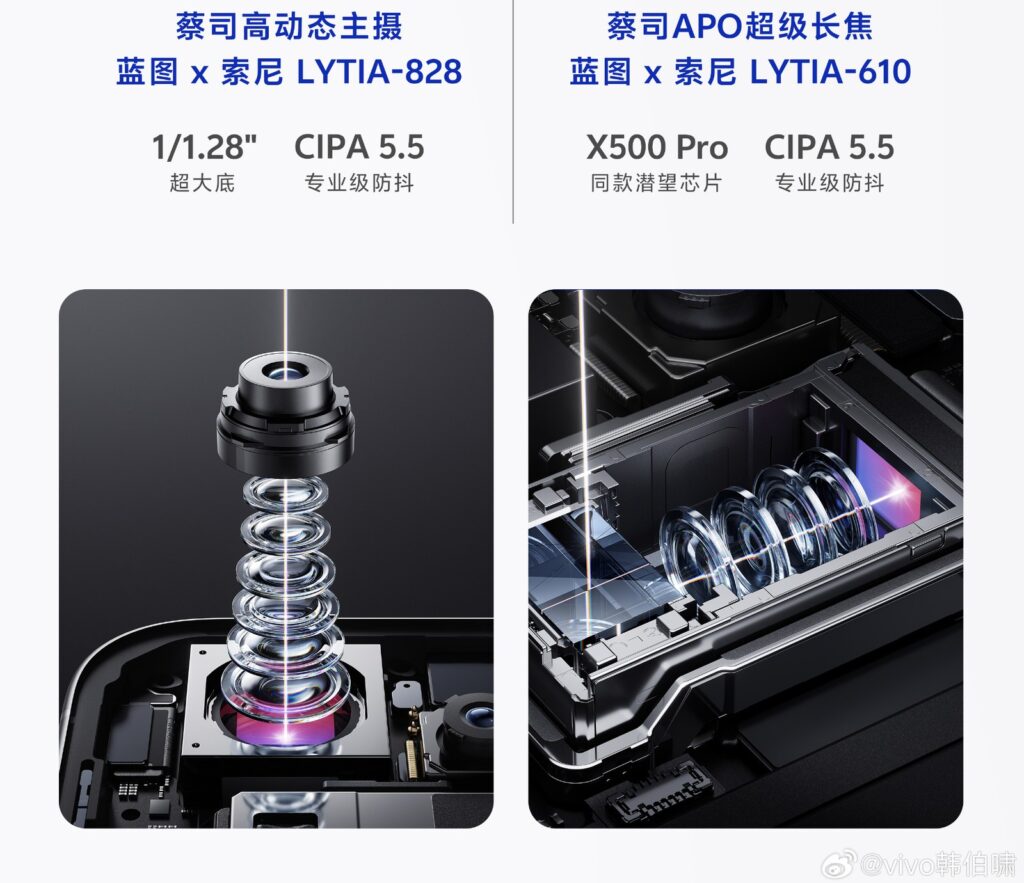
On 3 September, Vivo put an end to the guesswork. Han Boxiao published the camera poster for the standard model, and it comes down to one line: “the main camera is Pro, and so is the telephoto”. Both optics are co-developed with Zeiss.
- Zeiss high-dynamic main sensor: a 1/1.28-inch Sony LYTIA-828. It is the largest main sensor ever fitted to a standard X-series model, and it is no stranger: it already sits in the Vivo X300 Pro we stock, with its 1.22 µm pixels and f/1.57 aperture. The standard model therefore inherits, unchanged, the main camera of the previous generation’s Pro.
- Ultra-wide: 50 megapixels. This module does not appear on the poster and remains, at this stage, a leak.
- Zeiss APO periscope telephoto: a 64-megapixel Sony LYTIA-610, and Vivo specifies that it is the same periscope chip as the X500 Pro’s. The APO label refers to apochromatic lenses, corrected so that the different colours converge at the same point: in practice, fewer purple fringes along backlit edges. It records 4K video at 120 frames per second.
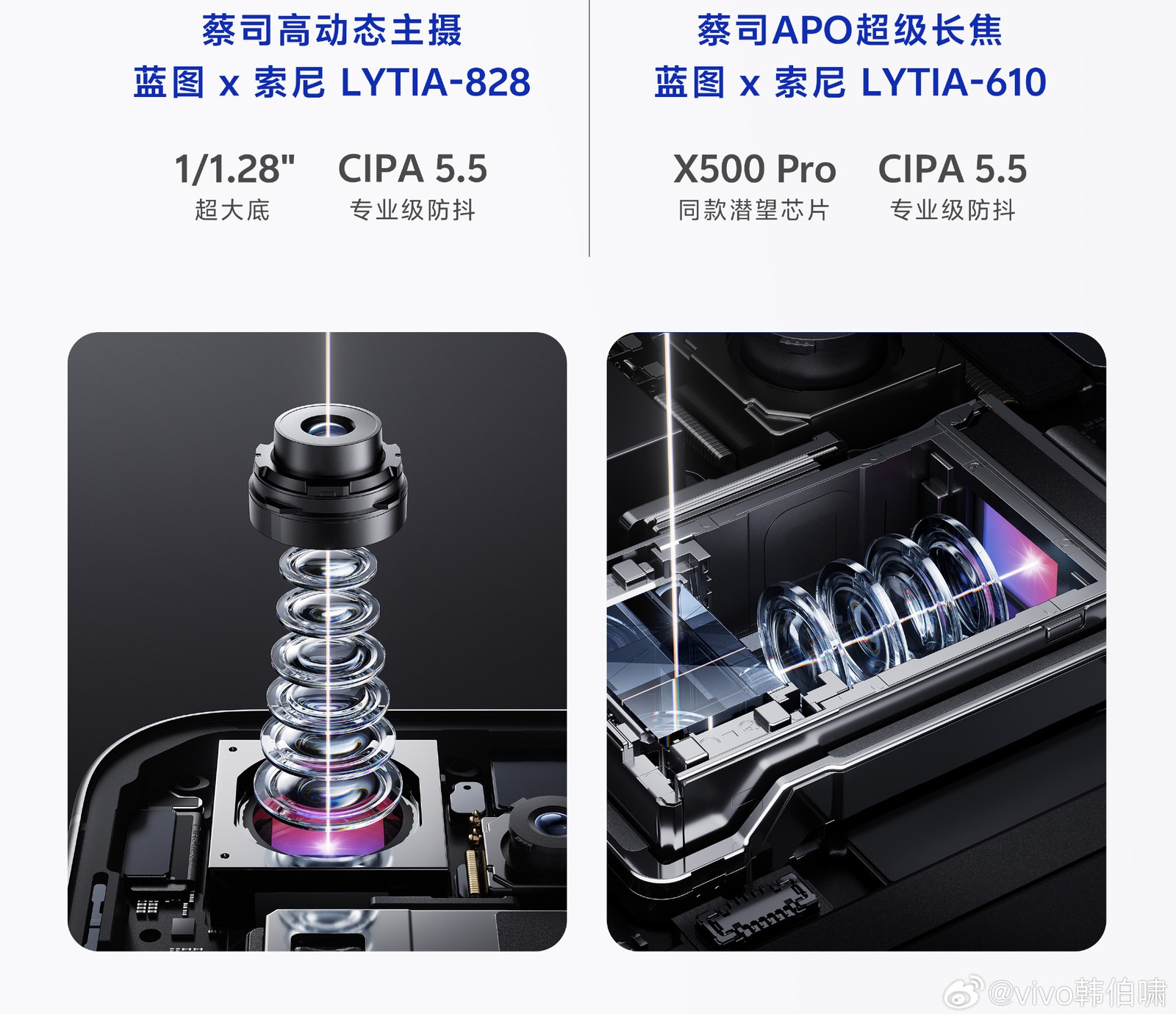
Both sensors are rated at CIPA 5.5. That scale, set by the Japanese camera industry association, measures stabilisation in stops of shutter speed gained: 5.5 stops means a scene that would demand 1/60th of a second handheld stays usable at around 1/1.5th. This is gimbal-class territory, and applying it to both optics is what the poster’s “dual Pro” wording refers to.
A word on the megapixel count, which could mislead. The Vivo X300 of the previous generation carried a 200 MP main camera, a 1/1.4-inch Samsung ISOCELL HPB opening at f/1.69. The X500 drops to 50 MP, on a larger sensor and behind a brighter lens. Sensor area and aperture govern how much light is collected, while resolution governs the level of detail in good light. Vivo has chosen the former, and that choice shows up mostly after dark.
Two points sit outside the official announcement. The phone is said to support the Lipstick 200, the brand’s compact telephoto extender, which clips onto the periscope to stretch the focal length — an interesting prospect for concert photography. A 50 MP autofocus selfie camera is also being reported, without confirmation. Image processing, finally, would be handled by Vivo’s in-house BluePrint V3+ chip.
Vivo has also confirmed, across the whole series, a video toolkit no one expected on the entry model: 10-bit 4:2:2 encoding, support for the ACES colour system — the one film post-production pipelines are built around — and a native 8K Live output presented as a first. The AI photography assistant has been rebuilt as well.
How the range will evolve and what comes next
The date is now settled: the event takes place on 21 September at 7 pm in China, and the X500 series will not be alone there — Vivo will also show the Vivo Watch 6 and the Vivo Buds Clip earbuds. The rollout outside China is expected in November.
The global versions are being readied in parallel. The X500, under the reference V2619, has already cleared SIRIM certification in Malaysia, IMDA in Singapore and TÜV; the X500 Pro (V2621) and the X500 Pro Max (V2610) have just joined it in the Malaysian database. Filings like these usually come a few weeks before a global announcement.
The brand’s roadmap doesn’t stop at the initial launch. Mid-cycle refreshes (Vivo X500s) are already being discussed, along with a Vivo X500 Ultra pencilled in for the first half of 2027. This ultimate model, a genuine technology showcase, is expected to drop MediaTek in favour of the rival Qualcomm Snapdragon 8 Elite Gen 6 Pro. All the details are in our dedicated article: Vivo X500 Ultra, the 200 MP zoom caught in a dilemma.
Vivo X500 (standard) spec sheet
| Display | Flat, 6.59 inches, 1.5K, 144Hz refresh rate |
| Processor | MediaTek Dimensity 9600M (8 cores, 4.21 GHz, 3 nm N3P), made official on 15 September: Dimensity 9500 hardware, Scheduling Engine 3.0 and updated AI |
| Memory | 12 GB + 512 GB base configuration (hands-on photo) |
| Software | OriginOS 7 (Android 17) |
| Cameras | 50 MP Sony LYTIA-828 (1/1.28″) + 50 MP ultra-wide + 64 MP Sony LYTIA-610 periscope, Zeiss optics, CIPA 5.5 |
| Battery | 7,500 mAh (device spec sheet, hands-on photo) |
| Charging | 90 W wired (3C certified), 40 W wireless |
| Rear design | Circular camera module in the upper-left corner |
| Biometrics | Under-display fingerprint sensor |
| Estimated launch | 21 September 2026 at 7 pm (China, confirmed by Vivo) · global version V2619 certified by SIRIM, IMDA and TÜV |
Vivo X500 or Pro versions: what’s the difference?
- Size: the X500 Pro targets compact-phone fans (6.37 inches), the standard X500 offers the middle-ground compromise (6.59 inches) and the Pro Max goes for a big display (6.85 inches).
- Design: upper-left camera block on the X500, centred camera block on the Pro versions.
- Camera and power: the Pro versions get the Dimensity 9600 Pro and the Sony sensor with LOFIC technology.
To find out more about the high-end variants, have a look at our dedicated articles on the Vivo X500 Pro and the Vivo X500 Pro Max.
In summary
Due on 21 September 2026 in China, the Vivo X500 is shaping up to be a very tempting alternative thanks to its flat 6.59-inch 144Hz display, its 7,500 mAh battery and a camera section now documented by the brand itself, which brings the X300 Pro’s main sensor and the X500 Pro’s periscope down to the standard model. The gradual arrival of international certifications suggests global availability shortly after the Chinese announcement.
You’ll find the range in our shop as soon as it launches. In the meantime, feel free to browse our Vivo smartphones, along with our Vivo cases and Vivo tempered glass screen protectors.

![Vivo X500 Pro Max: The Future Monster Holds No More Secrets [Update]](https://www.phonedroid.net/blog/wp-content/uploads/2026/08/une-x500.jpg)
![Vivo X500 Pro: 6.37-inch 144 Hz display, Dimensity 9600 Pro and the 7,000 mAh challenge [UPDATED]](https://www.phonedroid.net/blog/wp-content/uploads/2025/10/Vivo-X300-Pro-noir.jpg)
![iQOO 16: 2K 165 Hz display, Snapdragon 8 Elite Gen 6 Pro and an 8,400 mAh battery [UPDATED]](https://www.phonedroid.net/blog/wp-content/uploads/2026/09/iqoo-16-rendu-fuite-noir.jpg)
![Xiaomi 18 Pro Max: Heading for an Outrageous Spec Sheet [UPDATED]](https://www.phonedroid.net/blog/wp-content/uploads/2025/09/Xiaomi-17-Pro-Max.jpg)
![Oppo Find X10: unveiling on 22 September, dual 200 MP and 8,000 mAh [UPDATED]](https://www.phonedroid.net/blog/wp-content/uploads/2026/09/oppo-find-x10-rendu-officiel-qingcheng.jpg)