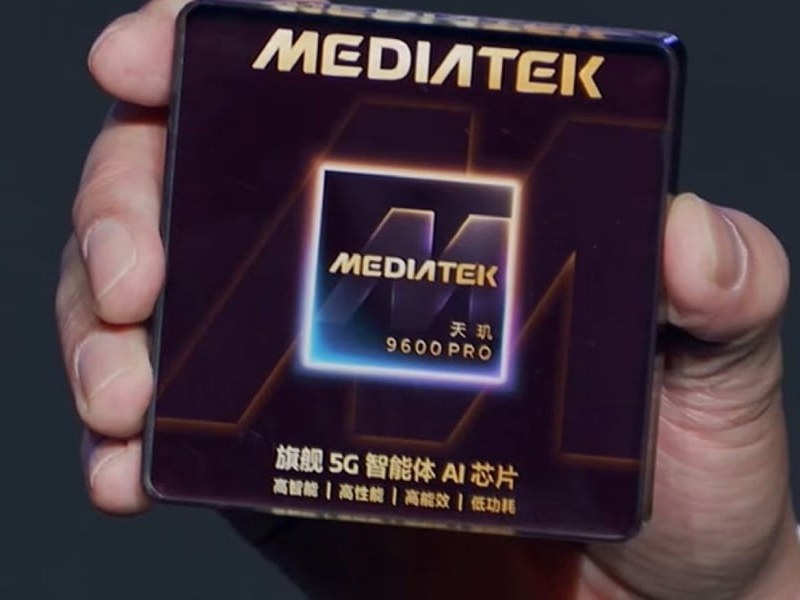
📌 Updated 15 September 2026 — It is official: Oppo confirms the Find X10 Pro Max runs the Dimensity 9600 Pro, unveiled by MediaTek the same day. The brand has also made its 8,000 mAh battery official under the name Glacier: spherical silicon-carbon at 867 Wh/L, designed to stay healthy for up to five years. And it promises up to eight hours of gaming at full frame rate thanks to its Tide Engine. Launch on 22 September in China.
Some spec sheets make you raise an eyebrow. This one makes you read it twice. With the Oppo Find X10 Ultra not expected before the first quarter of 2027, it is the Find X10 Pro Max that will carry the brand’s colours this autumn. And judging by the documents circulating out of China, Oppo has no intention of holding back.
A “Pro Max” from Oppo is a first
Before we even get to the specifications, the name itself deserves a pause. Oppo has never sold a “Pro Max” before. Last year’s Find X9 line-up consisted of the X9 and the X9 Pro; the X9 Ultra completed the range earlier this year. Three models, never more.
The arrival of a Pro Max therefore means Oppo is adding a tier, slotted between the Pro and the Ultra. That is more than a marketing detail: it points to a phone designed to deliver everything right away, without waiting months for the Ultra. We covered that reshuffle in our article on the completely reworked Find X10 line-up.
The September family has three models. The pre-reservation page Oppo opened on 14 September brings together the Find X10E, at the entry point of the series, the Find X10 and the Find X10 Pro Max. The Find X10 Pro is not on it.
First renders: a square module set inside its island
Until now, the Find X10 Pro Max only existed as a column of specifications. Chinese tipster Dingjiao Shuma has just published the first renders of the phone — unofficial, but detailed enough to settle the design question.
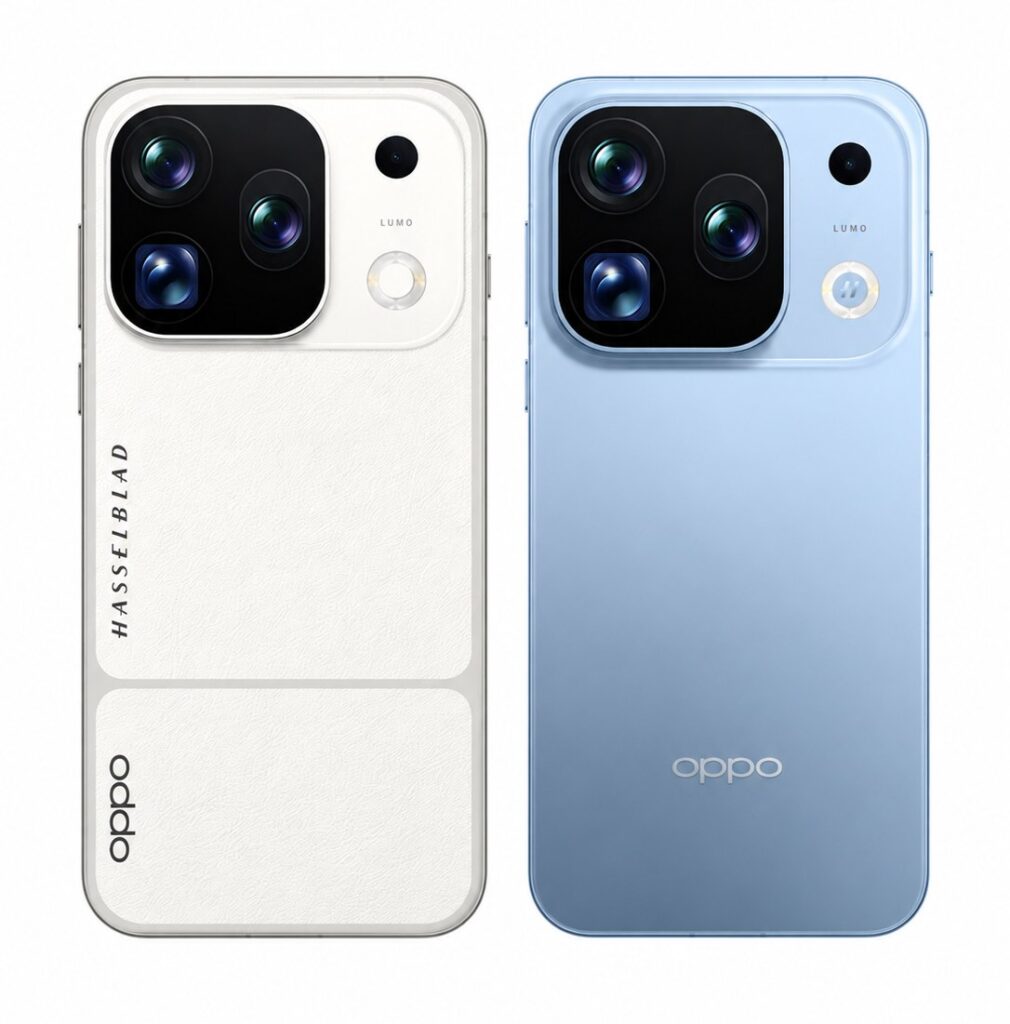
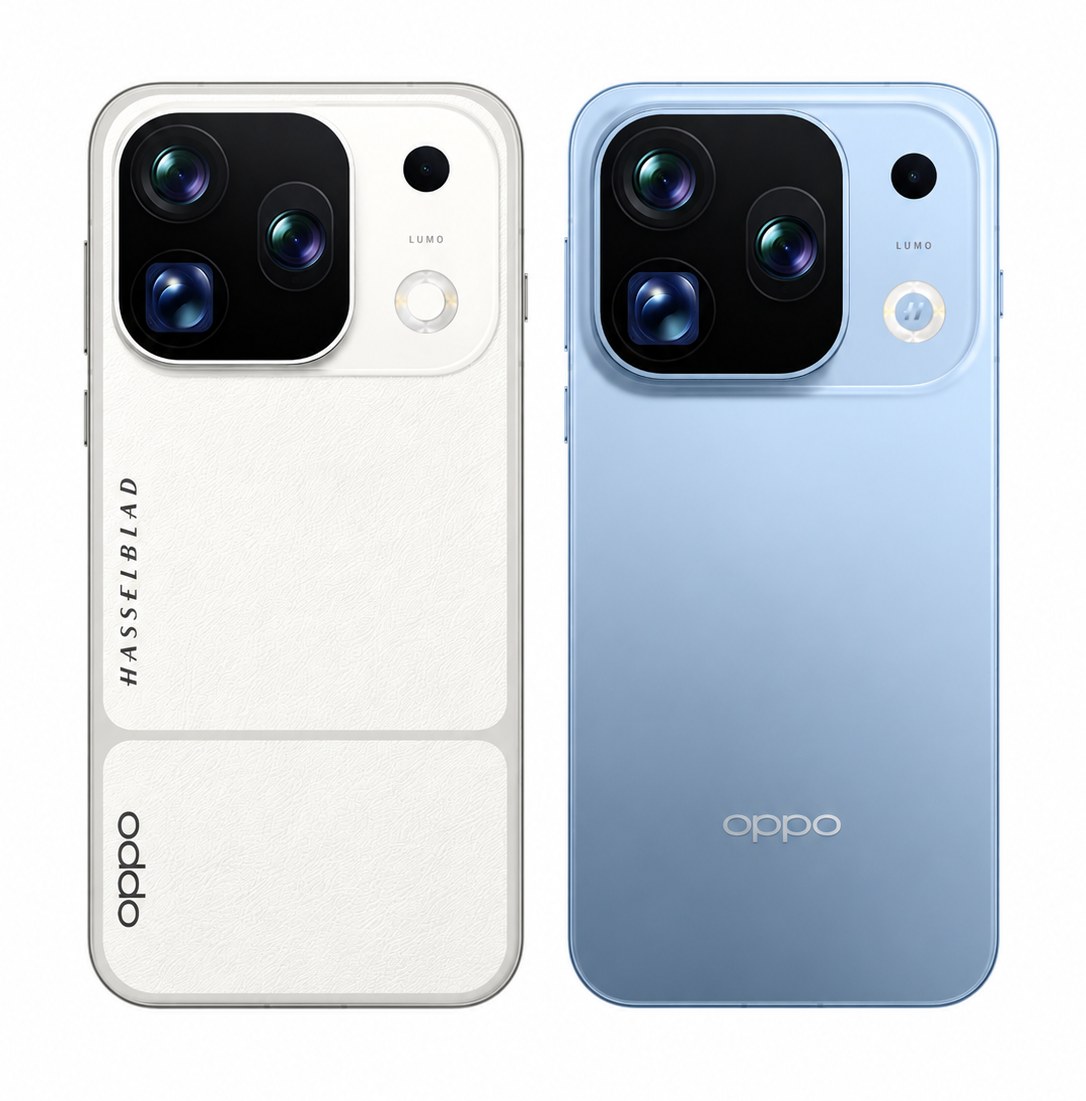
The back is built around a rounded rectangular island spanning the full upper width. Inside it, a square module gathers the three large lenses; to its right, a separate sensor and a circular flash sit within the same raised section. The geometry is unusual: rather than lining its optics up as most rivals do, Oppo groups them into a square and leaves the rest of the island to the secondary parts.
Two finishes appear in the images:
- A matte-textured white: marked vertically with HASSELBLAD, the signature of the camera partnership Oppo has kept with the Swedish maker since the Find X3 Pro. A horizontal seam splits the lower half of the back.
- A graduated blue: smoother, plainer, with no visible branding — the discreet one of the pair.
The renders also add a detail on the camera side: the main sensor would be a 1/1.3-inch Samsung ISOCELL HPC, backed by a small 3 MP multispectral sensor whose job is to sharpen colour accuracy — that is the isolated sensor visible to the right of the square module.
Oppo goes official, and the renders were right
On 7 September, Oppo published the first official poster for the range. It carries both names — Find X10 and Find X10 Pro Max — and one promise in large type: the “Hasselblad Super Clear Camera”, the name the company gives its new imaging system. For the Pro Max, the wording takes no precautions at all: three 200 MP lenses, presented as a world first. The standard model stops at two.
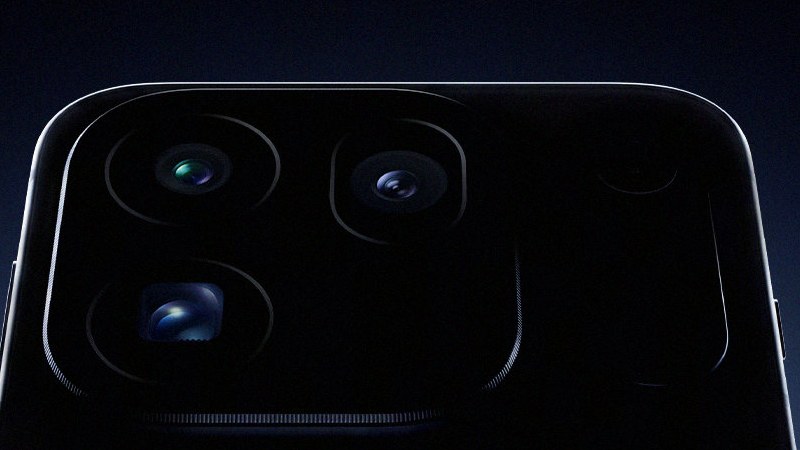
The image settles the design, and it proves Dingjiao Shuma’s renders right down to the detail: a rounded rectangular island running the full width, a soft-cornered square gathering the three large lenses — two round ones on top, and at the bottom left the one whose rectangular window gives away a periscope — then, on its own to the right, a small circular element. A thin ribbed band runs beneath the square. A design leak landing this accurately three weeks before the reveal is not that common.
On timing, the poster stayed broad: it said “September”, with no date. Oppo settled it on 14 September by opening pre-reservations: the range will be unveiled on 22 September in China, five days after the ColorOS 17 conference.

The official images released the same day complete the picture. The Find X10 Pro Max appears in Warm Orange, Moon White and Light Titanium, with its three-lens camera square extended on the right by a vertical pill, and, on the Moon White model, HASSELBLAD written vertically down the middle of the back. The graduated blue of Dingjiao Shuma’s renders is not among this model’s colours: an Ice Blue is offered on the Find X10 and the Find X10E instead.
Expected Oppo Find X10 Pro Max specifications
Here is what we know so far: the camera, chip, battery, memory and colour rows now come from Oppo, the rest still rests on leaks. We will keep this table alive over the coming weeks, all the way to the full announcement.
| Display | 6.78-inch flat OLED, LTPO, 2K, adaptive 144 Hz, symmetrical sub-millimetre bezels |
| Chipset | MediaTek Dimensity 9600 Pro (MT6995), built on 2 nm (official) |
| Performance | Up to 8 hours of gaming at full frame rate, sustained 4K 60 fps video (Tide Engine, Falcon Scheduler — official) |
| Geekbench | 3,691 single-core · 11,093 multi-core (non-final firmware) |
| Memory | 12 GB + 256 GB, 12 GB + 512 GB, 16 GB + 512 GB, 16 GB + 1 TB (official) |
| Main camera | 200 MP, 1/1.3-inch Samsung ISOCELL HPC, 24 mm at f/1.5, DeepPix, CIPA 6.5, 17 EV |
| Ultra-wide | 200 MP, 1/1.56-inch, f/2.2, 124° field of view |
| Telephoto | 200 MP, 1/1.56-inch, 70 mm at f/2.1, CIPA 7.5, 3x optical zoom |
| Colour | Second-generation Danxia optics (24 sampling channels, 15 stops of dynamic range), 3 MP multispectral sensor, LUMO engine |
| Front camera | 50 MP, 1/2.75-inch, autofocus |
| Battery | 8,000 mAh Glacier, spherical silicon-carbon, 867 Wh/L, designed to stay healthy for five years (official) |
| Charging | 80 W wired · 50 W wireless |
| Water resistance | IP66, IP68 and IP69 |
| Connectivity | 5G-A (5G Advanced) · eSIM |
| Finishes | Warm Orange, Moon White, Light Titanium (official) |
| Availability | China: 22 September 2026 · Global version: late October 2026 |
600 MP on the back: three cameras, no weak link
This is where the Find X10 Pro Max breaks away from the pack. Most camera flagships save their best sensor for the main module and leave the ultra-wide and the telephoto to make do with far more modest components. Oppo would be doing the exact opposite: all three rear cameras would come in at 200 megapixels.
- The main wide camera — 200 MP on a generous 1/1.3-inch sensor using DeepPix technology, which Oppo presents as an industry first. It opens at f/1.5, a figure you almost never see on a sensor this size, and its stabilisation is rated CIPA 6.5 — on a 24 mm lens, the company specifies. Enough to handle high-contrast scenes, the kind that usually blow a sky out to pure white: Oppo claims 17 EV of dynamic range, seventeen stops between the deepest shadow and the brightest highlight held in a single frame.
- The ultra-wide — 200 MP on a 1/1.56-inch sensor, opening at f/2.2 across a 124° field of view. That is an unusually large format for this focal length, and it may well be the best news on the entire sheet: the ultra-wide would finally stop being the poor relation of the camera array as soon as the light drops. Oppo puts the gain at 102% more light — but read the small print at the foot of the poster: the comparison is against the Find X9 Pro, in Hasselblad mode and on 50 MP shots.
- The periscope telephoto — 200 MP as well, also 1/1.56-inch, with a 3x optical zoom. At that resolution, cropping into the frame stops being a punishment: detail holds up well beyond the optical reach. Digital Chat Station adds two details on poster day: the production version would drop the OV52A sensor floated earlier, and the optics would open at f/2.1 for 70 mm. That 70 mm matches the stated 3x, and f/2.1 is bright for a periscope — rivals sit closer to f/2.6 or f/3.0, and every stop gained shows the moment the light drops. The poster of 8 September confirms both: f/2.1, with the 70 mm appearing in black and white in the small print, which also gives the stabilisation — CIPA 7.5, the highest of the three lenses. A separate leak, absent from the poster, adds telephoto macro from 10 cm.
Oppo sums the whole thing up in one phrase — an “8K cinema camera across the whole focal range” — and details the rest of the chain on its poster. The Danxia colour restoration optics move to a second generation, with 24 sampling channels and 15 stops of dynamic range — fifteen steps between the deepest shadow and the brightest highlight, held in a single frame. Alongside it sits an in-house engine called LUMO, in charge of light and shadow: the stated aim is to keep a face readable against the light without washing out the rest of the scene, something HDR applied to portraits still gets wrong fairly often. And selfie fans get a 50 MP front camera with autofocus, still a rare refinement on the front of a phone.
8,000 mAh: the real generational jump
If one number deserves your attention, it is this one. While the market has settled comfortably between 5,000 and 6,000 mAh, the Find X10 Pro Max packs 8,000 mAh, now confirmed by Oppo. That is a break, not an increment.
The pleasant surprise is that Oppo does not appear to be trading anything away for it: wired charging would stay at 80 W and wireless charging at 50 W. You keep the speed and gain the endurance, which is far from always the case when a manufacturer grows a battery.
On 15 September Oppo gave that battery a name: Glacier. Its energy density reaches 867 Wh/L, thanks to in-house spherical silicon-carbon technology, and that density is what lets 8,000 mAh fit inside a conventionally sized phone. The brand pairs it with its own battery health and charging algorithms, and says the cell is designed to stay healthy for up to five years.
That may be the most useful promise on the whole sheet. A large battery loses capacity over its charge cycles, and it is after a few years that day-one endurance starts to fall short. Aiming for five years speaks directly to people who keep their phone for a long time.
A 6.78-inch flat OLED display and a 2 nm chip
On the display side, expect a 6.78-inch LTPO OLED panel at 2K resolution, with an adaptive refresh rate climbing to 144 Hz. Both figures have been revised upwards since the first reports, and they fit the phone’s positioning: 2K packs the pixels tighter across a 6.78-inch diagonal, and 144 Hz goes beyond the 120 Hz that has become the flagship norm — extra smoothness you notice most when scrolling and in games able to make use of it. LTPO does all the quiet work here: it drops the frequency when the image is static and pushes it back up the moment you start scrolling.
More importantly, Oppo would be continuing its switch to a perfectly flat screen, with symmetrical sub-millimetre bezels on all four sides. After years of curved panels, flat is coming back across the board — and it is genuinely good news day to day: no more distorted reflections along the edges, no more accidental touches, and fitting a screen protector finally becomes straightforward.
Running the show, MediaTek’s brand-new Dimensity 9600 Pro, built on a 2 nm process. That is the most advanced node in the industry today, and it is not there for show: processing 200-megapixel files in real time demands serious compute, and matching efficiency. Oppo has confirmed the memory: four configurations, from 12 GB + 256 GB to 16 GB + 1 TB.
On 5 September the phone turned up on Geekbench under the reference PMX110, and its chip is spelled out there: part number MediaTek MT6995, three cores at 3.10 GHz, three at 4.35 GHz and two at 4.56 GHz, with Mali-G2-Ultra-NX MC12 graphics. The commercial name is now official: on 15 September Oppo confirmed that its Pro Max runs the Dimensity 9600 Pro, unveiled by MediaTek the same day. The readings give 3,691 points single-core and 11,093 multi-core, on a unit that is in all likelihood not yet running final firmware.
One detail puts those numbers in perspective. The Vivo X500 Pro Max, benchmarked on the same platform the same day, carries exactly the same MT6995: identical clocks, identical GPU. Its readings nonetheless climb to 4,137 and 13,086 points, 12 % and 18 % higher. At this stage of development, a gap that size on identical silicon comes down to firmware maturity and thermal tuning, not to available power. Retail results will converge.
Oppo did not stop at naming the chip. Its 15 September poster details what the brand has built around it: a new-generation Tide Engine that dynamically shifts resources between high-frame-rate gaming and on-device AI tasks, and a scheduler called Falcon Scheduler, tasked with handling demanding camera features and heavy loads at the same time.
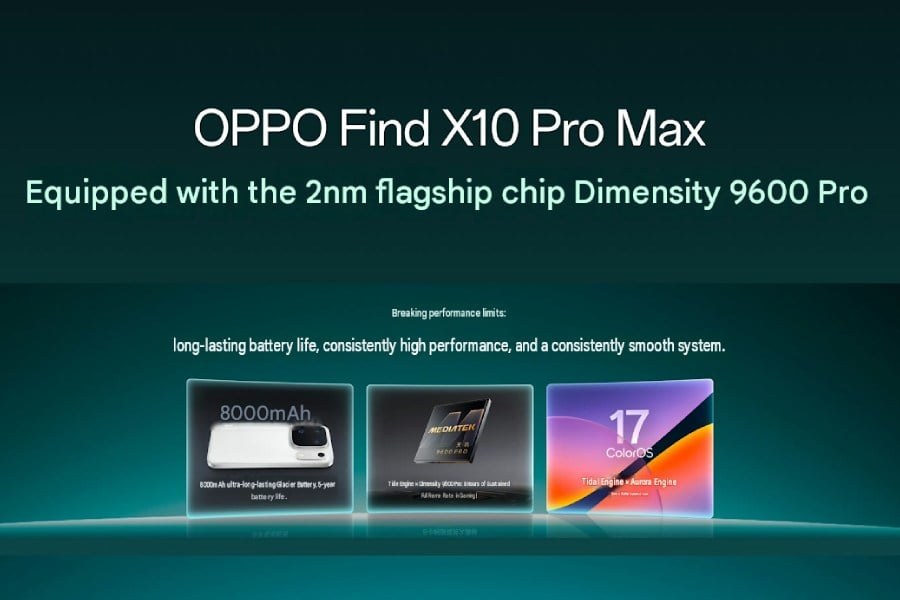
The promises come with numbers: 4K 60 fps video sustained over long periods, and up to eight hours of gaming at full frame rate in demanding titles. Those figures are about duration rather than peaks, and that is exactly where chips are judged: holding a high pace through a long session matters more than a score captured in a few seconds.
As for the chip itself, MediaTek claims 17% more single-core and 15% more multi-core performance than the Dimensity 9500, with lab readings of 4,276 and 12,650 points on Geekbench 6.4.
The standard Find X10, on the other hand, does not share this chip. Its own Geekbench run revealed an MT6993 — the 3 nm Dimensity 9500, the current generation, which is expected to be sold as the Dimensity 9600M, a chip MediaTek made official on 15 September with Dimensity 9500 hardware. The detail is in our Find X10 article.
The rest of the sheet confirms its flagship status. The phone would target triple IP66, IP68 and IP69 certification — the last of which is the most demanding, covering high-pressure, high-temperature water jets. 5G-A and eSIM support would round things off.
Oppo Find X10 Pro Max price and availability
No official pricing has been announced yet, and we will most likely have to wait for the Chinese launch on 22 September before the first figures start circulating.
One thing is predictable, though: do not expect a gentle price tag. The memory price surge currently running through the industry weighs directly on the most generous spec sheets, and 16 GB of RAM paired with 512 GB of storage costs considerably more today than it did a year ago. Add three 200 MP sensors and a freshly produced 2 nm chip, and this Find X10 Pro Max will unsurprisingly sit right at the top of the catalogue.
The configurations, on the other hand, have been known since pre-reservations opened: 12 GB + 256 GB, 12 GB + 512 GB, 16 GB + 512 GB and 16 GB + 1 TB. The standard Find X10 uses exactly the same grid, so the price gap between the two will come down to the camera, the chip and the display rather than memory.
We will update this page as soon as we have something concrete.
Release date: September in China, late October here
The rollout would come in two stages. First a Chinese launch on 22 September 2026, limited to the domestic market. Then the global version at the end of October — and it is that version, compatible with our networks and our usage, that we will be offering in our store.
That timing is now firming up. According to analyst Yogesh Brar, Oppo would be targeting a global launch by the end of October, with India in its sights before Diwali. The Find X10 Pro Max is one of only two models retained there, alongside the standard Find X10 — a sign that the manufacturer intends to distribute its new flagship widely rather than keep it for its home market.
Conclusion
Between its three 200 MP cameras, its 8,000 mAh battery, its flat display and its 2 nm chip, the Oppo Find X10 Pro Max does not look like a routine annual refresh. It is an entirely new tier in Oppo’s range, and the company clearly means to make a statement. The official unveiling is on 22 September — and we will be following it closely.
In the meantime, browse our range of Oppo smartphones in stock, along with our Oppo cases and tailor-made tempered glass to kit out your phone from day one.



![Oppo Find X10: unveiling on 22 September, dual 200 MP and 8,000 mAh [UPDATED]](https://www.phonedroid.net/blog/wp-content/uploads/2026/09/oppo-find-x10-rendu-officiel-qingcheng.jpg)

![Xiaomi 18 Pro: The Compact Monster With Two 200 MP Sensors [UPDATE]](https://www.phonedroid.net/blog/wp-content/uploads/2026/09/xiaomi-18-pro-photos-en-main-face-dos.jpg)